Department of Psychological and Brain Sciences, Dartmouth College, Hanover, New Hampshire, USA.
Nat Neurosci. 2012 Oct;15(10):1445-53. doi: 10.1038/nn.3215. Epub 2012 Sep 16.
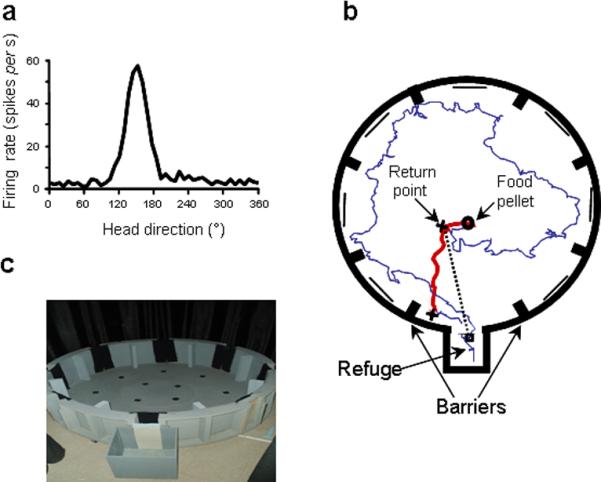
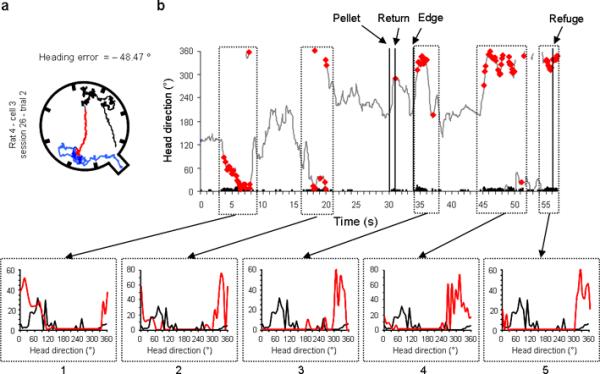
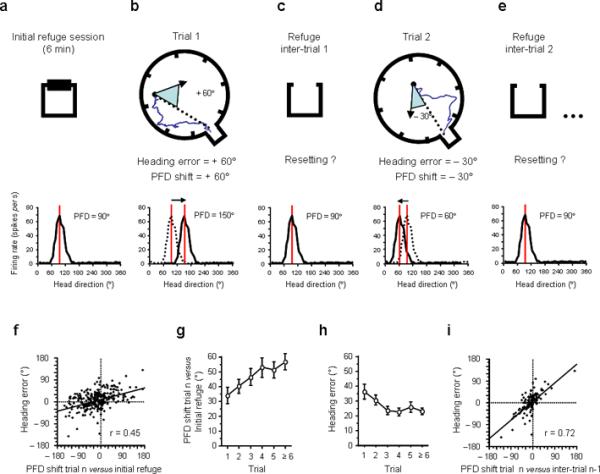
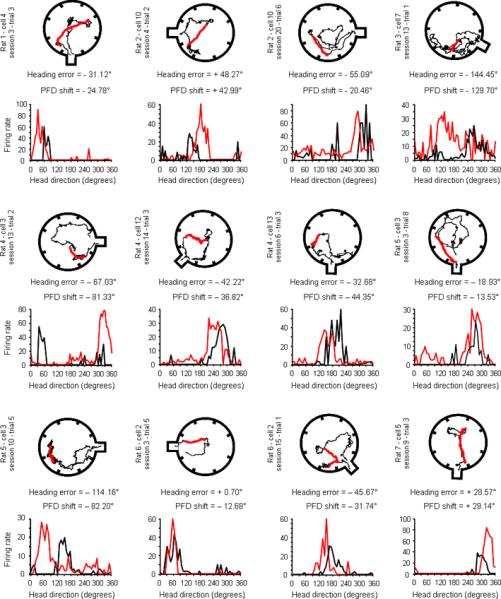
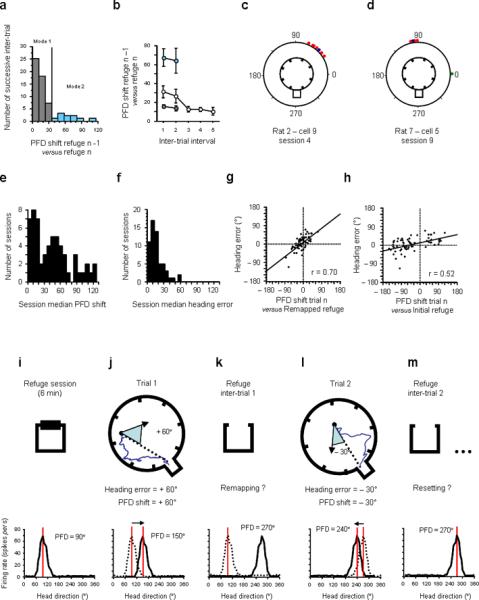
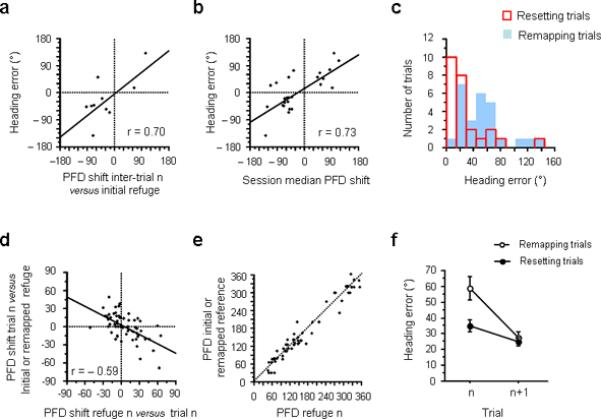
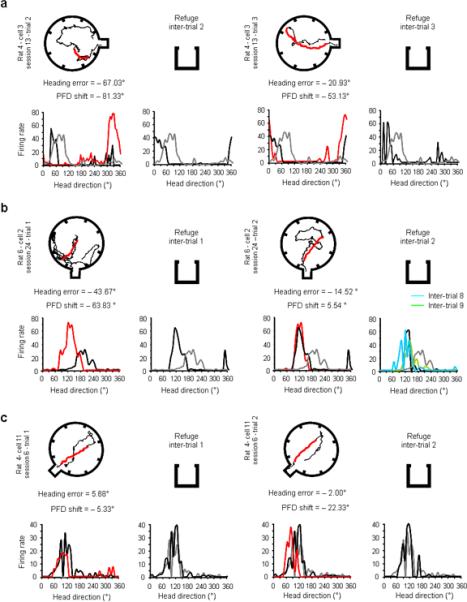
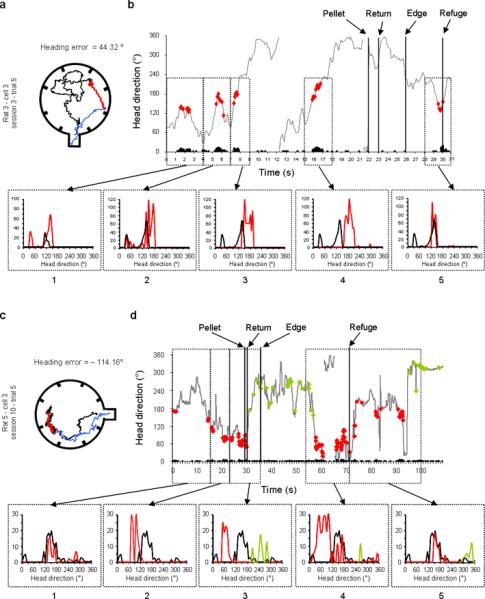
Head-direction cells have frequently been regarded as an internal 'compass' that can be used for navigation, although there is little evidence showing a link between their activity and spatial behavior. In a navigational task requiring the use of internal cues to return to a home location without vision (path integration), we found a robust correlation between head-direction cell activity and the rat's heading error in the rat's homing behavior. We observed two different correction processes that rats used to improve performance after an error. The more frequent one consists of 'resetting' the cell whenever the rat returns to the home location. However, we found that when large errors occur, the head-direction system has the ability to 'remap' and set a new reference frame, which is then used in subsequent trials. We also offer some insight into how these two correction processes operate when rats make an error.
头方向细胞通常被认为是一种内部“罗盘”,可用于导航,尽管很少有证据表明它们的活动与空间行为之间存在联系。在一项需要使用内部线索在没有视觉的情况下返回起始位置的导航任务(路径整合)中,我们发现大鼠在归巢行为中的头方向细胞活动与大鼠的航向误差之间存在很强的相关性。我们观察到两种不同的纠正过程,大鼠在出现错误后会使用这些过程来提高表现。更频繁的一种是每当大鼠返回起始位置时,就对头方向细胞进行“重置”。然而,我们发现当出现大的错误时,头方向系统具有“重新映射”并设置新参考系的能力,然后在随后的试验中使用该参考系。当大鼠出现错误时,我们还提供了一些有关这两种纠正过程如何运作的见解。