Geriatric Research, Education and Clinical Center, Veterans Affairs Pittsburgh Healthcare System, Pittsburgh, PA 15260, USA.
Stroke. 2012 Nov;43(11):3071-7. doi: 10.1161/STROKEAHA.112.663120. Epub 2012 Sep 13.
Erythropoietin (EPO) confers potent neuroprotection against ischemic injury. However, treatment for stroke requires high doses and multiple administrations of EPO, which may cause deleterious side effects due to its erythropoietic activity. This study identifies a novel nonerythropoietic mutant EPO and investigates its potential neuroprotective effects and underlying mechanism in an animal model of cerebral ischemia.
We constructed a series of mutant EPOs, each containing a single amino acid mutation within the erythropoietic motif, and tested their erythropoietic activity. Using cortical neuronal cultures exposed to N-methyl-d-aspartate neurotoxicity and a murine model of transient middle cerebral artery occlusion, neuroprotection and neurofunctional outcomes were assessed as well as activation of intracellular signaling pathways.
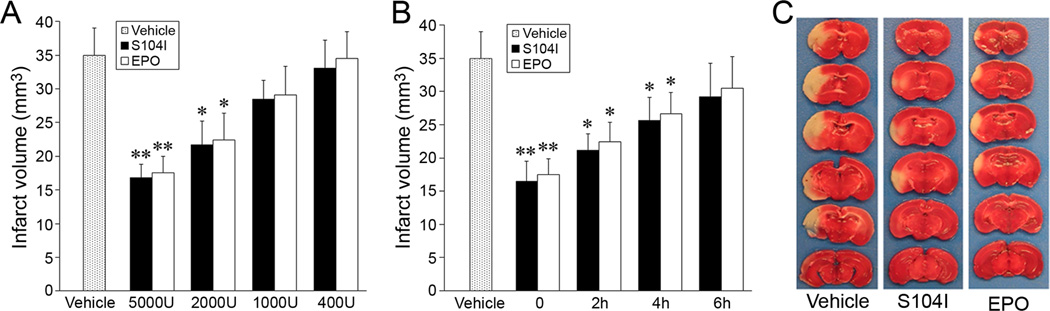
The serine to isoleucine mutation at position 104 (S104I-EPO) completely abolished the erythropoietic and platelet-stimulating activity of EPO. Administration of S104I-EPO significantly inhibited N-methyl-d-aspartate-induced neuronal death in primary cultures and protected against cerebral infarction and neurological deficits with an efficacy similar to that of wild-type EPO. Both S104-I-EPO and wild-type EPO activated similar prosurvival signaling pathways such as phosphatidylinositol 3-kinase/AKT, mitogen-activated protein kinase/extracellular signal-regulated kinase 1/2, and STAT5. Inhibition of phosphatidylinositol 3-kinase/AKT or mitogen-activated protein kinase/extracellular signal-regulated kinase 1/2 signaling pathways significantly attenuated the neuroprotective effects of S104-I-EPO, indicating that activation of these pathways underlies the neuroprotective mechanism of mutant EPO against cerebral ischemia.
S104-I-EPO confers neuroprotective effects comparable to those of wild-type EPO against ischemic brain injury with the added benefit of lacking erythropoietic and platelet-stimulating side effects. Our novel findings suggest that the nonerythropoietic mutant EPO is a legitimate candidate for ischemic stroke intervention.
促红细胞生成素(EPO)对缺血性损伤具有强大的神经保护作用。然而,治疗中风需要高剂量和多次给予 EPO,由于其促红细胞生成作用,可能会引起有害的副作用。本研究鉴定了一种新型非促红细胞生成突变 EPO,并在脑缺血动物模型中研究了其潜在的神经保护作用及其机制。
我们构建了一系列突变 EPO,每个突变 EPO 都在促红细胞生成基序内包含一个单一的氨基酸突变,并测试了它们的促红细胞生成活性。使用皮质神经元培养物暴露于 N-甲基-D-天冬氨酸神经毒性和短暂性大脑中动脉闭塞的小鼠模型,评估了神经保护和神经功能结果以及细胞内信号通路的激活。
第 104 位丝氨酸到异亮氨酸的突变(S104I-EPO)完全消除了 EPO 的促红细胞生成和血小板刺激活性。S104I-EPO 的给药显著抑制了原代培养物中 N-甲基-D-天冬氨酸诱导的神经元死亡,并可防止脑梗死和神经功能缺损,其疗效与野生型 EPO 相似。S104I-EPO 和野生型 EPO 均激活了类似的促生存信号通路,如磷脂酰肌醇 3-激酶/AKT、丝裂原活化蛋白激酶/细胞外信号调节激酶 1/2 和 STAT5。磷脂酰肌醇 3-激酶/AKT 或丝裂原活化蛋白激酶/细胞外信号调节激酶 1/2 信号通路的抑制显著减弱了 S104I-EPO 的神经保护作用,表明这些通路的激活是突变 EPO 对脑缺血的神经保护机制的基础。
S104I-EPO 对缺血性脑损伤具有与野生型 EPO 相当的神经保护作用,并且没有促红细胞生成和血小板刺激作用的副作用。我们的新发现表明,非促红细胞生成突变 EPO 是缺血性中风干预的一个合理候选物。