Department of Food Science and Nutrition, Zhejiang University, Hangzhou, China.
PLoS One. 2012;7(9):e44525. doi: 10.1371/journal.pone.0044525. Epub 2012 Sep 11.
Prospective cohort studies in relation to the associations between n-3 polyunsaturated fatty acids (PUFA) and risk of type 2 diabetes (T2D) were inconsistent. Differences in tissue n-3 PUFA compositions in subjects with and without T2D were also inconsistent in both cohort and case-control studies. We conducted a systematic review and meta-analysis of prospective cohort studies to examine the associations of fish and n-3 PUFA intake with T2D risk. The differences in tissue n-3 PUFA compositions in subjects with and without T2D were investigated based on cohort and case-control studies.
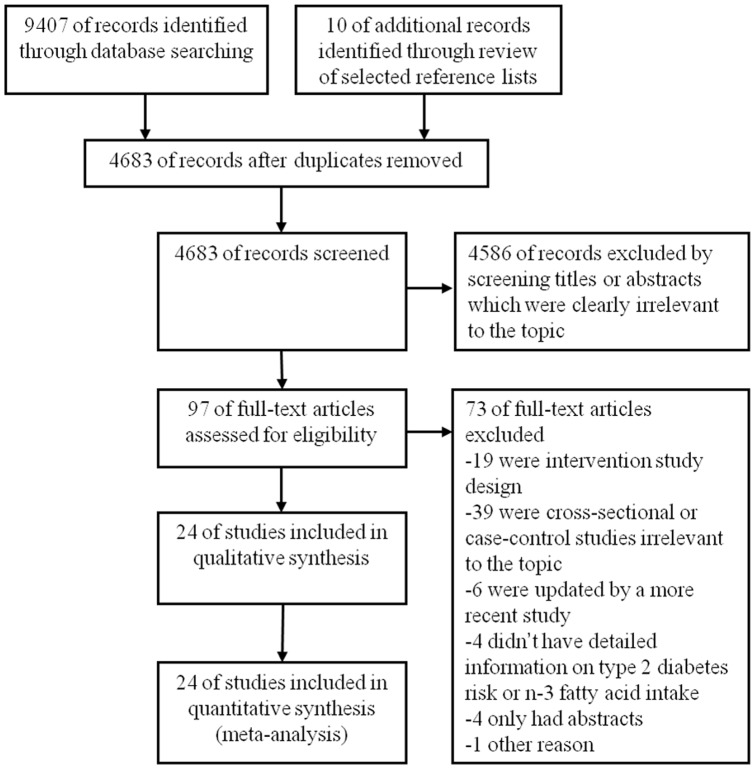
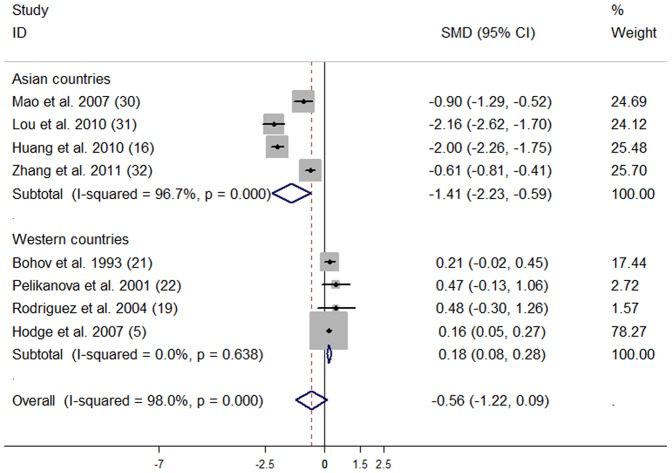
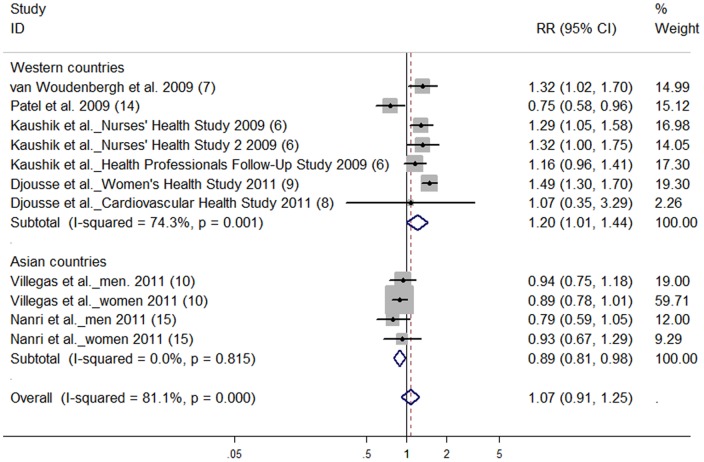
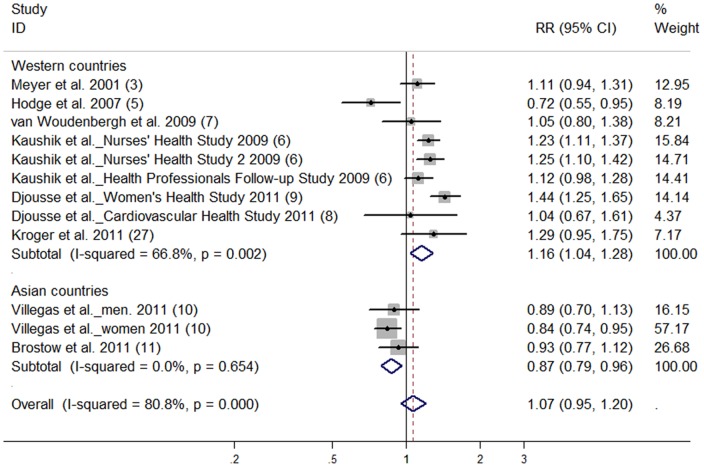
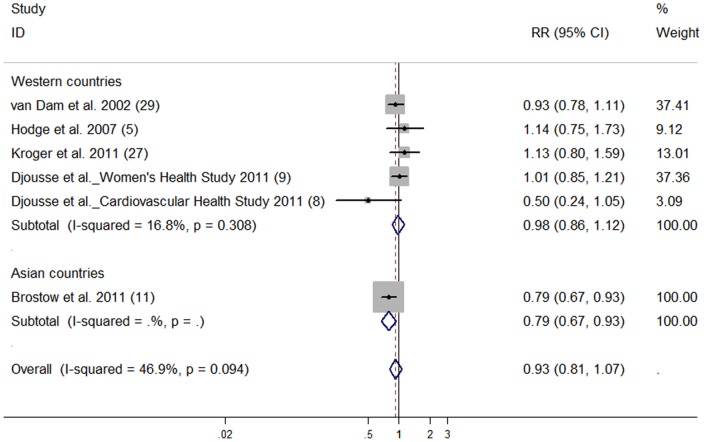
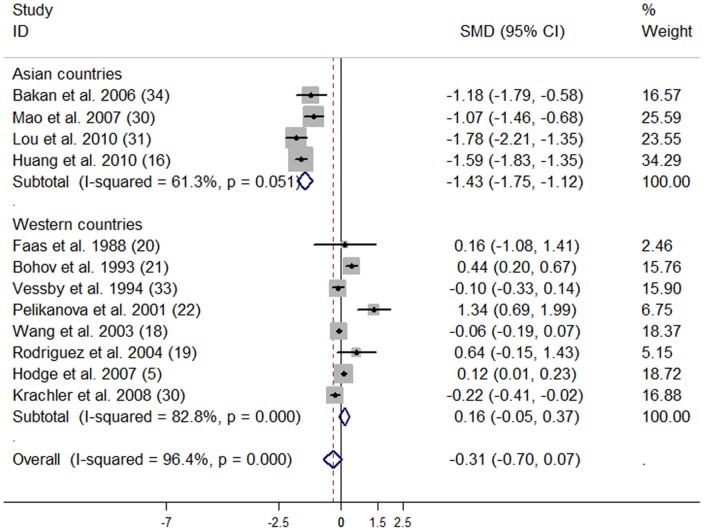
PubMed, Embase, Cochrane library, China National Knowledge Infrastructure (CNKI) and Chinese VIP database up to January 2012 was used to identify relevant studies, and reference lists from retrieved studies were reviewed. Two authors independently extracted the data. Random-effects models were used to pool the summary relative risk (RR). Twenty-four studies including 24,509 T2D patients and 545,275 participants were identified. For cohort studies, the summary RR of T2D for the highest vs lowest categories of total fish, marine n-3 PUFA and alpha-linolenic acid intake was 1.07 (95% CI: 0.91, 1.25), 1.07 (95% CI: 0.95, 1.20) and 0.93 (95% CI: 0.81, 1.07), respectively. Subgroup analyses indicated that summary RR (highest vs lowest category) of T2D for fish and marine n-3 PUFA intake was 0.89 (95% CI: 0.81, 0.98) and 0.87 (95% CI: 0.79, 0.96) for Asian populations, and 1.20 (95% CI: 1.01, 1.44) and 1.16 (95% CI: 1.04, 1.28) for Western populations. Asian subjects with T2D had significantly lower tissue compositions of C22:6n-3 (SMD: -1.43; 95% CI: -1.75, -1.12) and total n-3 PUFA (SMD: -1.41; 95% CI: -2.23, -0.59) compared with those without T2D.
This systematic review and meta-analysis provides evidence that marine n-3 PUFA have beneficial effects on the prevention of T2D in Asian populations.
前瞻性队列研究表明,n-3 多不饱和脂肪酸(PUFA)与 2 型糖尿病(T2D)风险之间存在关联,但结果并不一致。在队列和病例对照研究中,T2D 患者和非 T2D 患者的组织 n-3 PUFA 组成也存在差异。我们进行了一项系统评价和荟萃分析,以研究前瞻性队列研究中鱼类和 n-3 PUFA 摄入与 T2D 风险之间的关系。并根据队列和病例对照研究调查了 T2D 患者和非 T2D 患者组织 n-3 PUFA 组成的差异。
我们检索了PubMed、Embase、Cochrane 图书馆、中国国家知识基础设施(CNKI)和中国维普数据库(VIP),以确定相关研究,并对检索到的研究的参考文献进行了综述。两名作者独立提取数据。使用随机效应模型汇总汇总相对风险(RR)。共纳入 24 项研究,包括 24509 例 T2D 患者和 545275 名参与者。对于队列研究,总鱼、海洋 n-3 PUFA 和α-亚麻酸摄入量最高与最低类别之间 T2D 的汇总 RR 分别为 1.07(95%CI:0.91,1.25)、1.07(95%CI:0.95,1.20)和 0.93(95%CI:0.81,1.07)。亚组分析表明,鱼类和海洋 n-3 PUFA 摄入量最高与最低类别的 T2D 汇总 RR(最高与最低类别)分别为亚洲人群 0.89(95%CI:0.81,0.98)和 0.87(95%CI:0.79,0.96),西方人群为 1.20(95%CI:1.01,1.44)和 1.16(95%CI:1.04,1.28)。与非 T2D 患者相比,患有 T2D 的亚洲患者的 C22:6n-3(SMD:-1.43;95%CI:-1.75,-1.12)和总 n-3 PUFA(SMD:-1.41;95%CI:-2.23,-0.59)组织组成明显更低。
本系统评价和荟萃分析提供的证据表明,海洋 n-3 PUFA 对亚洲人群预防 T2D 具有有益作用。