Research Centre for Prevention and Health, The Capital Region of Denmark, Glostrup, Denmark.
Environ Health. 2012 Sep 17;11:65. doi: 10.1186/1476-069X-11-65.
Exposure to second hand smoke (SHS) is an important preventable cause of morbidity and mortality in children. We hypothesised that there has been a growth in social inequality in children's exposure to SHS at home over time. The purpose of this study was to investigate temporal change in smoking in homes including children, focusing on the socioeconomic differences.
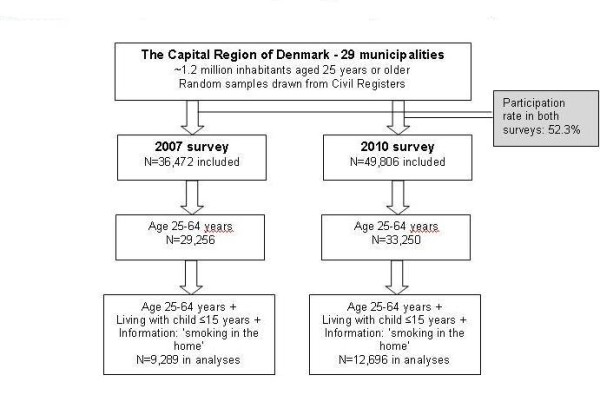
Data is from a repeated cross-sectional survey, 'Health Profiles of the Capital Region of Denmark' conducted in 2007 and 2010, in 29 municipalities. The response rate was 52.3%, in both surveys. Our study included persons aged 25 to 64, living with children ≤15 years of age; N=9,289 in 2007 and 12,696 in 2010. Analyses were weighted for size of municipality and for non-response, which was higher among men and among persons who were younger, had a lower income, were living alone, were unemployed, and/or were of an ethnicity other than Danish. Regression analyses were used to investigate smoking in homes including children across parent/adult education levels, focusing on temporal changes.
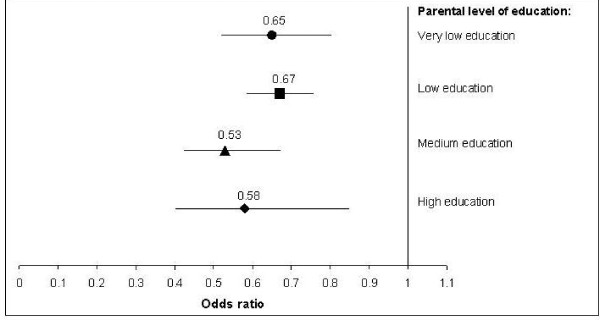
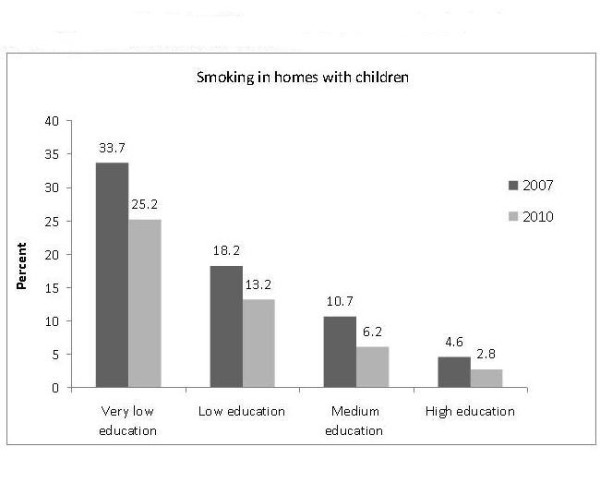
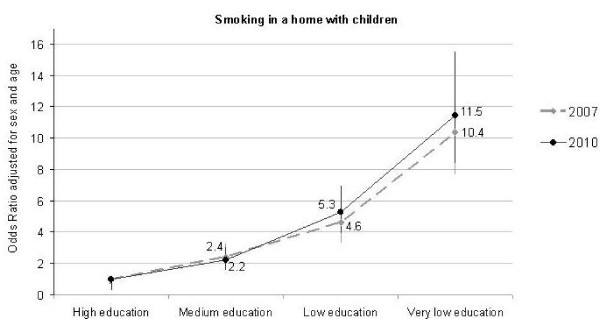
There were significant large socioeconomic differences in both 2007 and 2010. In 2010 it was more than 11 times more likely for a child to be exposed to SHS at home if the parent had very low education than if they were highly educated (p<0.001). Smoking in a home with children decreased from 16.2% in 2007 to 10.9% in 2010. The odds of a temporal decrease in domestic smoking did not differ significantly across parent education levels (p=0.40).
Marked social inequalities in children's exposure to SHS and a significant temporal decrease in exposure, independent of the education level of the parent/adult, were found in repeated large cross-sectional population-based studies. Social disparities have persisted over time, but not increased. Both clinical and population policy interventions will be needed in order to control child SHS exposure. We call for legislative protection of children from tobacco smoke inside their home as a supplement to parental education and support for smoking cessation.
接触二手烟(SHS)是导致儿童发病和死亡的一个重要可预防因素。我们假设,随着时间的推移,儿童在家中接触 SHS 的社会不平等现象有所增加。本研究的目的是调查家庭中吸烟情况的时间变化,包括儿童,重点关注社会经济差异。
本研究数据来自丹麦首都地区重复的横断面调查“健康概况”,于 2007 年和 2010 年在 29 个市进行。两次调查的回应率均为 52.3%。我们的研究包括 25 至 64 岁、与≤15 岁儿童同住的人群;2007 年有 9289 人,2010 年有 12696 人。分析对市的规模和非响应进行了加权,男性、年龄较小、收入较低、独居、失业以及/或非丹麦族裔的人非响应率较高。回归分析用于调查家庭中儿童的吸烟情况,按父母/成人教育水平进行分析,重点关注时间变化。
2007 年和 2010 年都存在显著的大社会经济差异。如果父母的受教育程度非常低,那么孩子在家中接触 SHS 的可能性是受教育程度较高的父母的 11 倍以上(p<0.001)。2010 年,家中有孩子的吸烟率从 2007 年的 16.2%下降到 10.9%。家庭吸烟的时间减少与父母教育水平无关(p=0.40)。
在重复的大型横断面人群研究中,我们发现儿童接触 SHS 存在明显的社会不平等现象,且接触程度显著下降,这与父母/成人的教育水平无关。随着时间的推移,社会差距持续存在,但没有扩大。为了控制儿童接触 SHS,需要采取临床和人群政策干预措施。我们呼吁立法保护儿童免受家中烟草烟雾的侵害,作为对父母教育和支持戒烟的补充。