Institut de Myologie, UPMC UM 76, INSERM U 974, CNRS UMR 7215, Paris Cedex 13, 75651, France.
BMC Musculoskelet Disord. 2012 Sep 18;13:176. doi: 10.1186/1471-2474-13-176.
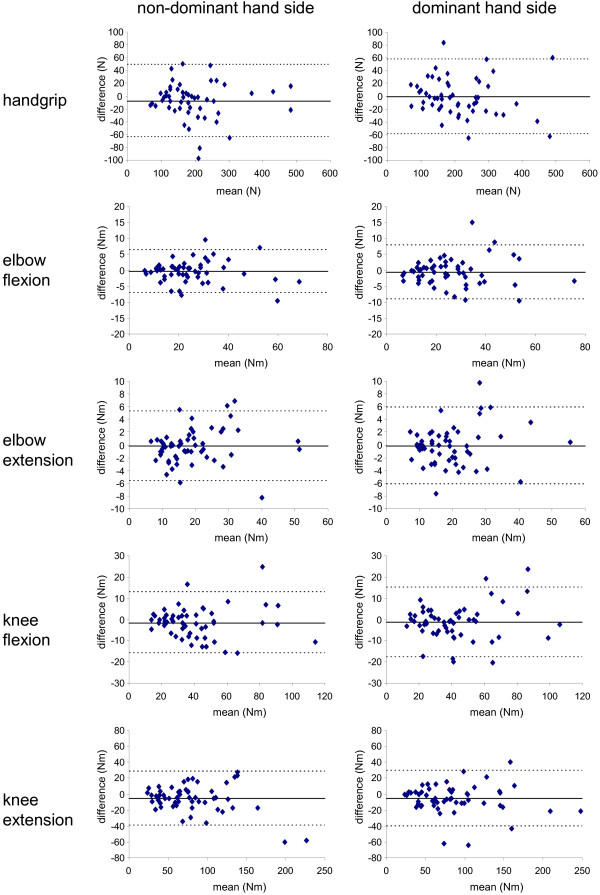
Children with growth retardation or short stature generally present with lower strength than children of the same chronological age. The aim of the study was to establish if strength was dependent on variables related to stature in a population of healthy children and to propose practical predictive models for the muscle functions tested. A secondary aim was to test for any learning effects concerning strength measured at two successive visits by children.
Hand grip, elbow flexion and extension, and knee flexion and extension were measured by fixed dynamometry in 96 healthy subjects (47 girls and 49 boys, aged from 5 to 17 years).
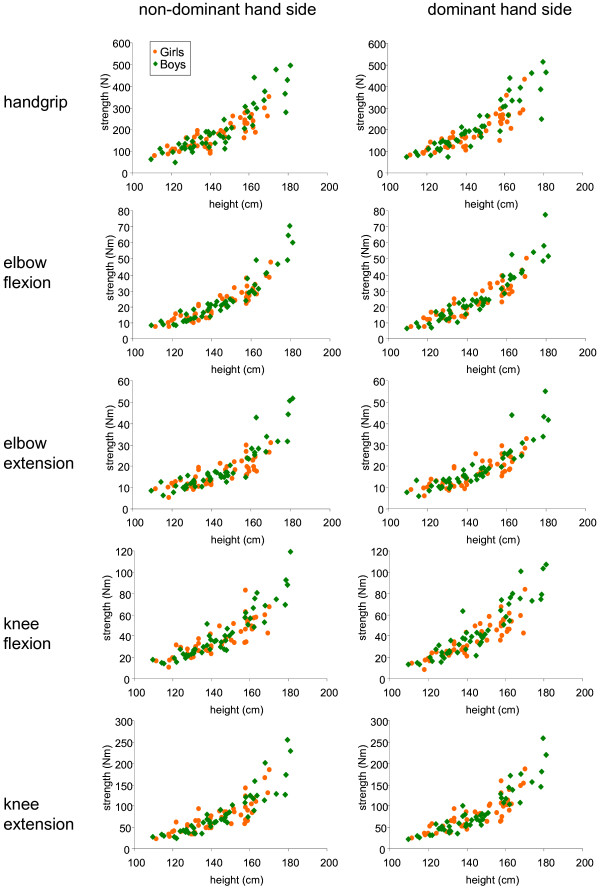
For the present paediatric population, muscle strength was highly dependent on height. Predictive models are proposed for the muscle functions tested. No learning effect between the first and the second visit was detected for any of the muscle functions tested.
This work shows that strength measurements using fixed dynamometry are reliable in children when using appropriate standardization of operating procedures. It underlines the particular relationship between body stature and muscle strength. Predictive equations may help with assessing the neuromuscular involvement in children suffering from various disorders, particularly those affecting their stature.
生长迟缓或身材矮小的儿童通常比同龄儿童力量弱。本研究旨在确定在健康儿童人群中,力量是否取决于与身高相关的变量,并提出用于测试肌肉功能的实用预测模型。次要目的是测试儿童在两次连续就诊时测量的力量是否存在学习效应。
使用固定测力计测量 96 名健康受试者(47 名女孩和 49 名男孩,年龄 5 至 17 岁)的握力、肘屈伸和膝屈伸。
对于目前的儿科人群,肌肉力量高度依赖于身高。为测试的肌肉功能提出了预测模型。测试的任何肌肉功能在第一次和第二次就诊之间均未检测到学习效应。
这项工作表明,当使用适当的操作程序标准化时,使用固定测力计测量力量在儿童中是可靠的。它强调了身体身高和肌肉力量之间的特殊关系。预测方程可能有助于评估患有各种疾病的儿童的神经肌肉受累情况,特别是那些影响其身高的疾病。