Decostre Valérie, Canal Aurélie, Ollivier Gwenn, Ledoux Isabelle, Moraux Amélie, Doppler Valérie, Payan Christine Anne Mary, Hogrel Jean-Yves
BMC Musculoskelet Disord. 2015 Jan 31;16(1):4. doi: 10.1186/s12891-015-0458-9.
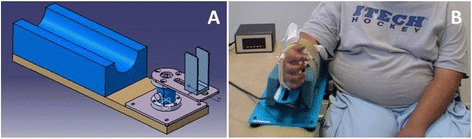
Wrist movements become impaired with disease progression in various neuromuscular disorders. With the development of new therapies, thorough measurement of muscle strength is crucial to document natural disease progression and to assess treatment efficacy. We developed a new dynamometer enabling wrist flexion and extension torque measurement with high sensitivity. The aims of the present study were to collect norms for healthy children and adults, to compute predictive equations, to assess the reliability of the measurements and to test the feasibility of using the device in patients with a neuromuscular disease.
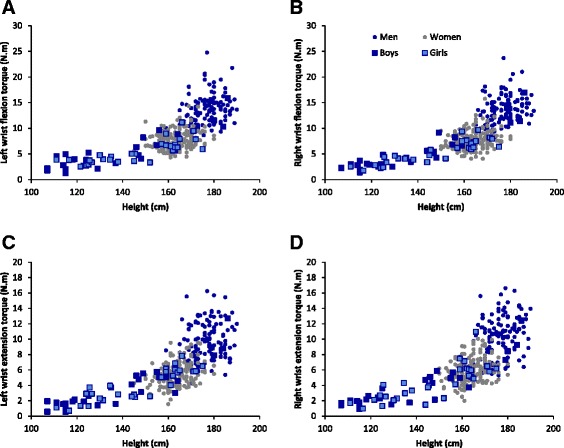
The peak isometric torque of wrist flexion and extension was measured with the MyoWrist dynamometer in 345 healthy subjects aged between 5 and 80 years old and in 9 patients with limb girdle muscle dystrophy type 2 C (LGMD2C) aged between 16 and 38 years old.
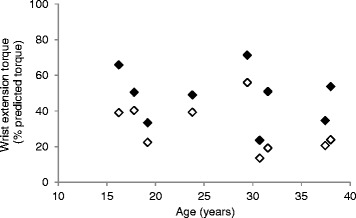
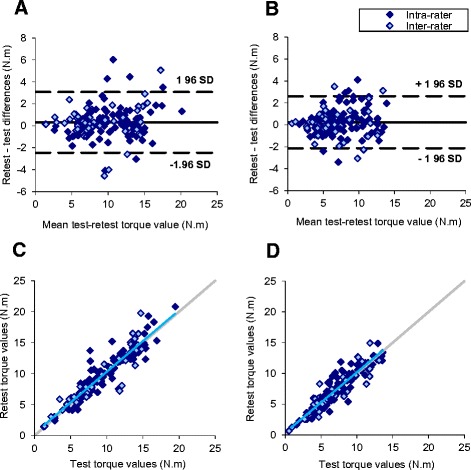
Predictive equations are proposed for the wrist flexion and extension strength in children and adults. Intra-rater and inter-rater reliability was good with ICCs higher than 0.9 for both wrist flexion and extension. However, retest values were significantly higher by 4% than test results. The dynamometer was applied with no difficulty to patients with LGMD2C and was sensitive enough to detect strength as weak as 0.82 N.m. From our models, we quantified the mean strength of wrist extension in LGMD2C patients to 39 ± 17% of their predicted values.
The MyoWrist dynamometer provides reliable and sensitive measurement of both wrist flexion and extension torques. However, a training session is recommended before starting a study as a small but significant learning effect was observed. Strength deficit can be quantified from predictive equations that were computed from norms of healthy children and adults.
在各种神经肌肉疾病中,随着疾病进展,手腕运动功能会受损。随着新疗法的发展,全面测量肌肉力量对于记录疾病自然进展和评估治疗效果至关重要。我们开发了一种新型测力计,能够高灵敏度地测量手腕屈伸扭矩。本研究的目的是收集健康儿童和成人的正常值,计算预测方程,评估测量的可靠性,并测试该设备在神经肌肉疾病患者中使用的可行性。
使用MyoWrist测力计测量了345名年龄在5至80岁之间的健康受试者以及9名年龄在16至38岁之间的2C型肢带型肌营养不良(LGMD2C)患者手腕屈伸的等长峰值扭矩。
提出了儿童和成人手腕屈伸力量的预测方程。组内和组间可靠性良好,手腕屈伸的组内相关系数(ICC)均高于0.9。然而,重测值比测试结果显著高4%。该测力计应用于LGMD2C患者时没有困难,并且灵敏度足以检测低至0.82 N.m的力量。根据我们的模型,我们将LGMD2C患者手腕伸展的平均力量量化为其预测值的39±17%。
MyoWrist测力计对手腕屈伸扭矩提供可靠且灵敏的测量。然而,由于观察到存在较小但显著的学习效应,建议在开始研究前进行一次训练。可以根据从健康儿童和成人正常值计算出的预测方程来量化力量 deficit。