Cambridge Institute for Medical Research, Addenbrooke's Hospital, Cambridge, CB2 0XY, England, UK.
Curr Opin Cell Biol. 2013 Feb;25(1):85-91. doi: 10.1016/j.ceb.2012.08.013. Epub 2012 Sep 16.
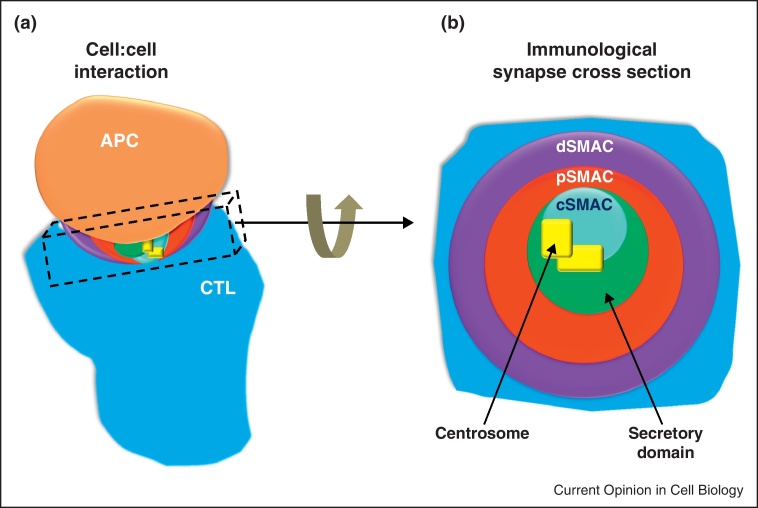
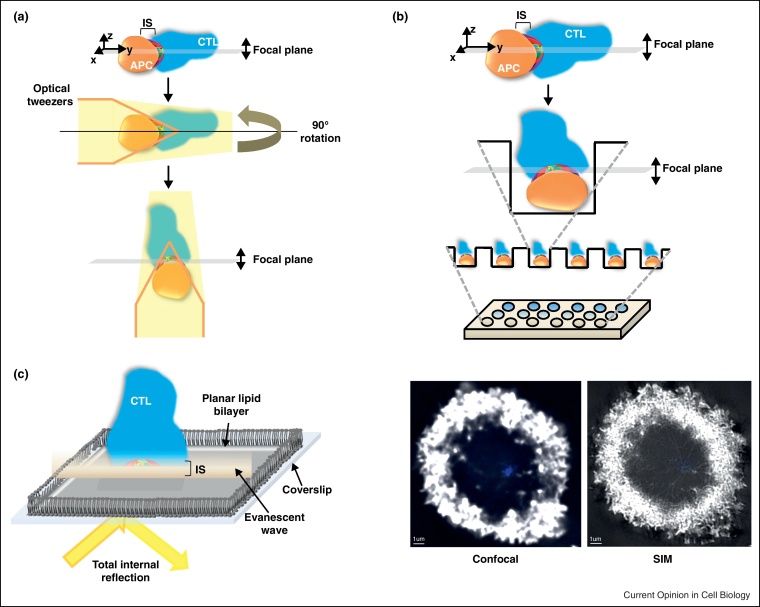
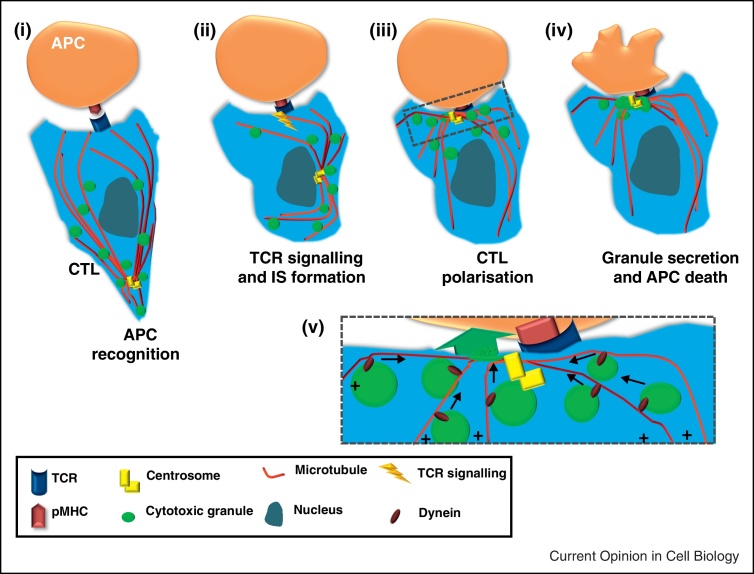
Directed secretion by immune cells requires formation of the immunological synapse at the site of cell-cell contact, concomitant with a dramatic induction of cell polarity. Recent findings provide us with insights into the various steps that are required for these processes: for example, the first identification of a protein at the centrosome that regulates its relocation to the plasma membrane; the use of super-resolution imaging techniques to reveal a residual actin network at the immunological synapse that may permit secretory granule exocytosis; and the drawing of parallels between primary cilia and IS architecture. Here we discuss these and other novel findings that have advanced our understanding of the complex process of immunological synapse formation and subsequent induced cell polarity in immune cells.
免疫细胞的定向分泌需要在细胞-细胞接触部位形成免疫突触,同时伴随着细胞极性的显著诱导。最近的发现使我们深入了解了这些过程所需的各个步骤:例如,首次在中心体中鉴定出一种调节其向质膜重定位的蛋白质;使用超分辨率成像技术揭示免疫突触处残留的肌动蛋白网络,该网络可能允许分泌颗粒胞吐;以及在初级纤毛和免疫突触结构之间建立平行关系。在这里,我们讨论了这些和其他新的发现,它们促进了我们对免疫细胞中免疫突触形成和随后诱导的细胞极性这一复杂过程的理解。