Department of Community and Behavioral Health, Colorado School of Public Health, University of Colorado Anschutz Medical Campus, Aurora, CO, USA.
Am J Prev Med. 2012 Oct;43(4):399-410. doi: 10.1016/j.amepre.2012.06.022.
Sun exposure, especially during childhood, is the most important preventable risk factor for skin cancer, yet few effective interventions to reduce exposure exist.
To test the effectiveness of a partially tailored mailed intervention based on the Precaution Adoption Process Model, delivered in the spring over 3 years to parents and children.
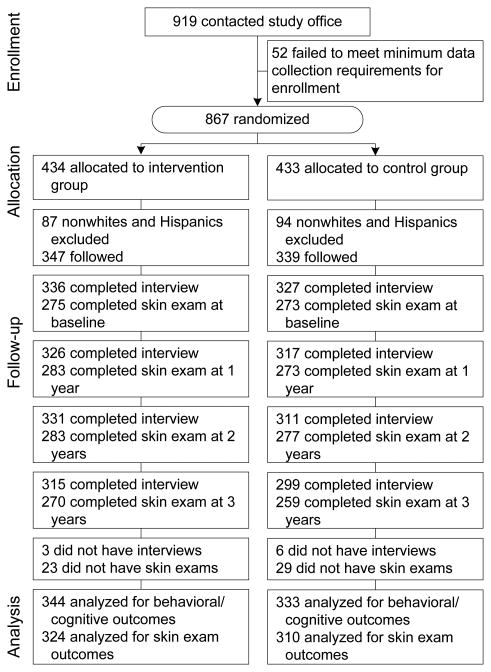
RCT, with data collection through telephone interviews of parents and skin exams of children at baseline (Summer 2004) and annually (Summer 2005-2007). The control group received no intervention.
SETTING/PARTICIPANTS: Families recruited in the Denver CO area, through private pediatric clinics, a large MCO, and community settings. Children born in 1998 were approximately 6 years of age at baseline; 867 children met inclusion criteria; analysis is reported for 677 white, non-Hispanic participants at highest risk for skin cancer.
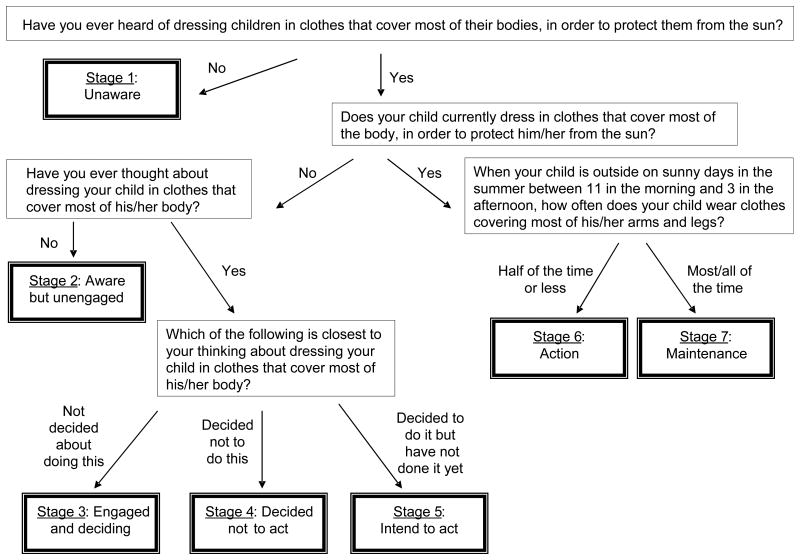
Primary outcomes were parent-reported child sun protection behaviors. Secondary outcomes included parents' risk perception, perceived effectiveness of and barriers to prevention behaviors, stage of change, reported sunburns, and observed tanning and nevus development. The longitudinal mixed-model analysis was conducted between 2008 and 2011.
The intervention group reported more use of sunscreen, protective clothing, hats, shade-seeking, and midday sun avoidance; fewer sunburns; more awareness of the risk of skin cancer; higher perceived effectiveness of sun protection; higher stage of change; and lower perception of barriers to sun protection (all p<0.05). The intervention group had fewer nevi ≥2 mm in 1 year of the study, 2006 (p=0.03). No differences were found in tanning or nevi <2 mm.
The level of behavior change associated with this single-modality intervention is not likely sufficient to reduce skin cancer risk. However, the intervention shows promise for inclusion in longer-term, multicomponent interventions that have sufficient intensity to affect skin cancer incidence.
阳光暴露,尤其是儿童时期的阳光暴露,是皮肤癌最重要的可预防风险因素,但目前针对减少暴露的有效干预措施却很少。
测试基于预防采用过程模型的部分定制邮件干预措施的有效性,该措施在三年中的春季通过电话访谈向父母和儿童进行,并在基线(2004 年夏季)和每年(2005 年至 2007 年夏季)对儿童进行皮肤检查。对照组未接受干预。
RCT,通过私人儿科诊所、大型 MCO 和社区环境在丹佛 CO 地区招募的家庭进行,2004 年夏季),每年一次(2005 年至 2007 年夏季)。对照组未接受干预。
地点/参与者:在丹佛 CO 地区通过私人儿科诊所、大型 MCO 和社区环境招募的家庭,2004 年夏季),每年一次(2005 年至 2007 年夏季)。对照组未接受干预。
主要结果是父母报告的儿童防晒行为。次要结果包括父母的风险认知、预防行为的有效性和障碍感知、改变阶段、报告的晒伤和观察到的晒黑和痣发展。纵向混合模型分析在 2008 年至 2011 年进行。
干预组报告了更多使用防晒霜、防护服、帽子、寻找阴凉处和避开中午阳光;更少晒伤;对皮肤癌风险的认识更高;防晒效果的感知更高;改变阶段更高;对防晒障碍的感知较低(均 p<0.05)。在研究的 1 年内,干预组的痣(≥2 毫米)数量减少(p=0.03)。在晒黑或痣(<2 毫米)方面没有发现差异。
与这种单一模式干预相关的行为改变水平不太可能足以降低皮肤癌风险。然而,该干预措施有望纳入更长期、多成分的干预措施,这些干预措施的强度足以影响皮肤癌的发病率。