Department of Protein Evolution, Max Planck Institute for Developmental Biology, D-72076 Tübingen, Germany.
J Biol Chem. 2012 Nov 9;287(46):39254-62. doi: 10.1074/jbc.M112.386458. Epub 2012 Sep 19.
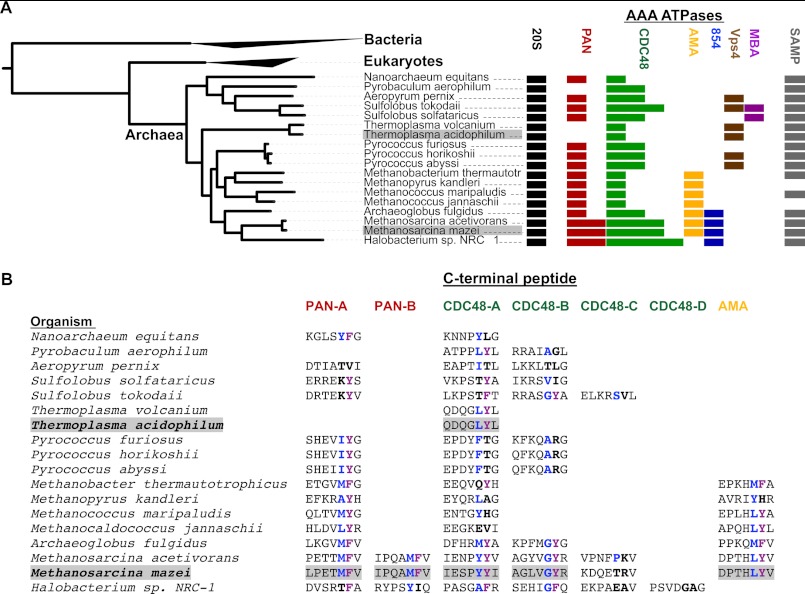
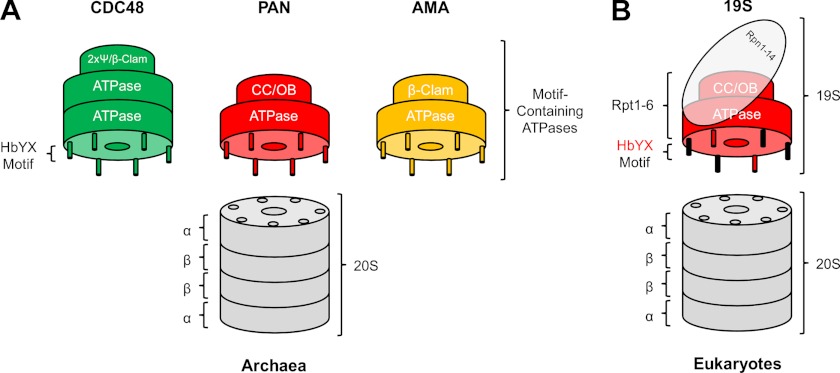
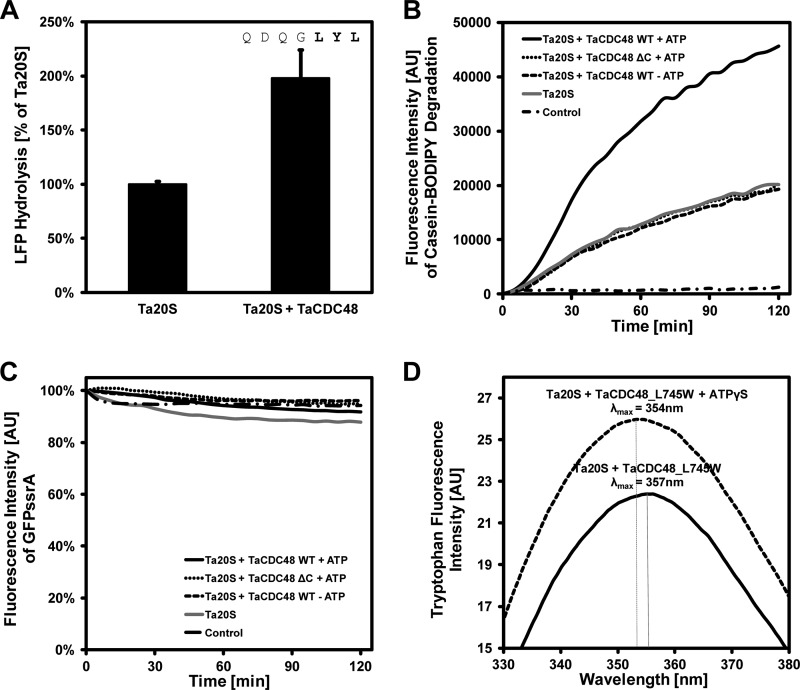
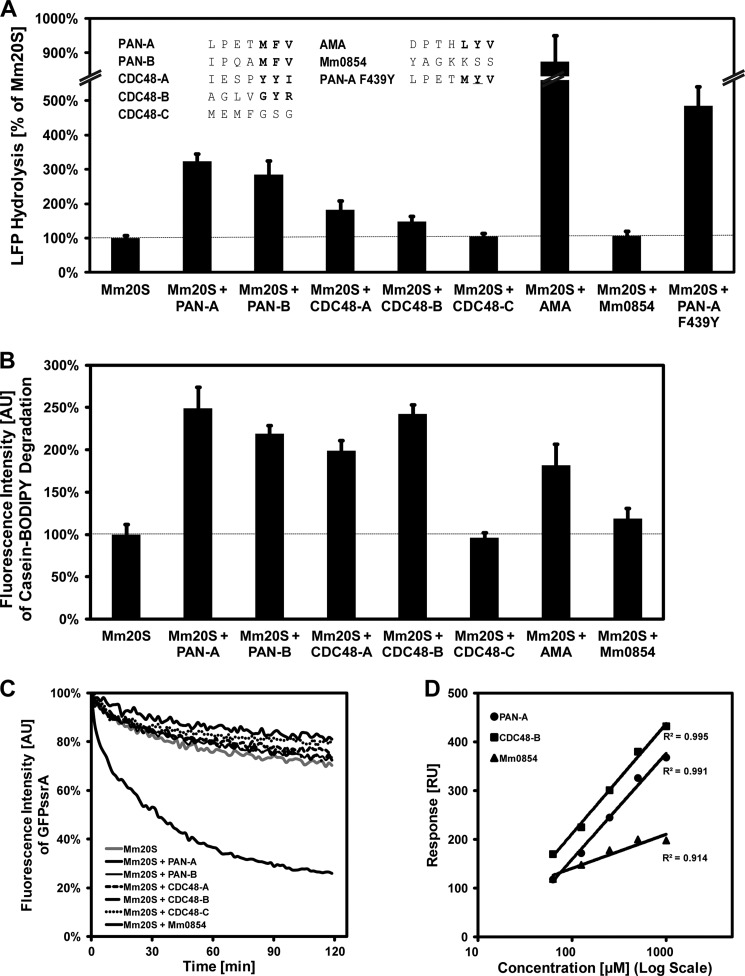
The proteasome is the central machinery for targeted protein degradation in archaea, Actinobacteria, and eukaryotes. In its basic form, it consists of a regulatory ATPase complex and a proteolytic core particle. The interaction between the two is governed by an HbYX motif (where Hb is a hydrophobic residue, Y is tyrosine, and X is any amino acid) at the C terminus of the ATPase subunits, which stimulates gate opening of the proteasomal α-subunits. In archaea, the proteasome-interacting motif is not only found in canonical proteasome-activating nucleotidases of the PAN/ARC/Rpt group, which are absent in major archaeal lineages, but also in proteins of the CDC48/p97/VAT and AMA groups, suggesting a regulatory network of proteasomal ATPases. Indeed, Thermoplasma acidophilum, which lacks PAN, encodes one CDC48 protein that interacts with the 20S proteasome and activates the degradation of model substrates. In contrast, Methanosarcina mazei contains seven AAA proteins, five of which, both PAN proteins, two out of three CDC48 proteins, and the AMA protein, function as proteasomal gatekeepers. The prevalent presence of multiple, distinct proteasomal ATPases in archaea thus results in a network of regulatory ATPases that may widen the substrate spectrum of proteasomal protein degradation.
蛋白酶体是古菌、放线菌和真核生物中靶向蛋白降解的核心机制。在其基本形式中,它由一个调节 ATP 酶复合物和一个蛋白水解核心粒子组成。两者的相互作用受 ATP 酶亚基 C 末端 HbYX 基序(其中 Hb 是疏水性残基,Y 是酪氨酸,X 是任何氨基酸)的控制,该基序刺激蛋白酶体 α 亚基的门控打开。在古菌中,蛋白酶体相互作用基序不仅存在于 PAN/ARC/Rpt 组的经典蛋白酶体激活核苷酸酶中,而且还存在于 CDC48/p97/VAT 和 AMA 组的蛋白质中,表明存在蛋白酶体 ATP 酶的调节网络。事实上,缺乏 PAN 的嗜酸热原体编码一种与 20S 蛋白酶体相互作用并激活模型底物降解的 CDC48 蛋白。相比之下,产甲烷菌含有七个 AAA 蛋白,其中五个是 PAN 蛋白,三个 CDC48 蛋白中的两个,以及 AMA 蛋白,作为蛋白酶体的守门员。因此,古菌中普遍存在多种不同的蛋白酶体 ATP 酶,导致调节 ATP 酶网络的形成,从而可能拓宽蛋白酶体蛋白降解的底物谱。