Ganesan Suganeswari, Raman Rajiv, Reddy Sumanth, Krishnan Tandava, Kulothungan Vaitheeswaran, Sharma Tarun
Shri Bhagwan Mahavir Vitreoretinal Services, Department of Preventive Ophthalmology, Sankara Nethralaya, 18, College Road, Chennai, Tamil Nadu, India.
Oman J Ophthalmol. 2012 May;5(2):91-6. doi: 10.4103/0974-620X.99371.
To report the prevalence of myopia and its association with diabetic retinopathy in subjects with type II diabetes mellitus and compare the diabetic retinopathy status in the myopic group vs the emmetropic group.
Population-based study.
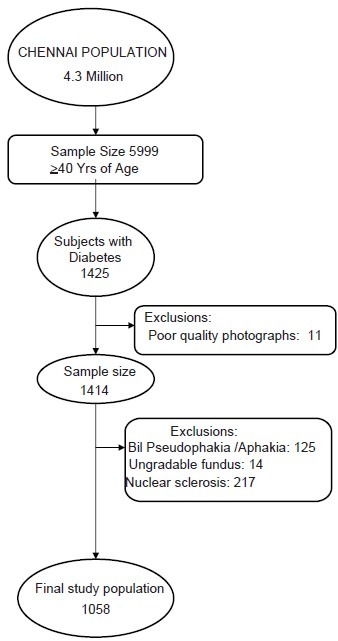
The population-based study estimated the prevalence of myopia from 1058 subjects, who were more than 40 years old and had type II diabetes mellitus; the patients were enrolled from a cross-sectional study. Participants answered a detailed questionnaire and underwent biochemical, physical and comprehensive ocular examination which included grading of nuclear sclerosis by lens opacities classification system III (LOCS III), seven field fundus photography and ultrasonography. Diabetic retinopathy and diabetic maculopathy were graded using the Klein's classification and early treatment diabetic retinopathy study (ETDRS) criteria respectively.
The prevalence of mild, moderate and high myopia in type 2 diabetes was 15.9, 2.1 and 1.9% respectively. The prevalence of any myopia was found to be 19.9% in our study population. After adjusting the age, gender, duration of diabetes, hemoglobin A1c and other factors, increasing age was associated with mild and moderate myopia [OR 1.11 (95% CI 1.05 - 1.18)]. Compared to emmetropia, complete posterior vitreous detachment (CPVD) was associated with high myopia (50% Vs 12.2%, P < 0.0001). Myopia had no association with diabetic retinopathy.
The prevalence of myopia and high myopia was found to be 19.9 and 1.9% respectively among subjects with type II diabetes. Myopia was not associated with diabetic retinopathy, thereby, suggesting the need for a longitudinal study.
报告2型糖尿病患者近视的患病率及其与糖尿病视网膜病变的关联,并比较近视组与正视组的糖尿病视网膜病变状况。
基于人群的研究。
这项基于人群的研究评估了1058名40岁以上的2型糖尿病患者的近视患病率;这些患者来自一项横断面研究。参与者回答了一份详细问卷,并接受了生化、体格和全面的眼科检查,包括使用晶状体混浊分类系统III(LOCS III)对核硬化进行分级、七视野眼底照相和超声检查。糖尿病视网膜病变和糖尿病黄斑病变分别使用克莱因分类法和早期治疗糖尿病视网膜病变研究(ETDRS)标准进行分级。
2型糖尿病患者中轻度、中度和高度近视的患病率分别为15.9%、2.1%和1.9%。在我们的研究人群中,任何程度近视的患病率为19.9%。在调整年龄、性别、糖尿病病程、糖化血红蛋白和其他因素后,年龄增长与轻度和中度近视相关[比值比1.11(95%置信区间1.05 - 1.18)]。与正视相比,完全性玻璃体后脱离(CPVD)与高度近视相关(50%对12.2%,P < 0.0001)。近视与糖尿病视网膜病变无关。
在2型糖尿病患者中,近视和高度近视的患病率分别为19.9%和1.9%。近视与糖尿病视网膜病变无关,因此,提示需要进行纵向研究。