School of Ophthalmology & Optometry, Wenzhou Medical University, Eye Hospital of Wenzhou Medical University, Wenzhou, China.
Fushun Eye Hospital, Liaoning, Province, China.
Diab Vasc Dis Res. 2020 Jul-Aug;17(4):1479164120940988. doi: 10.1177/1479164120940988.
To investigate the association between high myopia and diabetic retinopathy, and its possible mechanism, in a northeastern Chinese population with type 2 diabetic mellitus.
Patients were included from Fushun Diabetic Retinopathy Cohort Study. High myopia was defined as spherical equivalent of autorefraction less than -5D.
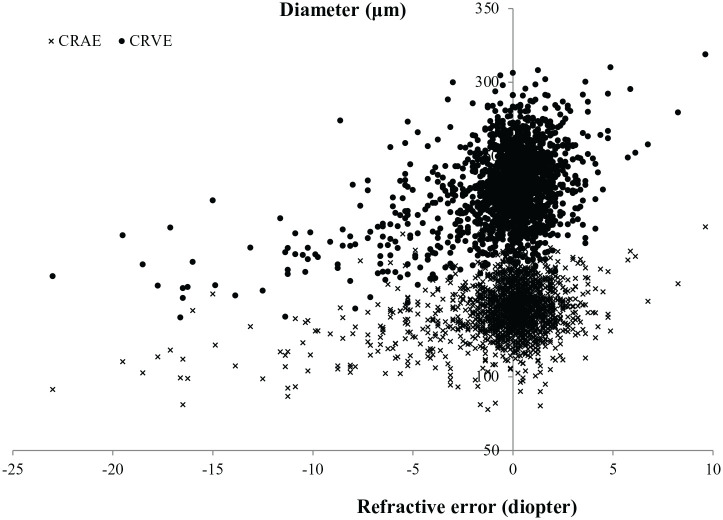
A total of 1817 patients [688 (37.9%) diabetic retinopathy, 102 (5.6%) high myopia] were included. Compared to eyes without high myopia, the frequency of diabetic retinopathy and non-proliferative diabetic retinopathy was significantly less in eyes with high myopia (23.5% vs 38.7%, = 0.002; 22.5% vs 35.3%, = 0.005). Eyes with high myopia were less likely to have diabetic retinopathy (multivariate odds ratio, 95% confidence interval: 0.39, 0.22-0.68) or non-proliferative diabetic retinopathy (odds ratio, 95% confidence interval: 0.40, 0.23-0.70). High myopia was negatively associated with central retinal venular equivalent (multivariate β, 95% confidence interval: -37.1, -42.3 to -31.8, < 0.001). Furthermore, central retinal venular equivalent (per 10 μm increase) had a significant association with diabetic retinopathy (odds ratio, 95% confidence interval: 1.24, 1.17-1.31) as well as non-proliferative diabetic retinopathy (odds ratio, 95% confidence interval: 1.24, 1.18-1.31).
High myopia was negatively associated with both diabetic retinopathy and non-proliferative diabetic retinopathy in this northeastern Chinese population. This protective effect may have been partially achieved via thinning retinal veins.
在中国东北地区的 2 型糖尿病患者中,研究高度近视与糖尿病视网膜病变的相关性及其可能的机制。
患者来自抚顺糖尿病视网膜病变队列研究。高度近视定义为自动折射的球镜等效值小于-5D。
共纳入 1817 例患者[688 例(37.9%)糖尿病视网膜病变,102 例(5.6%)高度近视]。与无高度近视的眼相比,高度近视眼中糖尿病视网膜病变和非增生性糖尿病视网膜病变的发生率明显较低(23.5% vs 38.7%, = 0.002;22.5% vs 35.3%, = 0.005)。高度近视眼发生糖尿病视网膜病变(多变量比值比,95%置信区间:0.39,0.22-0.68)或非增生性糖尿病视网膜病变(比值比,95%置信区间:0.40,0.23-0.70)的可能性较小。高度近视与中心视网膜静脉等效值呈负相关(多变量β,95%置信区间:-37.1,-42.3 至-31.8, < 0.001)。此外,中心视网膜静脉等效值(每增加 10μm)与糖尿病视网膜病变(比值比,95%置信区间:1.24,1.17-1.31)以及非增生性糖尿病视网膜病变(比值比,95%置信区间:1.24,1.18-1.31)显著相关。
在中国东北地区的这一人群中,高度近视与糖尿病视网膜病变和非增生性糖尿病视网膜病变均呈负相关。这种保护作用可能部分是通过视网膜静脉变薄来实现的。