Department of Electrical and Computer Engineering, University of Illinois at Urbana-Champaign, Urbana, IL 61801, USA.
Sci Rep. 2012;2:660. doi: 10.1038/srep00660. Epub 2012 Sep 17.
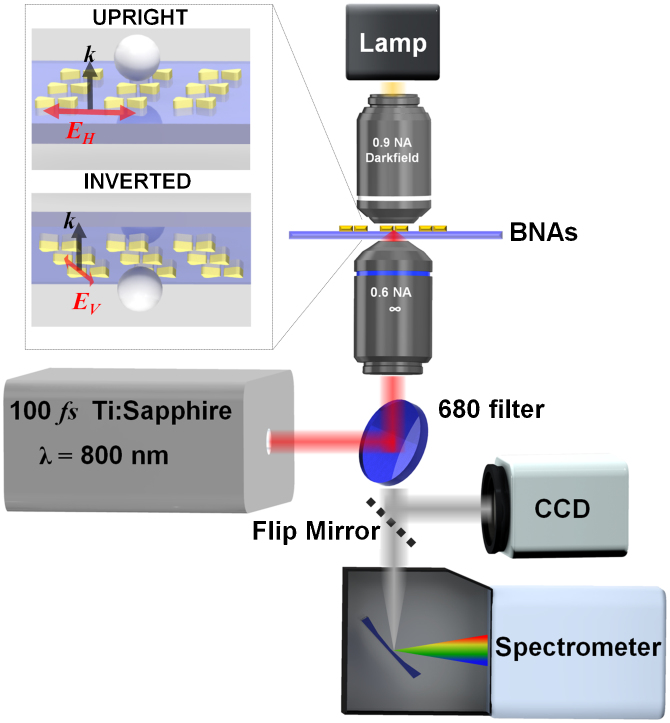
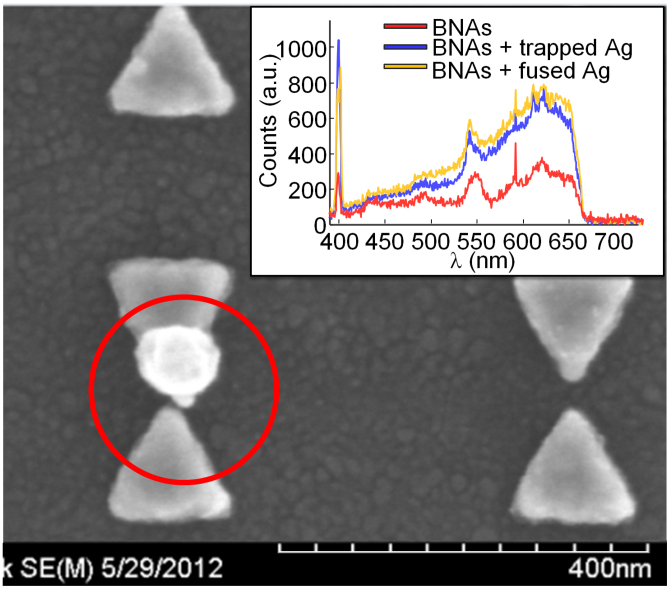
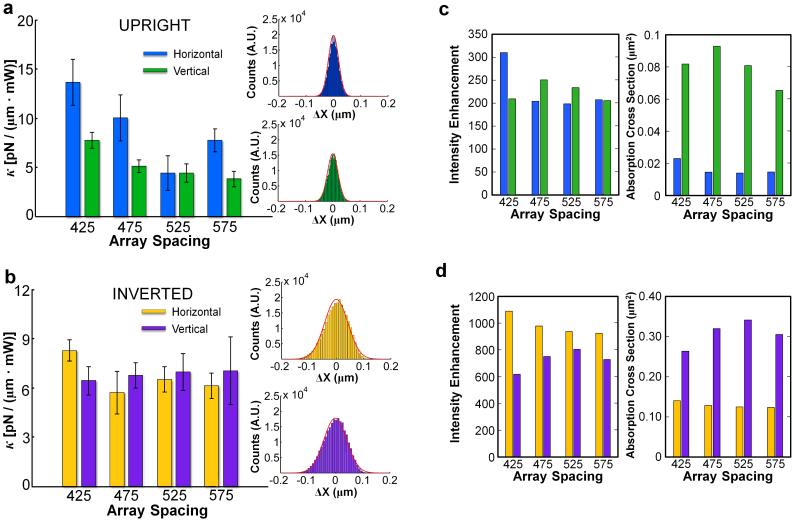
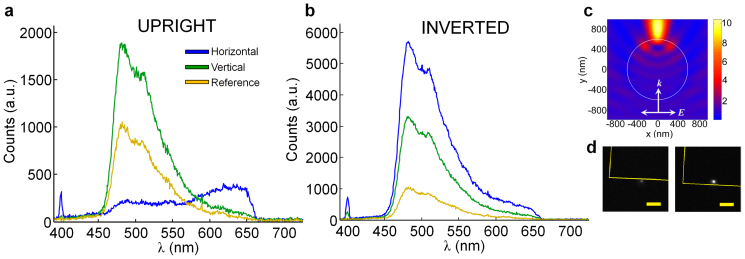
We demonstrate for the first time plasmonic nanotweezers based on Au bowtie nanoantenna arrays (BNAs) that utilize a femtosecond-pulsed input source to enhance trapping of both Rayleigh and Mie particles. Using ultra-low input power densities, we demonstrate that the high-peak powers associated with a femtosecond source augment the trap stiffness to 2x that of nanotweezers employing a continuous-wave source, and 5x that of conventional tweezers using a femtosecond source. We show that for trapped fluorescent microparticles the two-photon response is enhanced by 2x in comparison to the response without nanoantennas. We also demonstrate tweezing of 80-nm diameter Ag nanoparticles, and observe an enhancement of the second-harmonic signal of ~3.5x for the combined nanoparticle-BNA system compared to the bare BNAs. Finally, under select illumination conditions, fusing of Ag nanoparticles to the BNAs is observed which holds potential for in situ fabrication of three-dimensional, bimetallic nanoantennas.
我们首次展示了基于金蝶形纳米天线阵列(BNAs)的等离子体纳米镊子,它利用飞秒脉冲输入源来增强瑞利和米氏粒子的捕获。通过使用超低输入功率密度,我们证明了与连续波源相比,飞秒源的高峰值功率将陷阱刚度提高了 2 倍,与使用飞秒源的传统镊子相比,提高了 5 倍。我们表明,与没有纳米天线的情况相比,对于被捕获的荧光微粒子,双光子响应提高了 2 倍。我们还演示了对 80nm 直径的 Ag 纳米粒子的夹持,并观察到在结合纳米粒子-BNA 系统的情况下,二次谐波信号增强了约 3.5 倍,与裸 BNA 相比。最后,在选择的照明条件下,观察到 Ag 纳米粒子与 BNA 的融合,这为原位制造三维双金属纳米天线提供了可能性。