Behavioral Neuroscience Laboratory, Department of Psychology, University of Nevada, Las Vegas, United States.
Neurobiol Learn Mem. 2012 Oct;98(3):261-71. doi: 10.1016/j.nlm.2012.09.005. Epub 2012 Sep 23.
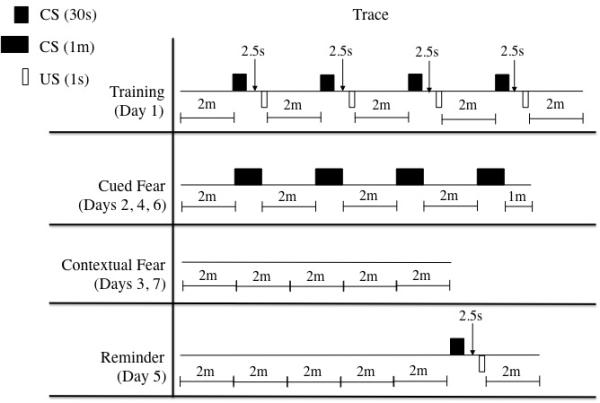
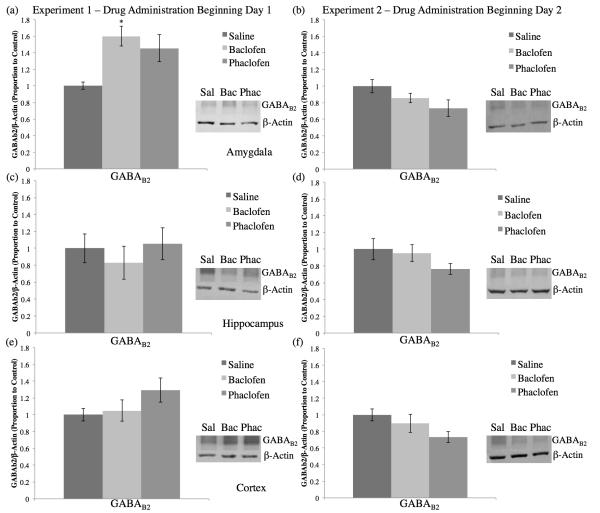
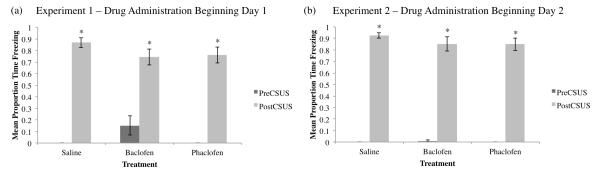
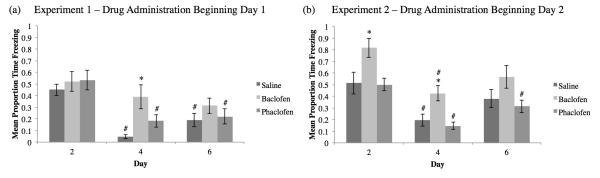
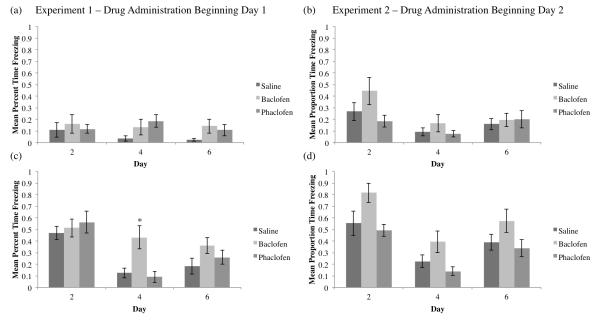
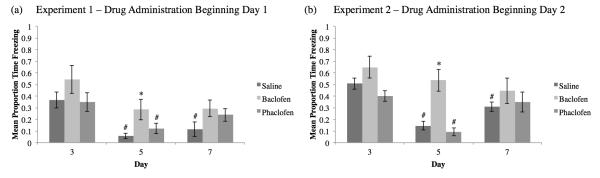
The investigation of GABAergic systems in learning and extinction has principally focused on ionotropic GABA(A) receptors. Less well characterized is the metabotropic GABA(B) receptor, which when activated, induces a more sustained inhibitory effect and has been implicated in regulating oscillatory activity. Few studies have been carried out utilizing GABA(B) ligands in learning, and investigations of GABA(B) in extinction have primarily focused on interactions with drugs of abuse. The current study examined changes in GABA(B) receptor function using the GABA(B) agonist baclofen (2 mg/mL) or the GABA(B) antagonist phaclofen (0.3 mg/mL) on trace cued and contextual fear conditioning and extinction. The compounds were either administered during training and throughout extinction in Experiment 1, or starting 24 h after training and throughout extinction in Experiment 2. All drugs were administered 1 mL/kg via intraperitoneal injection. These studies demonstrated that the administration of baclofen during training and extinction trials impaired animals' ability to extinguish the fear association to the CS, whereas the animals that were administered baclofen starting 24 h after training (Experiment 2) did display some extinction. Further, contextual fear extinction was impaired by baclofen in both experiments. Tissue analyses suggest the cued fear extinction deficit may be related to changes in the GABA(B2) receptor subunit in the amygdala. The data in the present investigation demonstrate that GABA(B) receptors play an important role in trace cued and contextual fear extinction, and may function differently than GABA(A) receptors in learning, memory, and extinction.
学习和遗忘过程中 GABA 能系统的研究主要集中在离子型 GABA(A)受体上。而代谢型 GABA(B)受体的特征则不那么明显,其被激活后会产生更持久的抑制作用,并与调节振荡活动有关。在学习过程中利用 GABA(B)配体的研究较少,而关于 GABA(B)在遗忘过程中的研究主要集中在与滥用药物的相互作用上。本研究使用 GABA(B)激动剂巴氯芬(2mg/mL)或 GABA(B)拮抗剂荷包牡丹碱(0.3mg/mL)在痕迹线索和情境恐惧条件作用和遗忘过程中,检查了 GABA(B)受体功能的变化。在实验 1 中,化合物在训练和整个遗忘过程中给药,或者在实验 2 中在训练后 24 小时开始并在整个遗忘过程中给药。所有药物均通过腹腔内注射 1mL/kg 给药。这些研究表明,在训练和遗忘试验期间给予巴氯芬会损害动物消除 CS 恐惧关联的能力,而在训练后 24 小时开始给予巴氯芬的动物(实验 2)确实表现出一些遗忘。此外,在两个实验中,巴氯芬均损害了情境恐惧的遗忘。组织分析表明,线索恐惧遗忘缺陷可能与杏仁核中 GABA(B2)受体亚基的变化有关。本研究中的数据表明,GABA(B)受体在痕迹线索和情境恐惧遗忘中起着重要作用,并且在学习、记忆和遗忘过程中的功能可能与 GABA(A)受体不同。