Department of Genetics, Center for Genome Sciences and Systems Biology, Washington University School of Medicine, St Louis, MO 63108, USA.
Mol Syst Biol. 2012;8:614. doi: 10.1038/msb.2012.48.
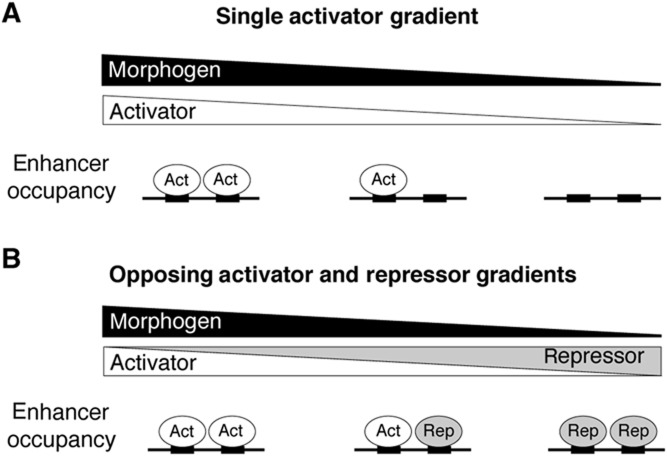
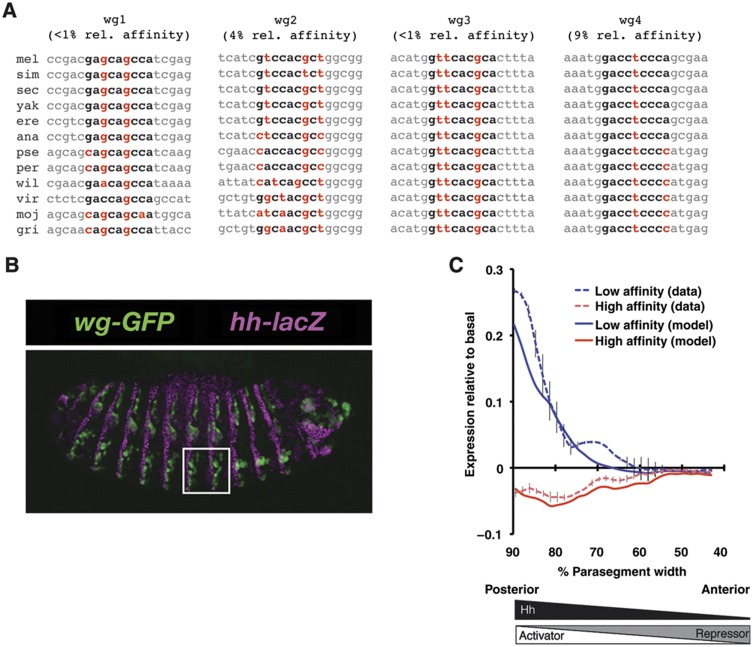
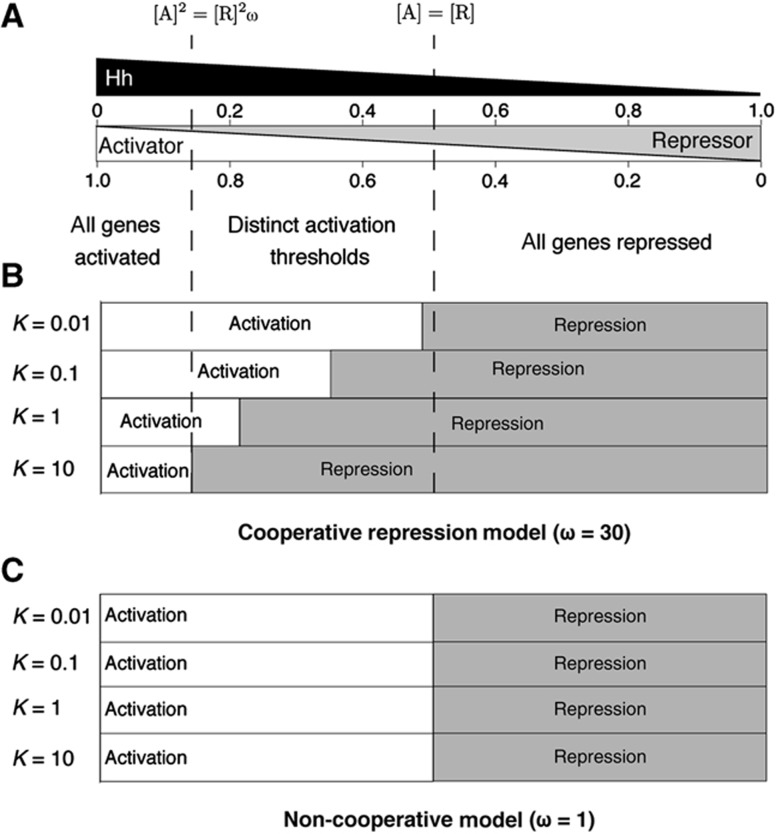
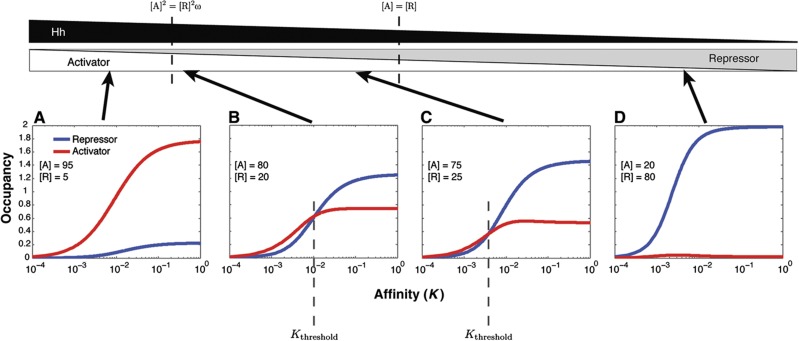
Morphogens control patterns of transcription in development, often by establishing concentration gradients of a single transcriptional activator. However, many morphogens, including Hedgehog, create opposing activator and repressor gradients (OARGs). In contrast to single activator gradients, it is not well understood how OARGs control transcriptional patterns. We present a general thermodynamic model that explains how spatial patterns of gene expression are established within OARGs. The model predicts that differences in enhancer binding site affinities for morphogen-responsive transcription factors (TFs) produce discrete transcriptional boundaries, but only when either activators or repressors bind cooperatively. This model quantitatively predicts the boundaries of gene expression within OARGs. When trained on experimental data, our model accounts for the counterintuitive observation that increasing the affinity of binding sites in enhancers of Hedgehog target genes produces more restricted transcription within Hedgehog gradients in Drosophila. Because our model is general, it may explain the role of low-affinity binding sites in many contexts, including mammalian Hedgehog gradients.
形态发生素在发育过程中控制转录模式,通常通过建立单个转录激活剂的浓度梯度来实现。然而,许多形态发生素,包括 Hedgehog,会产生相反的激活剂和抑制剂梯度(OARGs)。与单激活剂梯度不同,OARGs 如何控制转录模式尚不清楚。我们提出了一个通用的热力学模型,解释了 OARGs 内如何建立基因表达的空间模式。该模型预测,对形态发生素反应性转录因子(TFs)的增强子结合位点亲和力的差异会产生离散的转录边界,但只有当激活剂或抑制剂协同结合时才会产生这种情况。该模型定量预测了 OARGs 内基因表达的边界。当在实验数据上进行训练时,我们的模型解释了一个反直觉的观察结果,即在果蝇 Hedgehog 梯度中,增加 Hedgehog 靶基因增强子中结合位点的亲和力会导致转录更加受限。由于我们的模型具有普遍性,它可能解释了许多情况下低亲和力结合位点的作用,包括哺乳动物 Hedgehog 梯度。