Division of Haematology, University of Nottingham, Nottingham, UK.
BMC Cancer. 2012 Sep 26;12:431. doi: 10.1186/1471-2407-12-431.
The CD34+CD38- subset of AML cells is enriched for resistance to current chemotherapeutic agents and considered to contribute to disease progression and relapse in Acute Myeloid Leukaemia (AML) patients following initial treatment.
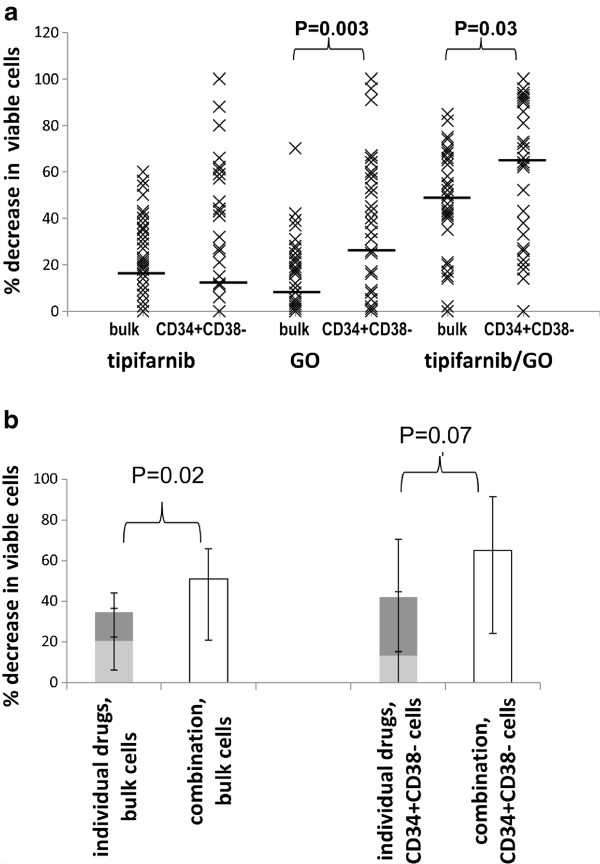
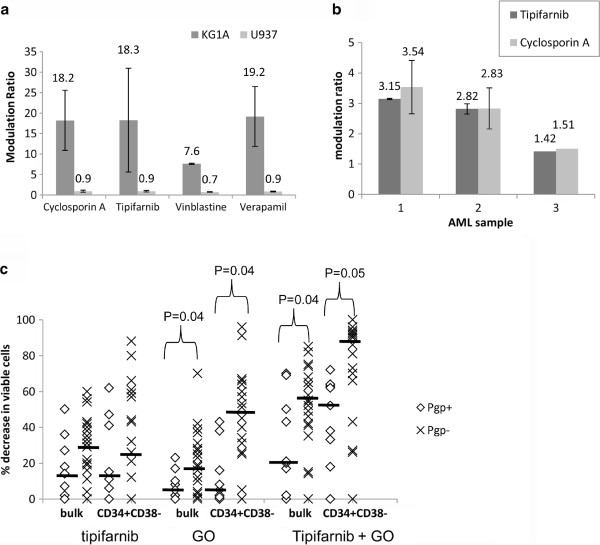
Chemosensitivity in phenotypically defined subsets from 34 primary AML samples was measured by flow cytometry following 48 hr in vitro treatment with gemtuzumab ozogamicin (GO, Mylotarg) and the farnesyltransferase inhibitor tipifarnib/zarnestra. The DNA damage response was measured using flow cytometry, immunofluorescence and immunohistochemistry.
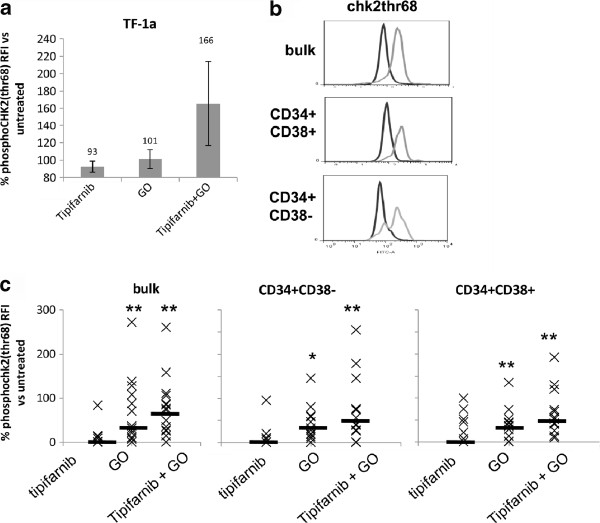
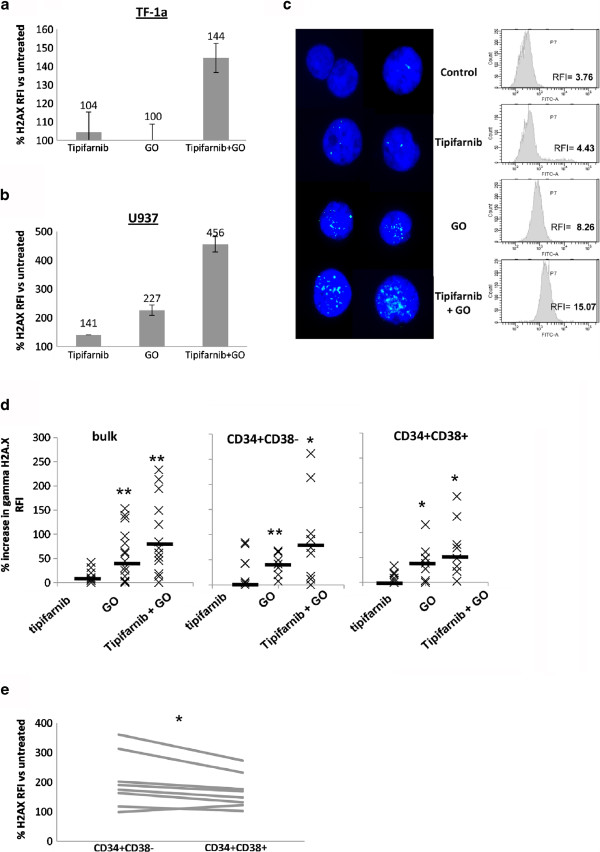
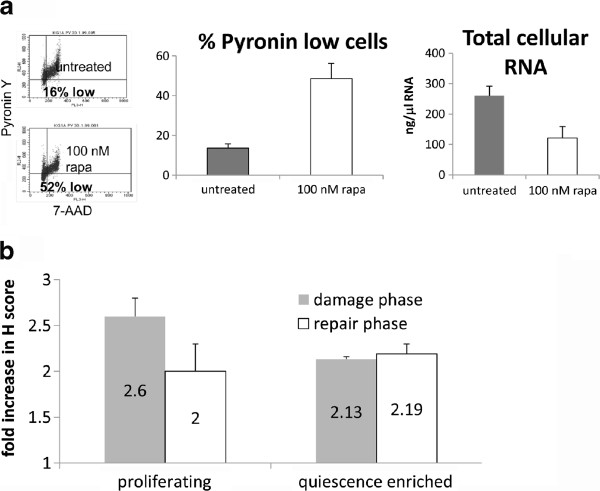
Using a previously validated in vitro minimal residual disease model, we now show that the combination of GO (10 ng/ml) and tipifarnib (5 μM) targets the CD34+CD38- subset resulting in 65% median cell loss compared to 28% and 13% CD34+CD38- cell loss in GO-treated and tipifarnib-treated cells, respectively. Using phosphokinome profiling and immunofluorescence in the TF-1a cell line, we demonstrate that the drug combination is characterised by the activation of a DNA damage response (induction of γH2A.X and thr68 phosphorylation of chk2). Higher induction of γH2AX was found in CD34+CD38- than in CD34+CD38+ patient cells. In a model system, we show that dormancy impairs damage resolution, allowing accumulation of γH2AX foci.
The chemosensitivity of the CD34+CD38- subset, combined with enhanced damage indicators, suggest that this subset is primed to favour programmed cell death as opposed to repairing damage. This interaction between tipifarnib and GO suggests a potential role in the treatment of AML.
CD34+CD38-AML 细胞亚群对现有化疗药物具有耐药性,被认为是导致急性髓系白血病(AML)患者初始治疗后疾病进展和复发的原因之一。
通过流式细胞术检测 34 例原发性 AML 样本中表型定义的亚群在体外 48 小时用吉妥珠单抗奥佐米星(GO,Mylotarg)和法尼基转移酶抑制剂 tipifarnib/zarnestra 处理后的化学敏感性。使用流式细胞术、免疫荧光和免疫组化检测 DNA 损伤反应。
使用先前验证的体外微小残留病模型,我们现在表明,GO(10ng/ml)和 tipifarnib(5μM)的联合作用靶向 CD34+CD38-亚群,导致 65%的中位细胞丢失,而 GO 处理和 tipifarnib 处理的细胞中 CD34+CD38-细胞丢失分别为 28%和 13%。在 TF-1a 细胞系中通过磷酸激酶组谱和免疫荧光分析,我们证明该药物组合的特点是激活 DNA 损伤反应(诱导γH2AX 和 chk2 的 thr68 磷酸化)。在 CD34+CD38-患者细胞中发现比在 CD34+CD38+患者细胞中更高的γH2AX 诱导。在模型系统中,我们表明休眠会损害损伤的修复,导致γH2AX 焦点的积累。
CD34+CD38-亚群的化学敏感性,结合增强的损伤指标,表明该亚群被优先诱导程序性细胞死亡,而不是修复损伤。tipifarnib 和 GO 之间的这种相互作用提示其在 AML 治疗中有潜在作用。