Department of Anatomy and Neurobiology, Virginia Commonwealth University, Richmond, Virginia 23298-0709, USA.
Environ Health Perspect. 2012 Dec;120(12):1684-91. doi: 10.1289/ehp.1104857. Epub 2012 Sep 26.
Environmental tobacco smoke (ETS) exposure is linked to developmental deficits and disorders with known cerebellar involvement. However, direct biological effects and underlying neurochemical mechanisms remain unclear.
We sought to identify and evaluate underlying neurochemical change in the rat cerebellum with ETS exposure during critical period development.
We exposed rats to daily ETS (300, 100, and 0 µg/m3 total suspended particulate) from postnatal day 8 (PD8) to PD23 and then assayed the response at the behavioral, neuroproteomic, and cellular levels.
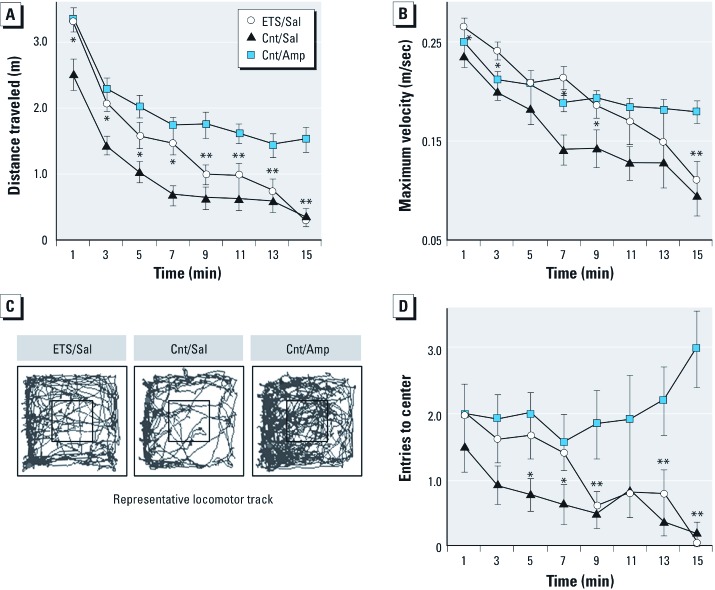
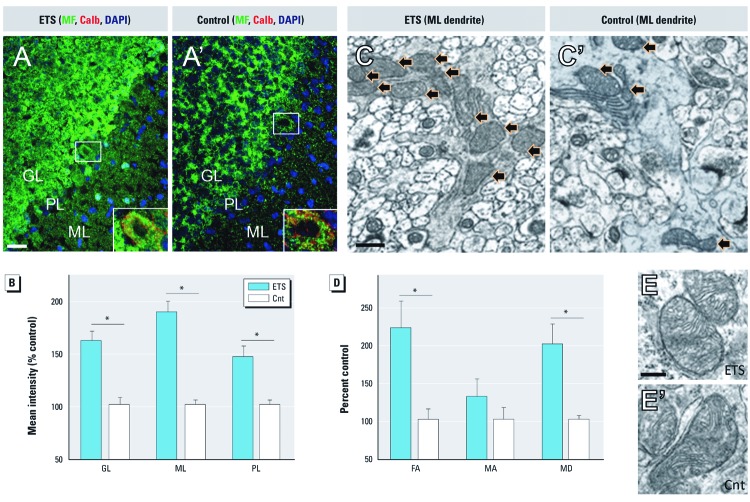
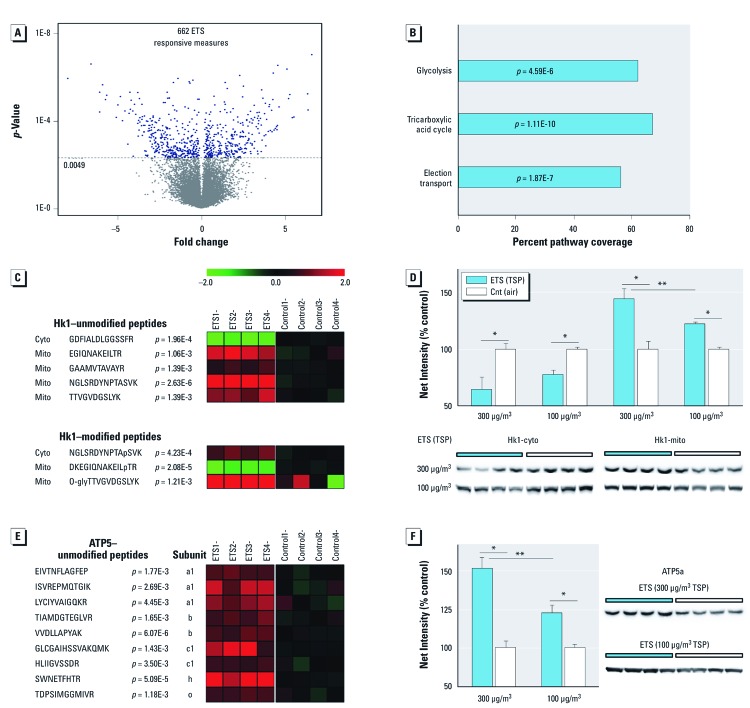
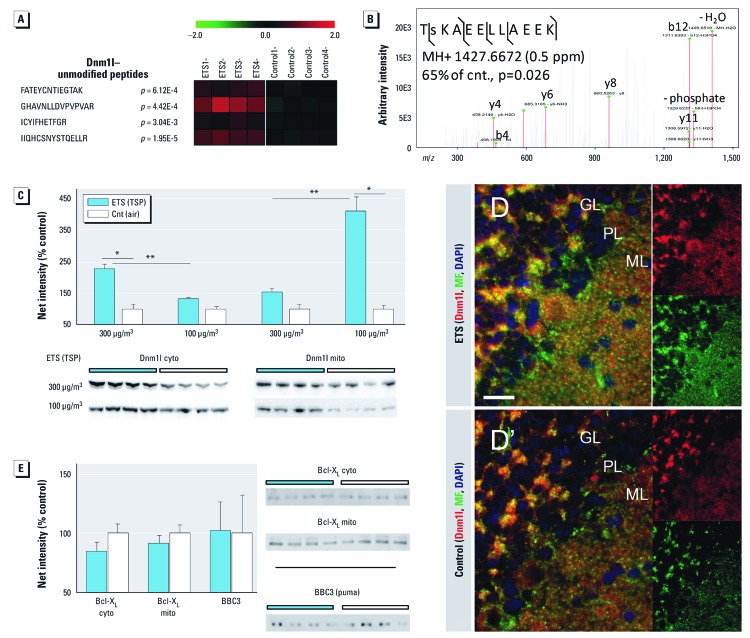
Postnatal ETS exposure induced heightened locomotor response in a novel environment on par initially with amphetamine stimulation. The cerebellar mitochondrial subproteome was significantly perturbed in the ETS-exposed rats. Findings revealed a dose-dependent up-regulation of aerobic processes through the modification and increased translocation of Hk1 to the mitochondrion with corresponding heightened ATP synthase expression. ETS exposure also induced a dose-dependent increase in total Dnm1l mitochondrial fission factor; although more active membrane-bound Dnm1l was found at the lower dose. Dnm1l activation was associated with greater mitochondrial staining, particularly in the molecular layer, which was independent of stress-induced Bcl-2 family dynamics. Further, electron microscopy associated Dnm1l-mediated mitochondrial fission with increased biogenesis, rather than fragmentation.
The critical postnatal period of cerebellar development is vulnerable to the effects of ETS exposure, resulting in altered behavior. The biological effect of ETS is underlain in part by a Dnm1l-mediated mitochondrial energetic response at a time of normally tight control. These findings represent a novel mechanism by which environmental exposure can impact neurodevelopment and function.
环境烟草烟雾(ETS)暴露与发育缺陷和已知小脑受累的疾病有关。然而,直接的生物学效应和潜在的神经化学机制尚不清楚。
我们试图在关键发育期的 ETS 暴露中识别和评估大鼠小脑的潜在神经化学变化。
我们从出生后第 8 天(PD8)到第 23 天每天暴露于 ETS(300、100 和 0 µg/m3 总悬浮颗粒物),然后在行为、神经保护组学和细胞水平上评估反应。
出生后 ETS 暴露会在初始阶段引起新环境中运动反应的增强,与安非他命刺激相当。暴露于 ETS 的大鼠小脑线粒体亚蛋白组受到显著干扰。研究结果表明,通过 Hk1 向线粒体的修饰和增加转位,有氧过程被剂量依赖性地上调,相应地增加了 ATP 合酶的表达。ETS 暴露还导致总 Dnm1l 线粒体裂变因子呈剂量依赖性增加;尽管在较低剂量下发现了更活跃的膜结合 Dnm1l。Dnm1l 激活与更多的线粒体染色相关,特别是在分子层,这与应激诱导的 Bcl-2 家族动力学无关。此外,电子显微镜将 Dnm1l 介导的线粒体裂变与增加的生物发生相关联,而不是碎片化。
小脑发育的关键发育期易受 ETS 暴露的影响,导致行为改变。ETS 的生物学效应部分是由 Dnm1l 介导的线粒体能量反应引起的,而在正常严格控制的时期,这种反应是正常的。这些发现代表了环境暴露可以影响神经发育和功能的一种新机制。