Champion Sports Medicine, Birmingham, Alabama.
Sports Health. 2009 Mar;1(2):131-6. doi: 10.1177/1941738108331201.
The loss of glenohumeral internal rotation range of motion in overhead athletes has been well documented in the literature. Several different methods of assessing this measurement have been described, making comparison between the results of studies difficult.
Significant differences in the amount of internal rotation range of motion exist when using different methods of stabilization.
Descriptive laboratory study.
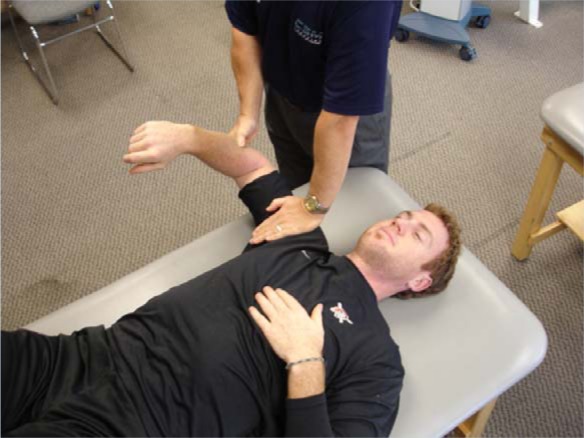
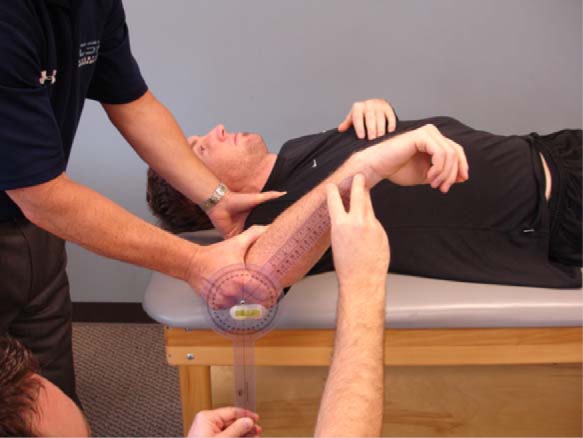
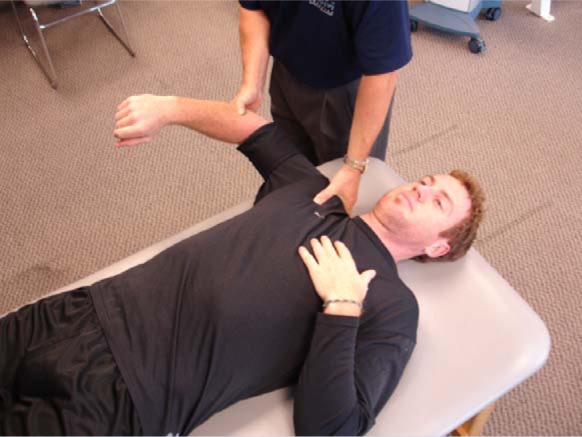
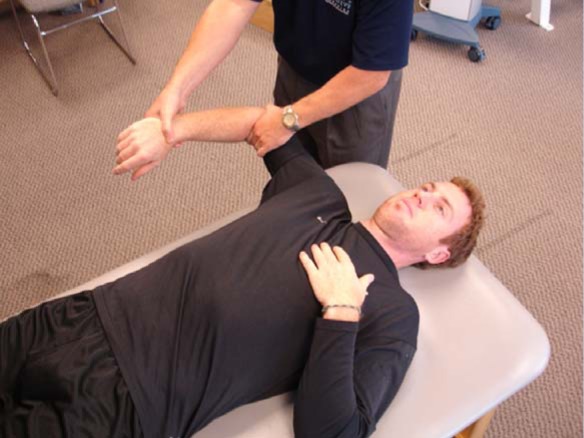
THREE TECHNIQUES WERE USED BILATERALLY IN RANDOM FASHION TO MEASURE GLENOHUMERAL INTERNAL ROTATION RANGE OF MOTION: stabilization of the humeral head, stabilization of the scapula, and visual inspection without stabilization. An initial study on 20 asymptomatic participants was performed to determine the intrarater and interrater reliability for each measurement technique. Once complete, measurements were performed on 39 asymptomatic professional baseball players to determine if a difference existed in measurement techniques and if there was a significant side-to-side difference. A 2-way repeated-measures analysis of variance was used.
While interrater reliability was fair between all 3 methods, scapular stabilization provided the best intrarater reliability. A statistically significant difference was observed between all 3 methods (P < .001). Internal rotation was significantly less in the dominant shoulder than in the nondominant shoulder (P < .001).
Differences in internal rotation range of motion measurements exist when using different methods. The scapula stabilization method displayed the highest intrarater reproducibility and should be considered when evaluating internal rotation passive range of motion of the glenohumeral joint.
A standardized method of measuring internal rotation range of motion is required to accurately compare physical examinations of patients. The authors recommend the use of the scapula stabilization method to assess internal rotation range of motion by allowing normal glenohumeral arthrokinematics while stabilizing the scapulothoracic articulation.
文献中已经充分记录了过顶运动员盂肱关节内旋活动度丧失的情况。已经描述了几种不同的评估这种测量的方法,使得研究结果之间的比较变得困难。
使用不同的稳定化方法,内部旋转活动范围的量存在显著差异。
描述性实验室研究。
三种技术以随机的方式双侧使用来测量盂肱关节内旋活动范围:肱骨头稳定、肩胛稳定和无稳定的视觉检查。对 20 名无症状参与者进行了初步研究,以确定每种测量技术的组内和组间可靠性。完成后,对 39 名无症状的职业棒球运动员进行测量,以确定测量技术是否存在差异,以及是否存在明显的侧别差异。使用双向重复测量方差分析。
虽然所有 3 种方法的组间可靠性都不错,但肩胛稳定法提供了最好的组内可靠性。所有 3 种方法之间均存在统计学显著差异(P <.001)。优势肩的内旋明显小于非优势肩(P <.001)。
使用不同的方法,内部旋转活动度的测量值存在差异。在评估盂肱关节的被动内旋活动范围时,肩胛稳定法显示出最高的组内可重复性,应予以考虑。
需要一种标准化的方法来测量内部旋转活动范围,以准确比较患者的体格检查。作者建议使用肩胛稳定法来评估内旋活动范围,通过允许正常的盂肱关节运动学,同时稳定肩胛胸关节。