Department of Psychiatry, Faculty of Medicine, Chiang Mai University, Chiang Mai, Thailand.
BMC Psychiatry. 2012 Sep 27;12:160. doi: 10.1186/1471-244X-12-160.
Schizophrenia and bipolar depression trials suggest that quetiapine may have an antidepressant effect.
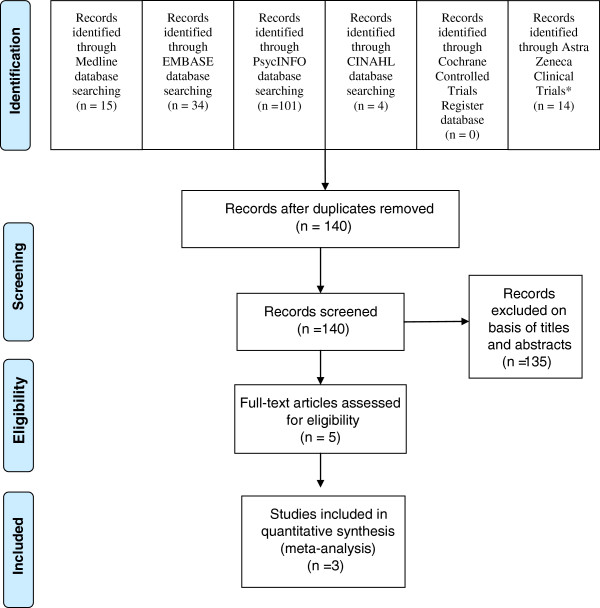
This meta-analysis aimed to determine the efficacy, acceptability and tolerability of quetiapine treatment for major depressive disorder (MDD). Only the randomized controlled trials (RCTs) comparison between quetiapine and placebo were included. The authors searched such clinical trials carried out between 1991 and February 2012.
MEDLINE, EMBASE, CINHL, PsycINFO and Cochrane Controlled Trials Register were searched in February 2012. Study populations comprised adults with MDD or major depression. STUDY ELIGIBLE CRITERIA, PARTICIPANTS AND INTERVENTIONS: Eligible studies were randomized, placebo-controlled trials of quetiapine monotherapy carried out in adults with MDD and presenting endpoint outcomes relevant to: i) depression severity, ii) response rate, iii) overall discontinuation rate, or iv) discontinuation rate due to adverse events. No language restriction was applied.
All abstracts identified by the electronic searches were examined. The full reports of relevant studies were assessed, and the data of interest were extracted. Based on the Cochrane methods of bias assessment, risks of bias were determined. The studies with two risks or less were included. The efficacy outcomes were the mean change scores of depression rating scales, the overall response rate, and the overall remission rates. The overall discontinuation rate was considered as a measure of acceptability. The discontinuation rate due to adverse events was a measure of tolerability. Relative risks (RRs) and weighted mean differences (WMDs) with 95% confidence intervals (CIs) were computed by using a random effect model.
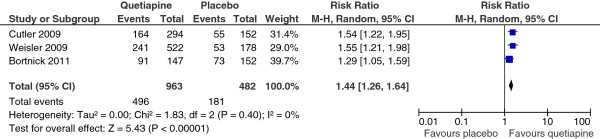
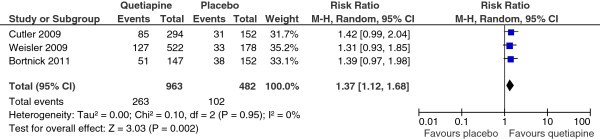
A total of 1,497 participants in three RCTs were included. All trials examined the quetiapine extended-release (XR). The pooled mean change scores of the Montgomery-Asberg Depression Rating Scale (MADRS) and the Hamilton Depression Rating Scale (HAM-D) of the quetiapine-treated group were higher than those of the placebo-treated group with the WMDs (95%CI) of -3.37 (-3.95, -2.79) and -2.46 (-3.47, -1.45), respectively. All studies defined the response and remission as ≥ 50% reduction of the MADRS total score and the MADRS total score of ≤8 at endpoint, respectively. The overall response and remission rates were significantly greater in the quetiapine-treated group with RRs (95%CIs) of 1.44 (1.26, 1.64) and 1.37 (1.12, 1.68), respectively. The pooled discontinuation rate was not significantly different between groups with an RR (95%CI) of 1.16 (0.97, 1.39). The pooled discontinuation rate due to adverse event was greater in the quetiapine group with an RR (95%CI) of 2.90 (1.87, 4.48). With respect to sleep time, the pooled mean change Pittsburgh Sleep Quality Index (PSQI) scores of the quetiapine-treated group was also significantly higher than that of the placebo-treated group [WMD (95%CI) of -1.21 (-1.81, -0.61)].
Variety of quetiapine XR doses and the small number of RCTs were key limitations of this meta-analysis.
Based on the limited evidence obtained from three RCTs, quetiapine XR is effective for adult patients with MDD. The high dropout rate due to adverse events suggests that some MDD patients may not be able to tolerate quetiapine XR. Due to the balance of its efficacy benefit and risk of side effects, as the overall discontinuation rate shown, the acceptability of this agent is not more than placebo. These results should be viewed as the very preliminary one. Further studies in this area are warranted. IMPLICATION OF KEY FINDINGS: Quetiapine may be an alternative antidepressant. However, both risk and benefit of this agent should be taken into account for an individual patient with MDD.
精神分裂症和双相抑郁症试验表明喹硫平可能具有抗抑郁作用。
本荟萃分析旨在确定喹硫平治疗重性抑郁障碍(MDD)的疗效、可接受性和耐受性。仅纳入了喹硫平与安慰剂的随机对照试验(RCT)比较。作者于 2012 年 2 月检索了 1991 年至 2012 年 2 月开展的此类临床试验。
检索了 MEDLINE、EMBASE、CINHL、PsycINFO 和 Cochrane 对照试验登记处,检索日期为 2012 年 2 月。研究人群包括 MDD 或重性抑郁症的成年人。
研究入选标准、参与者和干预措施:合格的研究是喹硫平单药治疗的随机、安慰剂对照试验,适用于以下终点结果:i)抑郁严重程度,ii)反应率,iii)整体停药率,或 iv)因不良事件而停药率。未应用语言限制。
对电子检索识别出的所有摘要进行了检查。评估了相关研究的完整报告,并提取了感兴趣的数据。基于 Cochrane 偏倚评估方法,确定了偏倚风险。纳入了风险为两项或更少的研究。疗效结果为抑郁评定量表的平均变化分数、总反应率和总缓解率。整体停药率被认为是可接受性的衡量标准。因不良事件而停药率是耐受性的衡量标准。采用随机效应模型计算相对风险(RR)和加权均数差(WMD)及 95%置信区间(CI)。
共有来自三项 RCT 的 1497 名参与者纳入分析。所有试验均检测了喹硫平缓释制剂(XR)。喹硫平治疗组的蒙哥马利-阿斯伯格抑郁评定量表(MADRS)和汉密尔顿抑郁评定量表(HAM-D)的平均变化评分均高于安慰剂治疗组,WMD(95%CI)分别为-3.37(-3.95,-2.79)和-2.46(-3.47,-1.45)。所有研究均将反应和缓解定义为 MADRS 总分降低≥50%和 MADRS 总分在终点时≤8。喹硫平治疗组的总体反应和缓解率均显著高于安慰剂组,RR(95%CI)分别为 1.44(1.26,1.64)和 1.37(1.12,1.68)。两组的停药率无显著差异,RR(95%CI)为 1.16(0.97,1.39)。因不良事件而停药的发生率喹硫平组较高,RR(95%CI)为 2.90(1.87,4.48)。关于睡眠时间,喹硫平治疗组匹兹堡睡眠质量指数(PSQI)的平均变化评分也显著高于安慰剂组[WMD(95%CI)为-1.21(-1.81,-0.61)]。
这项荟萃分析的主要局限性是喹硫平 XR 剂量的多样性和 RCT 数量少。
基于三项 RCT 获得的有限证据,喹硫平 XR 对 MDD 成年患者有效。由于不良事件导致的高停药率表明,一些 MDD 患者可能无法耐受喹硫平 XR。由于其疗效获益与副作用风险的平衡,如总体停药率所示,该药物的可接受性并不优于安慰剂。这些结果应被视为初步结果。在这一领域需要进一步的研究。
喹硫平可能是一种替代的抗抑郁药。然而,对于患有 MDD 的个体患者,应考虑该药物的风险和益处。