Shahiduzzaman Md, Coombs Kevin M
Department of Medical Microbiology, Faculty of Medicine, University of Manitoba Winnipeg, MB, Canada ; Manitoba Centre for Proteomics & Systems Biology Winnipeg, MB, Canada ; Department of Parasitology, Bangladesh Agricultural University Mymensingh, Bangladesh.
Front Microbiol. 2012 Aug 22;3:308. doi: 10.3389/fmicb.2012.00308. eCollection 2012.
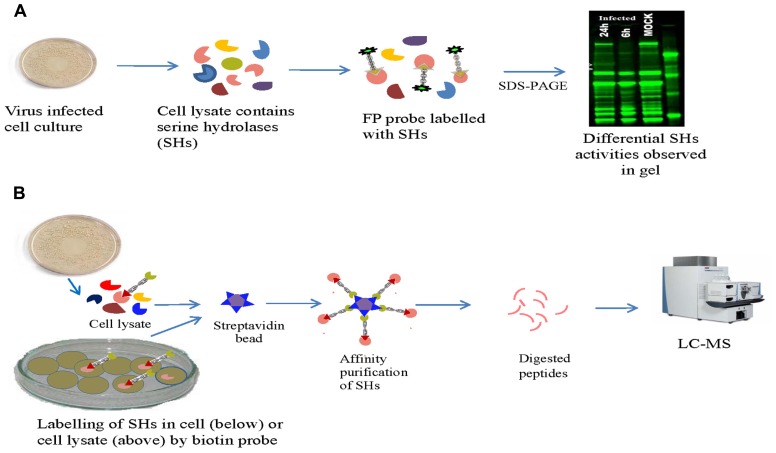
Activity-based protein profiling (ABPP) is a newly emerging technique that uses active site-directed probes to monitor the functional status of enzymes. Serine hydrolases are one of the largest families of enzymes in mammals. More than 200 serine hydrolases have been identified, but little is known about their specific roles. Serine hydrolases are involved in a variety of physiological functions, including digestion, immune response, blood coagulation, and reproduction. ABPP has been used recently to investigate host-virus interactions and to understand the molecular pathogenesis of virus infections. Monitoring the altered serine hydrolases during viral infection gives insight into the catalytic activity of these enzymes that will help to identify novel targets for diagnostic and therapeutic application. This review presents the usefulness of ABPP in detecting and analyzing functional annotation of host cell serine hydrolases as a result of host-virus interaction.
基于活性的蛋白质谱分析(ABPP)是一种新兴技术,它使用活性位点导向探针来监测酶的功能状态。丝氨酸水解酶是哺乳动物中最大的酶家族之一。已经鉴定出200多种丝氨酸水解酶,但对它们的具体作用了解甚少。丝氨酸水解酶参与多种生理功能,包括消化、免疫反应、血液凝固和生殖。最近,ABPP已被用于研究宿主-病毒相互作用,并了解病毒感染的分子发病机制。监测病毒感染期间丝氨酸水解酶的变化,有助于深入了解这些酶的催化活性,从而有助于识别诊断和治疗应用的新靶点。本综述介绍了ABPP在检测和分析宿主-病毒相互作用导致的宿主细胞丝氨酸水解酶功能注释方面的作用。