Department of Endocrinology, Ghent University Hospital, Ghent, Belgium.
PLoS One. 2012;7(9):e45145. doi: 10.1371/journal.pone.0045145. Epub 2012 Sep 28.
Lipotoxicity is a risk factor for developing obesity-related metabolic complications, including non-alcoholic fatty liver disease, type 2 diabetes (DM2), cardiovascular disease and stroke. Yet, the mechanisms underlying the development of lipotoxicity itself remain poorly understood. Here, we investigated whether glucose intolerance aggravates lipotoxicity by evaluating the association between triglyceride (TG) concentrations and glucose tolerance status in a cross-sectional study on obese Caucasian women at risk for DM2.
913 obese females unknown to have diabetes were recruited (mean age: 41.2 ± SD 12.3; median BMI: 36.2, IQR 32.9-40.2). Visceral (VAT) and subcutaneous abdominal adipose tissue volumes were quantified with computed tomography. Glucose, insulin, and triglyceride concentrations were determined in fasting state and following a 75 gram oral glucose tolerance test.
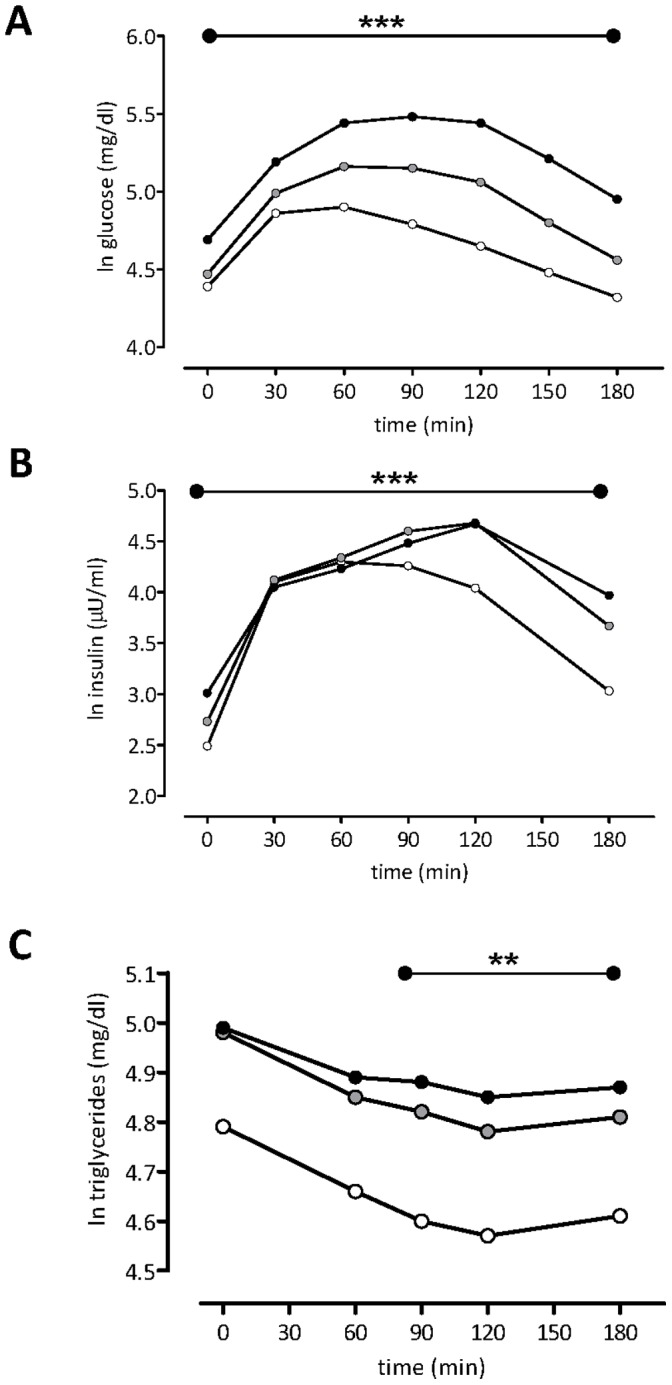
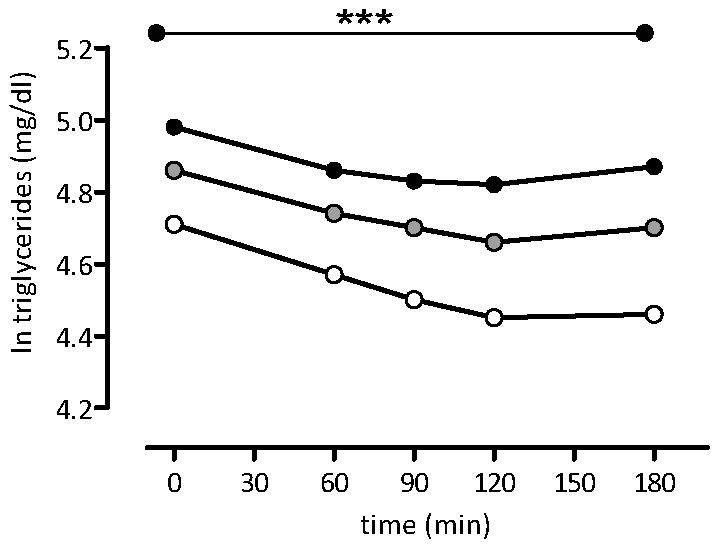
Based on fasting and 2 h post-load glucose levels, 27% of the women had impaired glucose tolerance (IGT), and 8% had newly diagnosed DM2. Fasting TG concentrations were similar between the IGT- and DM2-groups, and increased as compared to women with normal glucose tolerance (NGT). Even when adjusting for age, hip circumference and VAT, fasting TG concentrations remained elevated as compared to NGT. Mixed modelling analysis of post-load responses showed that TG concentrations declined more slowly in the DM2-group as compared to IGT and NGT. However, when adjusting for VAT the difference in decline between the glucose tolerance groups disappeared.
Glucose intolerance associates with elevated fasting TG concentrations in obese Caucasian women. We propose that glucose intolerance and increased VAT reduce lipid disposal mechanisms and may accelerate lipotoxicity.
脂毒性是导致肥胖相关代谢并发症的一个风险因素,包括非酒精性脂肪肝、2 型糖尿病(DM2)、心血管疾病和中风。然而,脂毒性本身的发展机制仍知之甚少。在这里,我们通过评估甘油三酯(TG)浓度与肥胖的白种女性 2 型糖尿病风险人群葡萄糖耐量状态之间的关系,研究了葡萄糖耐量不良是否会加重脂毒性。
招募了 913 名肥胖且不知道患有糖尿病的女性(平均年龄:41.2±12.3 岁;中位数 BMI:36.2,IQR 32.9-40.2)。使用计算机断层扫描定量测量内脏(VAT)和腹部皮下脂肪组织体积。空腹和 75 克口服葡萄糖耐量试验后测定血糖、胰岛素和甘油三酯浓度。
根据空腹和 2 小时负荷后血糖水平,27%的女性有葡萄糖耐量受损(IGT),8%的女性新诊断为 2 型糖尿病。IGT 组和 DM2 组的空腹甘油三酯浓度相似,且高于葡萄糖耐量正常(NGT)组。即使在校正年龄、臀围和 VAT 后,空腹甘油三酯浓度仍高于 NGT 组。负荷后反应的混合模型分析显示,与 IGT 和 NGT 组相比,DM2 组的 TG 浓度下降更缓慢。然而,当调整 VAT 后,葡萄糖耐量组之间的下降差异消失。
葡萄糖耐量不良与肥胖白种女性空腹甘油三酯浓度升高有关。我们提出,葡萄糖耐量不良和增加的 VAT 降低了脂质清除机制,并可能加速脂毒性。