Division of Medical Biology, Department of Pathology and Medical Biology, University Medical Center Groningen and University of Groningen, Groningen, The Netherlands.
PLoS One. 2012;7(9):e45229. doi: 10.1371/journal.pone.0045229. Epub 2012 Sep 13.
Both nonclassical and intermediate monocytes have been implicated in different inflammatory conditions. We hypothesized that these monocytes would increase during pregnancy, a condition associated with generalized activation of inflammatory responses and that they would increase even more during preeclampsia, in which inflammatory responses are further stimulated. In the present study we investigated changes in monocyte subsets during healthy pregnancy and preeclampsia in humans and rats.
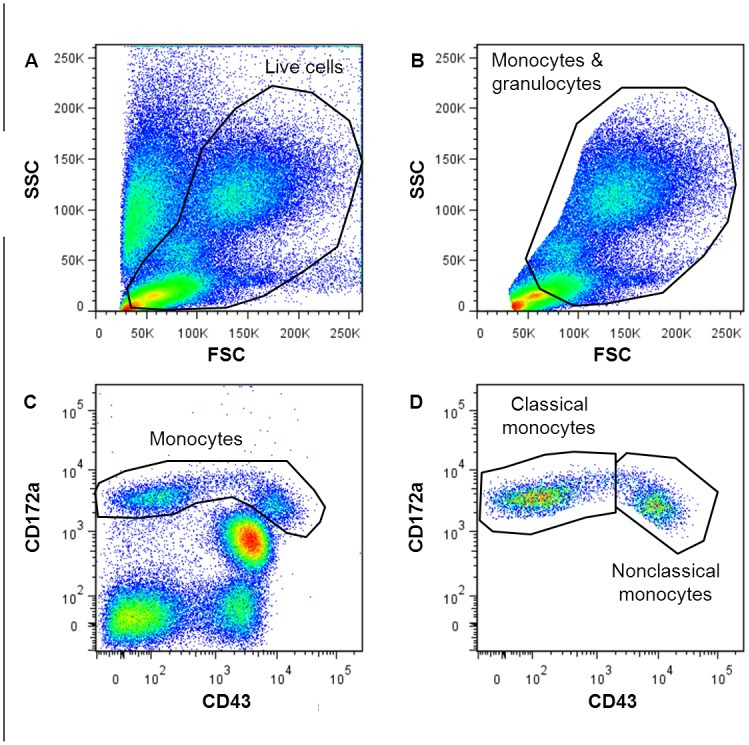
Blood monocyte subsets of nonpregnant, preeclamptic and healthy pregnant women were identified with CD14 and CD16. In nonpregnant and pregnant rats, blood monocytes were identified with CD172a and CD43, as well as in rats infused with adenosine triphosphate (ATP), a pro-inflammatory stimulus known to induce preeclampsia-like symptoms. Total and CD206-positive macrophages were quantified in placentas of these animals.
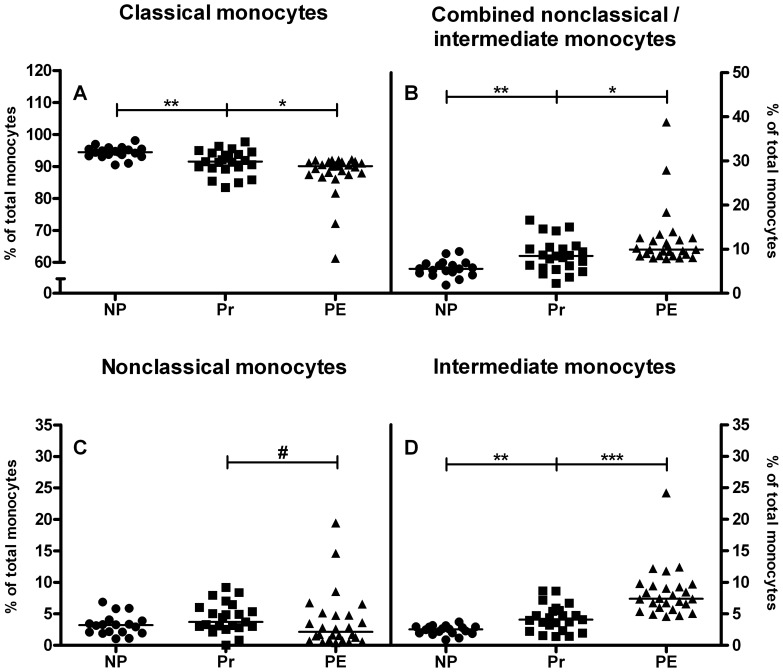
Lower percentages of classical monocytes were found in pregnant women (91%-[83-98%]) compared to nonpregnant women (94%-[90-98%]) and even less in preeclamptic patients (90%-[61-92%]). In contrast, the percentage of combined nonclassical/intermediate monocytes was higher in pregnant women (8.5%-[2.3-16.6%] vs. 5.6%-[1.9-9.5%]) and even higher in preeclamptic patients (9.9%-[7.8-38.7%]), which was caused by a selective increase of intermediate monocytes. In rats, we also found lower percentages of classical monocytes and higher percentages of nonclassical monocytes in pregnant versus nonpregnant rats. ATP infusion increased the percentage of nonclassical monocytes in pregnant rats even further but not in nonpregnant rats. These nonclassical monocytes showed a more activated phenotype in pregnant ATP-infused rats only. Mesometrial triangles of ATP-infused rats had less CD206-positive macrophages as compared to those of saline-infused rats.
The higher percentage of nonclassical/intermediate monocytes found in pregnancy and preeclampsia confirms their association with inflammatory responses. The observation that ATP stimulated numbers/activation of nonclassical monocytes in pregnant rats only, suggests that nonclassical monocytes are specifically altered in pregnancy and may play a role in the pathophysiology of preeclampsia.
非经典和中间单核细胞已被牵连到不同的炎症条件中。我们假设这些单核细胞在怀孕期间会增加,怀孕期间炎症反应普遍被激活,而在子痫前期中,炎症反应会进一步被刺激,这些单核细胞会增加更多。在本研究中,我们调查了人类和大鼠的健康妊娠和子痫前期中单核细胞亚群的变化。
用 CD14 和 CD16 鉴定非妊娠、子痫前期和健康孕妇的血液单核细胞亚群。在非妊娠和妊娠大鼠中,用 CD172a 和 CD43 鉴定血液单核细胞,以及用三磷酸腺苷(ATP)鉴定,ATP 是一种已知的引起子痫前期样症状的促炎刺激物。这些动物胎盘的总和 CD206 阳性巨噬细胞被定量。
与非妊娠妇女(94%-[90-98%])相比,妊娠妇女(91%-[83-98%])中经典单核细胞的百分比较低,而子痫前期患者(90%-[61-92%])中经典单核细胞的百分比甚至更低。相比之下,非经典/中间单核细胞的百分比在妊娠妇女中更高(8.5%-[2.3-16.6%]比 5.6%-[1.9-9.5%]),而在子痫前期患者中更高(9.9%-[7.8-38.7%]),这是由中间单核细胞的选择性增加引起的。在大鼠中,我们也发现与非妊娠大鼠相比,妊娠大鼠中经典单核细胞的百分比较低,而非经典单核细胞的百分比较高。ATP 输注甚至在非妊娠大鼠中进一步增加了妊娠大鼠中非经典单核细胞的百分比。这些非经典单核细胞在妊娠 ATP 输注大鼠中仅显示出更活跃的表型。与盐水输注大鼠相比,ATP 输注大鼠的 mesometrial 三角区的 CD206 阳性巨噬细胞较少。
在妊娠和子痫前期中发现的非经典/中间单核细胞的较高百分比证实了它们与炎症反应的关联。观察到只有在妊娠大鼠中,ATP 刺激非经典单核细胞的数量/激活,表明非经典单核细胞在妊娠中特异性改变,可能在子痫前期的病理生理学中发挥作用。