Department of Medicine, Vanderbilt University School of Medicine, Nashville, Tennessee, USA.
PLoS One. 2012;7(9):e45238. doi: 10.1371/journal.pone.0045238. Epub 2012 Sep 28.
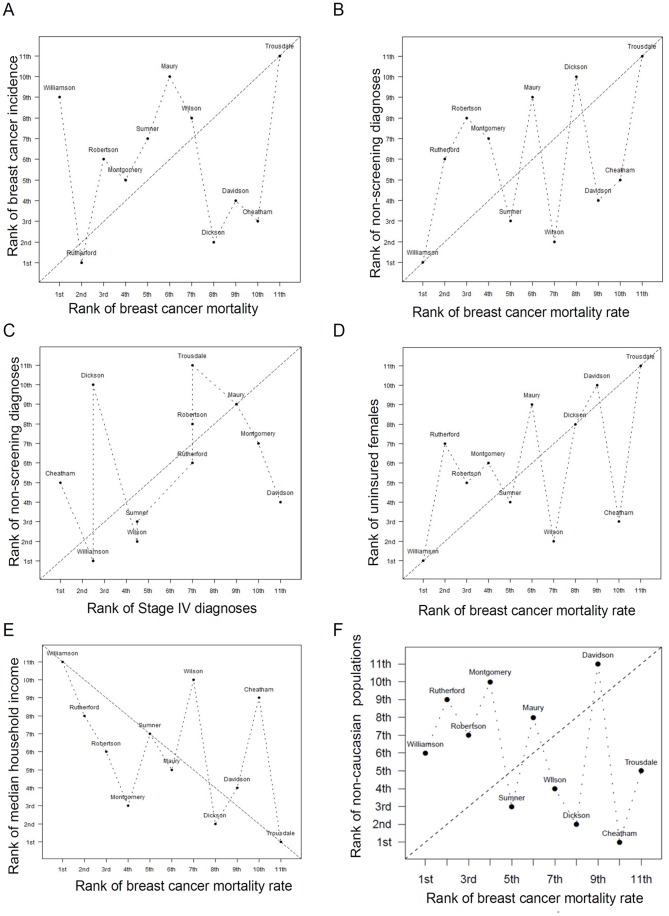
Despite available demographic data on the factors that contribute to breast cancer mortality in large population datasets, local patterns are often overlooked. Such local information could provide a valuable metric by which regional community health resources can be allocated to reduce breast cancer mortality. We used national and statewide datasets to assess geographical distribution of breast cancer mortality rates and known risk factors influencing breast cancer mortality in middle Tennessee. Each county in middle Tennessee, and each ZIP code within metropolitan Davidson County, was scored for risk factor prevalence and assigned quartile scores that were used as a metric to identify geographic areas of need. While breast cancer mortality often correlated with age and incidence, geographic areas were identified in which breast cancer mortality rates did not correlate with age and incidence, but correlated with additional risk factors, such as mammography screening and socioeconomic status. Geographical variability in specific risk factors was evident, demonstrating the utility of this approach to identify local areas of risk. This method revealed local patterns in breast cancer mortality that might otherwise be overlooked in a more broadly based analysis. Our data suggest that understanding the geographic distribution of breast cancer mortality, and the distribution of risk factors that contribute to breast cancer mortality, will not only identify communities with the greatest need of support, but will identify the types of resources that would provide the most benefit to reduce breast cancer mortality in the community.
尽管在大型人群数据集的因素中,有可用的人口统计学数据可以帮助预测乳腺癌死亡率,但通常会忽略当地的模式。这种局部信息可以提供一个有价值的指标,通过该指标可以分配区域社区卫生资源,以降低乳腺癌死亡率。我们使用国家和州数据集来评估田纳西州中部乳腺癌死亡率的地理分布以及影响乳腺癌死亡率的已知风险因素。田纳西州中部的每个县,以及戴维森县大都市内的每个邮政编码,都根据风险因素的流行程度进行了评分,并分配了四分位数评分,该评分用作识别有需求的地理区域的指标。虽然乳腺癌死亡率通常与年龄和发病率相关,但我们发现了一些地区,在这些地区,乳腺癌死亡率与年龄和发病率无关,但与其他风险因素(如乳房 X 光筛查和社会经济地位)相关。具体风险因素的地理差异明显,这证明了这种方法识别局部风险区域的有效性。这种方法揭示了乳腺癌死亡率的局部模式,否则在更广泛的分析中可能会被忽略。我们的数据表明,了解乳腺癌死亡率的地理分布以及导致乳腺癌死亡率的风险因素的分布,不仅可以确定最需要支持的社区,还可以确定最有利于减少社区乳腺癌死亡率的资源类型。