Department of Psychiatry, Seoul National University College of Medicine, Korea.
PLoS One. 2012;7(9):e45938. doi: 10.1371/journal.pone.0045938. Epub 2012 Sep 20.
Pathological gambling (PG) and obsessive-compulsive disorder (OCD) are conceptualized as a behavioral addiction, with a dependency on repetitive gambling behavior and rewarding effects following compulsive behavior, respectively. However, no neuroimaging studies to date have examined reward circuitry during the anticipation phase of reward in PG compared with in OCD while considering repetitive gambling and compulsion as addictive behaviors.
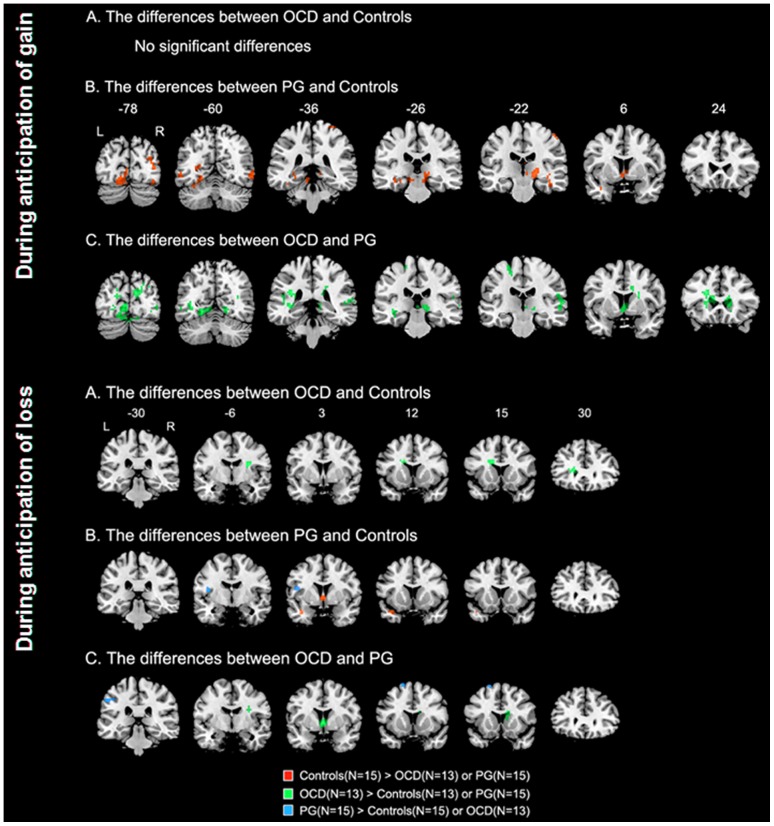
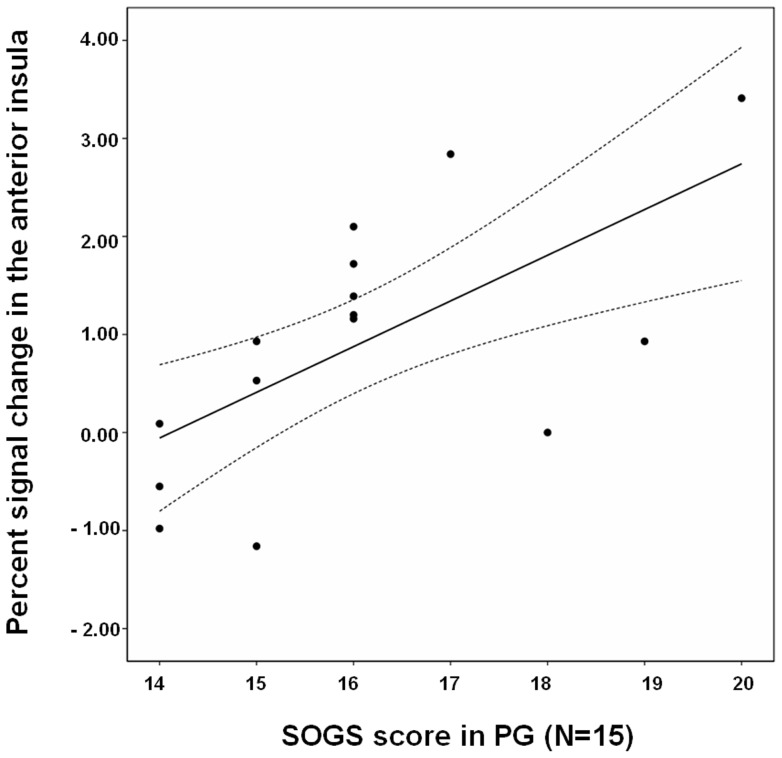
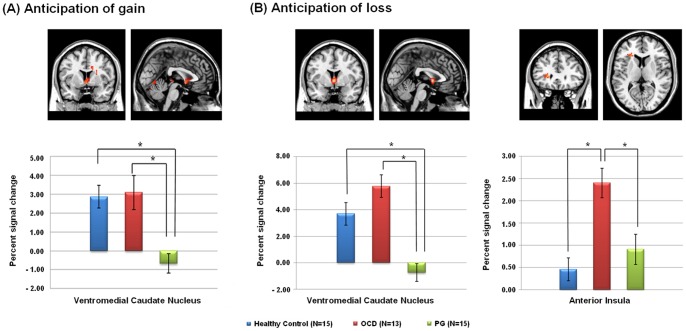
METHODS/PRINCIPAL FINDINGS: To elucidate the neural activities specific to the anticipation phase of reward, we performed event-related functional magnetic resonance imaging (fMRI) in young adults with PG and compared them with those in patients with OCD and healthy controls. Fifteen male patients with PG, 13 patients with OCD, and 15 healthy controls, group-matched for age, gender, and IQ, participated in a monetary incentive delay task during fMRI scanning. Neural activation in the ventromedial caudate nucleus during anticipation of both gain and loss decreased in patients with PG compared with that in patients with OCD and healthy controls. Additionally, reduced activation in the anterior insula during anticipation of loss was observed in patients with PG compared with that in patients with OCD which was intermediate between that in OCD and healthy controls (healthy controls < PG < OCD), and a significant positive correlation between activity in the anterior insula and South Oaks Gambling Screen score was found in patients with PG.
Decreased neural activity in the ventromedial caudate nucleus during anticipation may be a specific neurobiological feature for the pathophysiology of PG, distinguishing it from OCD and healthy controls. Correlation of anterior insular activity during loss anticipation with PG symptoms suggests that patients with PG fit the features of OCD associated with harm avoidance as PG symptoms deteriorate. Our findings have identified functional disparities and similarities between patients with PG and OCD related to the neural responses associated with reward anticipation.
病理性赌博(PG)和强迫症(OCD)被概念化为行为成瘾,分别依赖于重复的赌博行为和强迫行为后的奖励效应。然而,迄今为止,没有神经影像学研究在考虑重复赌博和强迫作为成瘾行为的情况下,比较 PG 与 OCD 患者在奖励预期阶段的奖励回路。
方法/主要发现:为了阐明奖励预期阶段特有的神经活动,我们在年轻的 PG 患者中进行了与事件相关的功能磁共振成像(fMRI),并将其与 OCD 患者和健康对照组进行了比较。15 名男性 PG 患者、13 名 OCD 患者和 15 名健康对照组,年龄、性别和智商相匹配,在 fMRI 扫描期间进行了货币奖励延迟任务。与 OCD 患者和健康对照组相比,PG 患者在预测收益和损失时,腹侧纹状体的神经激活减少。此外,与 OCD 患者相比,PG 患者在预测损失时,前岛叶的激活减少,而与 OCD 患者相比,健康对照组的激活减少(健康对照组<PG<OCD),并且在 PG 患者中,前岛叶的活动与 South Oaks 赌博筛查评分呈显著正相关。
腹侧纹状体在预测时的神经活动减少可能是 PG 病理生理学的特定神经生物学特征,将其与 OCD 和健康对照组区分开来。损失预测期间前岛叶活动与 PG 症状的相关性表明,随着 PG 症状的恶化,PG 患者符合与回避伤害相关的 OCD 特征。我们的研究结果确定了 PG 和 OCD 患者之间与奖励预期相关的神经反应相关的功能差异和相似性。