Department of Pathology, College of Medicine, University of Cincinnati Medical Center, Cincinnati, Ohio, United States of America.
PLoS One. 2012;7(9):e46158. doi: 10.1371/journal.pone.0046158. Epub 2012 Sep 28.
Our previous studies indicated that MSC(CXCR4) improved cardiac function after myocardial infarction (MI). This study was aimed to investigate the specific role of MSC(CXCR4) in neovascularization of infarcted myocardium using a suicide gene approach.
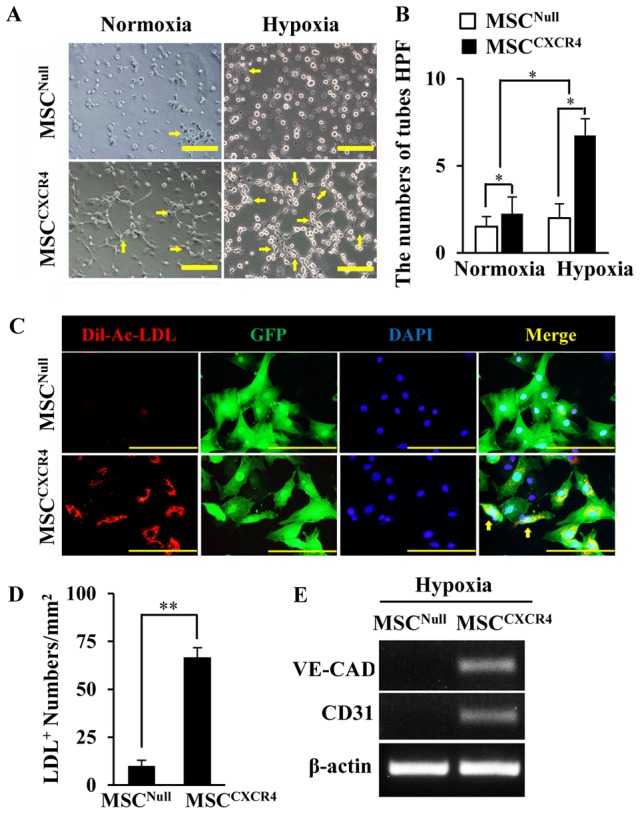
MSCs were transduced with either lentivirus-null vector/GFP (MSC(Null) as control) or vector encoding for overexpressing CXCR4/GFP. The MSC derived-endothelial cell (EC) differentiation was assessed by a tube formation assay, Dil-ac-LDL uptake, EC marker expression, and VE-cadherin promoter activity assay. Gene expression was analyzed by quantitative RT-PCR or Western blot. The suicide gene approach was under the control of VE-cadherin promoter. In vivo studies: Cell patches containing MSC(Null) or MSC(CXCR4) were transduced with suicide gene and implanted into the myocardium of MI rat. Rats received either ganciclovir (GCV) or vehicle after cell implantation. After one month, the cardiac functional changes and neovascularization were assessed by echocardiography, histological analysis, and micro-CT imaging.
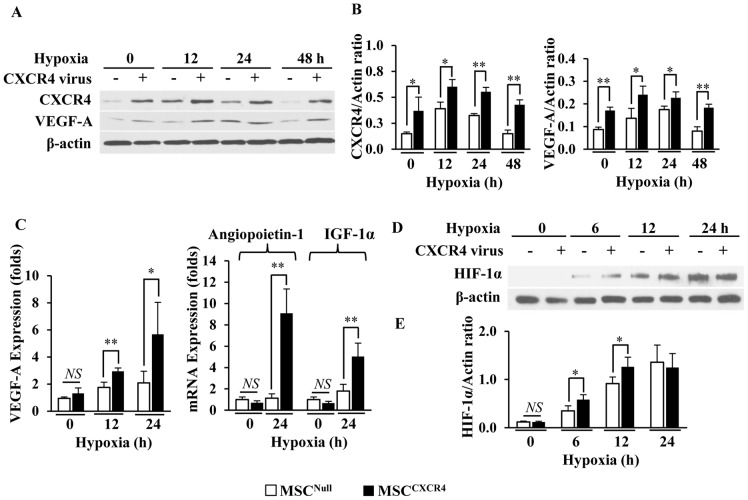
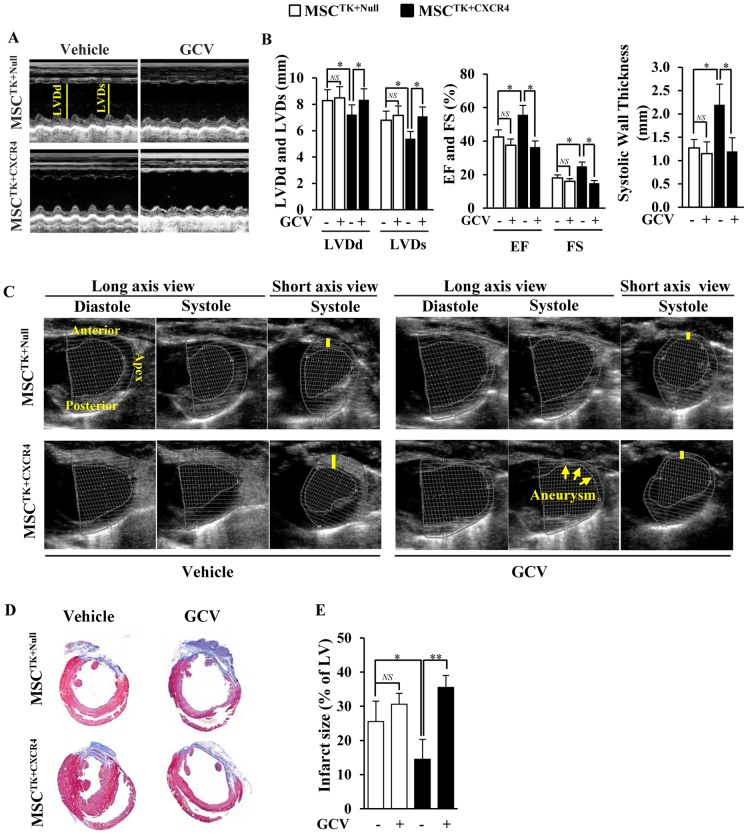
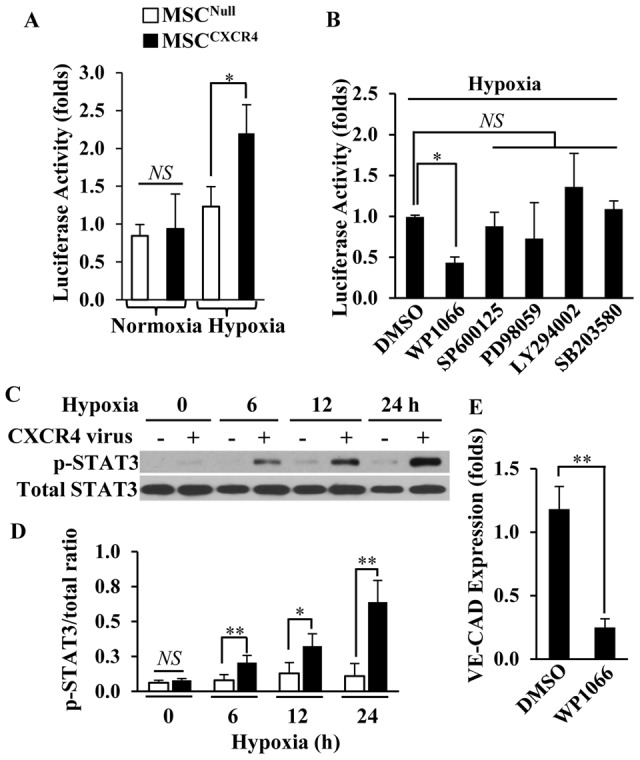
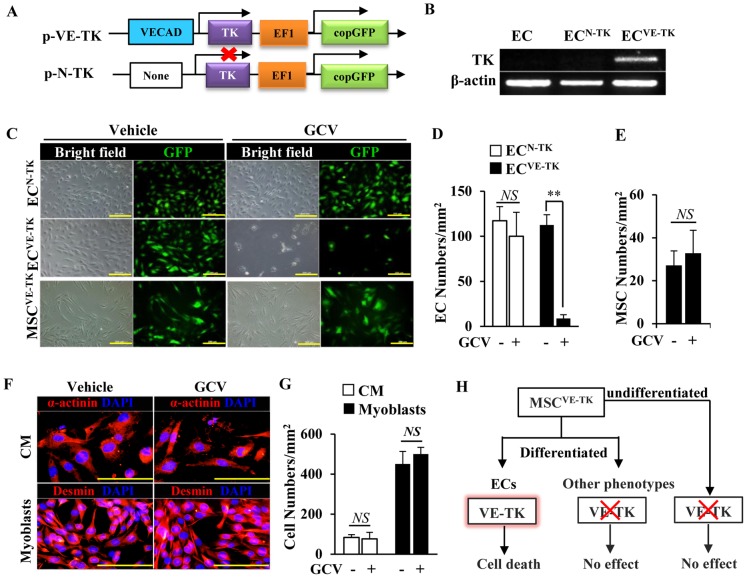
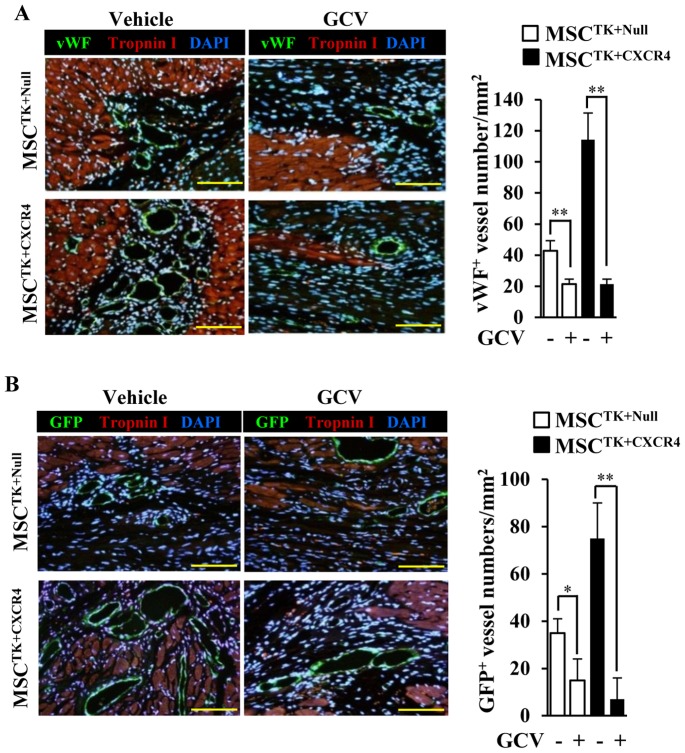
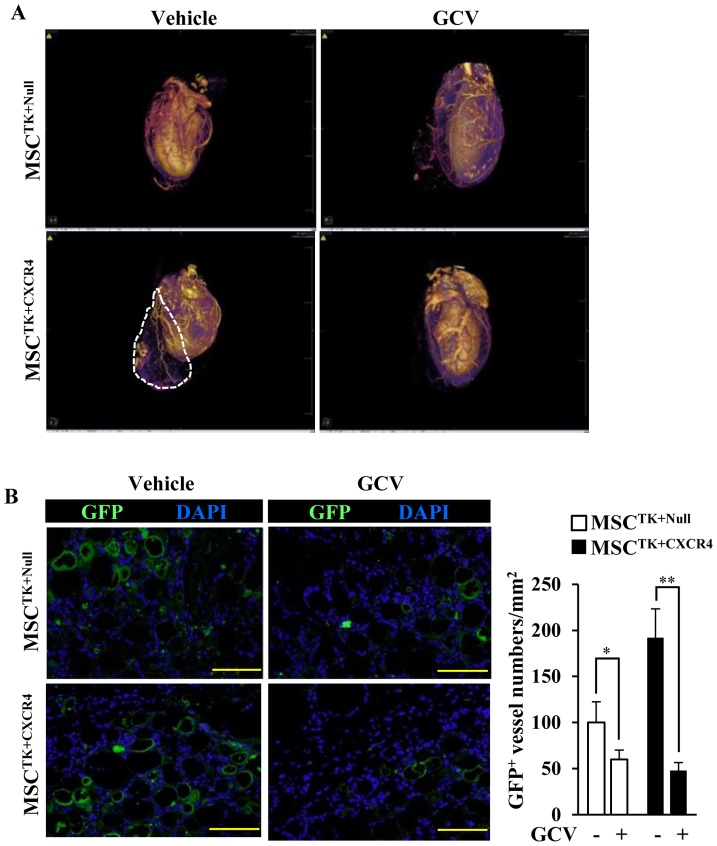
The expression of VEGF-A and HIF-1α was significantly higher in MSC(CXCR4) as compared to MSC(Null) under hypoxia. Additionally, MSC(CXCR4) enhanced new vessel formation and EC differentiation, as well as STAT3 phosphorylation under hypoxia. STAT3 participated in the transcription of VE-cadherin in MSC(CXCR4) under hypoxia, which was inhibited by WP1066 (a STAT3 inhibitor). In addition, GCV specifically induced death of ECs with suicide gene activation. In vivo studies: MSC(CXCR4) implantation promoted cardiac functional restoration, reduced infarct size, improved cardiac remodeling, and enhanced neovascularization in ischemic heart tissue. New vessels derived from MSC(CXCR4) were observed at the injured heart margins and communicated with native coronary arteries. However, the derived vessel networks were reduced by GCV, reversing improvement of cardiac function.
The transplanted MSC(CXCR4) enhanced neovascularization after MI by boosting release of angiogenic factors and increasing the potential of endothelial differentiation.
我们之前的研究表明 MSC(CXCR4)可改善心肌梗死(MI)后的心脏功能。本研究旨在通过自杀基因方法探讨 MSC(CXCR4)在梗死心肌新生血管形成中的具体作用。
通过慢病毒空载体/GFP(MSC(Null)作为对照)或载体转染过表达 CXCR4/GFP 的 MSC。通过管形成试验、Dil-ac-LDL 摄取、内皮细胞标志物表达和 VE-cadherin 启动子活性测定评估 MSC 衍生的内皮细胞(EC)分化。通过定量 RT-PCR 或 Western blot 分析基因表达。自杀基因方法受 VE-cadherin 启动子控制。体内研究:将含有 MSC(Null)或 MSC(CXCR4)的细胞片用自杀基因转导后植入 MI 大鼠的心肌中。细胞植入后,大鼠接受更昔洛韦(GCV)或载体。一个月后,通过超声心动图、组织学分析和 micro-CT 成像评估心脏功能变化和新生血管形成。
与 MSC(Null)相比,缺氧时 MSC(CXCR4)中 VEGF-A 和 HIF-1α 的表达明显更高。此外,缺氧下 MSC(CXCR4)增强了新血管形成和 EC 分化,以及 STAT3 磷酸化。STAT3 参与了缺氧下 MSC(CXCR4)中 VE-cadherin 的转录,WP1066(STAT3 抑制剂)抑制了这一转录。此外,GCV 可通过自杀基因激活特异性诱导 EC 死亡。体内研究:MSC(CXCR4)植入可促进心脏功能恢复、减少梗死面积、改善心脏重构,并增强缺血心肌组织中的新生血管形成。在受伤的心脏边缘观察到源自 MSC(CXCR4)的新血管,并与原生冠状动脉相通。然而,GCV 减少了衍生的血管网络,逆转了心脏功能的改善。
移植的 MSC(CXCR4)通过增加血管生成因子的释放和增加内皮分化的潜力,增强 MI 后的新生血管形成。