• 文献检索
  • 文档翻译
  • 深度研究
  • 学术资讯
  • Suppr Zotero 插件Zotero 插件
  • 邀请有礼
  • 套餐&价格
  • 历史记录
应用&插件
Suppr Zotero 插件Zotero 插件浏览器插件Mac 客户端Windows 客户端微信小程序
定价
高级版会员购买积分包购买API积分包
服务
文献检索文档翻译深度研究API 文档MCP 服务
关于我们
关于 Suppr公司介绍联系我们用户协议隐私条款
关注我们

Suppr 超能文献

核心技术专利:CN118964589B侵权必究
粤ICP备2023148730 号-1Suppr @ 2026

文献检索

告别复杂PubMed语法,用中文像聊天一样搜索,搜遍4000万医学文献。AI智能推荐,让科研检索更轻松。

立即免费搜索

文件翻译

保留排版,准确专业,支持PDF/Word/PPT等文件格式,支持 12+语言互译。

免费翻译文档

深度研究

AI帮你快速写综述,25分钟生成高质量综述,智能提取关键信息,辅助科研写作。

立即免费体验

在神经损伤患者的虚拟训练环境中可视化第三维:有益还是有干扰?

Visualizing the third dimension in virtual training environments for neurologically impaired persons: beneficial or disruptive?

机构信息

Game Experience Lab, Human Technology Interaction group, Eindhoven University of Technology, PO Box 513, Eindhoven, 5600MB, The Netherlands.

出版信息

J Neuroeng Rehabil. 2012 Oct 5;9:73. doi: 10.1186/1743-0003-9-73.

DOI:10.1186/1743-0003-9-73
PMID:23036010
原文链接:https://pmc.ncbi.nlm.nih.gov/articles/PMC3548715/
Abstract

BACKGROUND

Many contemporary systems for neurorehabilitation utilize 3D virtual environments (VEs) that allow for training patients' hand or arm movements. In the current paper we comparatively test the effectiveness of two characteristics of VEs in rehabilitation training when utilizing a 3D haptic interaction device: Stereo Visualization (monoscopic vs stereoscopic image presentation) and Graphic Environment (2.5D vs 3D).

METHOD

An experimental study was conducted using a factorial within-subjects design. Patients (10 MS, 8 CVA) completed three tasks, each including a specific arm-movement along one of three directional axes (left-right, up-down and forward-backward).

RESULTS

The use of stereoscopy within a virtual training environment for neurorehabilitation of CVA and MS patients is most beneficial when the task itself requires movement in depth. Further, the 2.5D environment yields the highest efficiency and accuracy in terms of patients' movements. These findings were, however, dependent on participants' stereoscopic ability.

CONCLUSION

Despite the performance benefits of stereoscopy, our findings illustrate the non-triviality of choices of using stereoscopy, and the type of graphic environment implemented. These choices should be made with the task and target group, and even the individual patient in mind.

摘要

背景

许多现代神经康复系统都利用 3D 虚拟环境(VE)来训练患者的手部或手臂运动。在目前的研究中,我们使用 3D 触觉交互设备,比较测试了 VE 中两种特性在康复训练中的有效性:立体视觉(单目与立体图像呈现)和图形环境(2.5D 与 3D)。

方法

采用完全随机实验设计,对 10 名 MS 患者和 8 名 CVA 患者进行了一项实验研究。患者完成了三个任务,每个任务都包括沿着三个方向轴(左右、上下和前后)中的一个特定手臂运动。

结果

对于 CVA 和 MS 患者的神经康复,在虚拟训练环境中使用立体视觉最有益于需要深度运动的任务。此外,2.5D 环境在患者运动的效率和准确性方面表现最佳。然而,这些发现取决于参与者的立体视觉能力。

结论

尽管立体视觉具有性能优势,但我们的研究结果表明,选择使用立体视觉以及实施的图形环境类型具有一定的复杂性。在选择时,应考虑任务、目标人群,甚至是个体患者的特点。
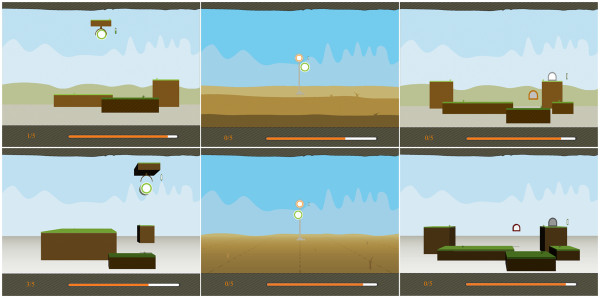
https://cdn.ncbi.nlm.nih.gov/pmc/blobs/e0c4/3548715/27e50e5d7c08/1743-0003-9-73-1.jpg

相似文献

1
Visualizing the third dimension in virtual training environments for neurologically impaired persons: beneficial or disruptive?在神经损伤患者的虚拟训练环境中可视化第三维:有益还是有干扰?
J Neuroeng Rehabil. 2012 Oct 5;9:73. doi: 10.1186/1743-0003-9-73.
2
Robot-supported upper limb training in a virtual learning environment : a pilot randomized controlled trial in persons with MS.虚拟学习环境中机器人辅助上肢训练:一项针对多发性硬化症患者的试点随机对照试验
J Neuroeng Rehabil. 2015 Jul 23;12:60. doi: 10.1186/s12984-015-0043-3.
3
Neurorehabilitation using the virtual reality based Rehabilitation Gaming System: methodology, design, psychometrics, usability and validation.基于虚拟现实的康复游戏系统的神经康复:方法学、设计、心理计量学、可用性和验证。
J Neuroeng Rehabil. 2010 Sep 22;7:48. doi: 10.1186/1743-0003-7-48.
4
Viewing medium affects arm motor performance in 3D virtual environments.观看媒介会影响 3D 虚拟环境中的手臂运动表现。
J Neuroeng Rehabil. 2011 Jun 30;8:36. doi: 10.1186/1743-0003-8-36.
5
Virtual reality to maximize function for hand and arm rehabilitation: exploration of neural mechanisms.虚拟现实用于最大限度地促进手部和手臂康复功能:神经机制探索
Stud Health Technol Inform. 2009;145:109-25.
6
Functional electrical stimulation mediated by iterative learning control and 3D robotics reduces motor impairment in chronic stroke.迭代学习控制和 3D 机器人介导的功能性电刺激可减少慢性中风的运动障碍。
J Neuroeng Rehabil. 2012 Jun 7;9:32. doi: 10.1186/1743-0003-9-32.
7
Skill transfer from symmetric and asymmetric bimanual training using a robotic system to single limb performance.从使用机器人系统的对称和非对称双手训练到单肢性能的技能转移。
J Neuroeng Rehabil. 2012 Jul 17;9:43. doi: 10.1186/1743-0003-9-43.
8
Towards functional robotic training: motor learning of dynamic tasks is enhanced by haptic rendering but hampered by arm weight support.迈向功能性机器人训练:触觉渲染可增强动态任务的运动学习,但会受到手臂重量支撑的阻碍。
J Neuroeng Rehabil. 2022 Feb 13;19(1):19. doi: 10.1186/s12984-022-00993-w.
9
Kinematics of reaching movements in a 2-D virtual environment in adults with and without stroke.成人脑卒中患者与非脑卒中患者在二维虚拟环境中进行伸展运动的运动学分析。
IEEE Trans Neural Syst Rehabil Eng. 2012 Nov;20(6):778-87. doi: 10.1109/TNSRE.2012.2206117. Epub 2012 Aug 14.
10
Representation of virtual arm movements in precuneus.顶下小叶中虚拟手臂运动的表象。
Exp Brain Res. 2011 Feb;208(4):543-55. doi: 10.1007/s00221-010-2503-0. Epub 2010 Dec 25.

引用本文的文献

1
Influence of virtual reality and task complexity on digital health metrics assessing upper limb function.虚拟现实和任务复杂性对上肢功能数字健康指标的影响。
J Neuroeng Rehabil. 2024 Jul 27;21(1):125. doi: 10.1186/s12984-024-01413-x.
2
The Use of the Term Virtual Reality in Post-Stroke Rehabilitation: A Scoping Review and Commentary.虚拟现实技术在中风后康复中的应用:一项范围综述与评论
Psychol Belg. 2021 Jun 3;61(1):145-162. doi: 10.5334/pb.1033.
3
Development of Activity-Related Muscle Fatigue during Robot-Mediated Upper Limb Rehabilitation Training in Persons with Multiple Sclerosis: A Pilot Trial.

本文引用的文献

1
Development of a 3D immersive videogame to improve arm-postural coordination in patients with TBI.开发一款 3D 沉浸式视频游戏,以提高 TBI 患者的手臂姿势协调性。
J Neuroeng Rehabil. 2011 Oct 31;8:61. doi: 10.1186/1743-0003-8-61.
2
The Armeo Spring as training tool to improve upper limb functionality in multiple sclerosis: a pilot study.Armeo Spring 作为一种训练工具,可改善多发性硬化症患者的上肢功能:一项初步研究。
J Neuroeng Rehabil. 2011 Jan 24;8:5. doi: 10.1186/1743-0003-8-5.
3
Robot-assisted therapy for long-term upper-limb impairment after stroke.
多发性硬化症患者在机器人介导的上肢康复训练中与活动相关的肌肉疲劳的发展:一项试点试验。
Mult Scler Int. 2015;2015:650431. doi: 10.1155/2015/650431. Epub 2015 May 24.
4
Adaptive personalized training games for individual and collaborative rehabilitation of people with multiple sclerosis.用于多发性硬化症患者个体及协作康复的适应性个性化训练游戏
Biomed Res Int. 2014;2014:345728. doi: 10.1155/2014/345728. Epub 2014 May 28.
机器人辅助治疗脑卒中后长期上肢功能障碍。
N Engl J Med. 2010 May 13;362(19):1772-83. doi: 10.1056/NEJMoa0911341. Epub 2010 Apr 16.
4
Robot-based rehabilitation of the upper limbs in multiple sclerosis: feasibility and preliminary results.基于机器人的多发性硬化症上肢康复:可行性及初步结果
J Rehabil Med. 2009 Nov;41(12):966-70. doi: 10.2340/16501977-0401.
5
Sensorimotor training in virtual reality: a review.虚拟现实中的感觉运动训练:综述
NeuroRehabilitation. 2009;25(1):29-44. doi: 10.3233/NRE-2009-0497.
6
Arm and hand skills: training preferences after stroke.手臂和手部技能:中风后的训练偏好
Disabil Rehabil. 2009;31(16):1344-52. doi: 10.1080/09638280902823664.
7
The effect of the GENTLE/s robot-mediated therapy system on arm function after stroke.GENTLE/s机器人介导治疗系统对中风后手臂功能的影响。
Clin Rehabil. 2008 May;22(5):395-405. doi: 10.1177/0269215507085060.
8
Stroke and visual rehabilitation.中风与视觉康复。
Top Stroke Rehabil. 2008 Jan-Feb;15(1):27-36. doi: 10.1310/tsr1501-27.
9
Effects of robot-assisted therapy on upper limb recovery after stroke: a systematic review.机器人辅助治疗对中风后上肢恢复的影响:一项系统评价。
Neurorehabil Neural Repair. 2008 Mar-Apr;22(2):111-21. doi: 10.1177/1545968307305457. Epub 2007 Sep 17.
10
Game design in virtual reality systems for stroke rehabilitation.用于中风康复的虚拟现实系统中的游戏设计。
Stud Health Technol Inform. 2007;125:146-8.