Polymer Program, Institute of Materials Science, University of Connecticut, Storrs, CT 06269-3136.
Biorasis Inc. Technology Incubation Program, University of Connecticut, Storrs, CT 06269-4213.
Anal Chem. 2012 Oct 16;84(20):8837-8845. doi: 10.1021/ac3022423. Epub 2012 Oct 5.
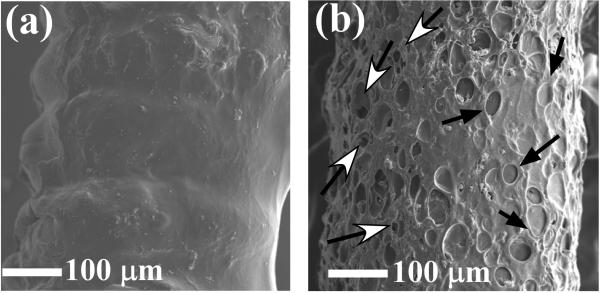
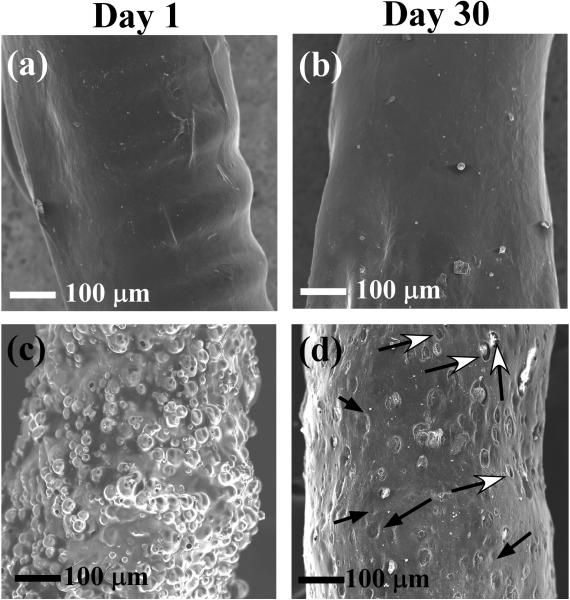
Biofouling and tissue inflammation present major challenges toward the realization of long-term implantable glucose sensors. Following sensor implantation, proteins and cells adsorb on sensor surfaces to not only inhibit glucose flux but also signal a cascade of inflammatory events that eventually lead to permeability-reducing fibrotic encapsulation. The use of drug-eluting hydrogels as outer sensor coatings has shown considerable promise to mitigate these problems via the localized delivery of tissue response modifiers to suppress inflammation and fibrosis, along with reducing protein and cell absorption. Biodegradable poly (lactic-co-glycolic) acid (PLGA) microspheres, encapsulated within a poly (vinyl alcohol) (PVA) hydrogel matrix, present a model coating where the localized delivery of the potent anti-inflammatory drug dexamethasone has been shown to suppress inflammation over a period of 1-3 months. Here, it is shown that the degradation of the PLGA microspheres provides an auxiliary venue to offset the negative effects of protein adsorption. This was realized by: (1) the creation of fresh porosity within the PVA hydrogel following microsphere degradation (which is sustained until the complete microsphere degradation) and (2) rigidification of the PVA hydrogel to prevent its complete collapse onto the newly created void space. Incubation of the coated sensors in phosphate buffered saline (PBS) led to a monotonic increase in glucose permeability (50%), with a corresponding enhancement in sensor sensitivity over a 1 month period. Incubation in serum resulted in biofouling and consequent clogging of the hydrogel microporosity. This, however, was partially offset by the generated macroscopic porosity following microsphere degradation. As a result of this, a 2-fold recovery in sensor sensitivity for devices with microsphere/hydrogel composite coatings was observed as opposed to similar devices with blank hydrogel coatings. These findings suggest that the use of macroscopic porosity can reduce sensitivity drifts resulting from biofouling, and this can be achieved synergistically with current efforts to mitigate negative tissue responses through localized and sustained drug delivery.
生物污垢和组织炎症是实现长期植入式葡萄糖传感器的主要挑战。在传感器植入后,蛋白质和细胞会吸附在传感器表面,不仅会抑制葡萄糖通量,还会引发一系列炎症事件,最终导致渗透性降低的纤维囊包封。使用载药水凝胶作为传感器外涂层已经显示出很大的潜力,可以通过局部递送组织反应调节剂来抑制炎症和纤维化,同时减少蛋白质和细胞的吸收,从而缓解这些问题。包埋在聚乙烯醇 (PVA) 水凝胶基质中的可生物降解的聚 (乳酸-共-羟基乙酸) (PLGA) 微球提供了一种模型涂层,其中局部递送强效抗炎药物地塞米松已被证明可以在 1-3 个月内抑制炎症。在这里,研究表明 PLGA 微球的降解为抵消蛋白质吸附的负面影响提供了一个辅助途径。这是通过以下两种方式实现的:(1) 微球降解后在 PVA 水凝胶中形成新的孔隙 (这种孔隙可持续到微球完全降解);(2) 使 PVA 水凝胶变硬,防止其完全塌陷到新形成的空洞中。将涂层传感器在磷酸盐缓冲盐水 (PBS) 中孵育会导致葡萄糖渗透性呈单调增加 (50%),并且在 1 个月的时间内传感器灵敏度相应提高。在血清中孵育会导致生物污垢,并导致水凝胶微孔堵塞。然而,这部分被微球降解后产生的宏观孔隙所抵消。因此,与具有空白水凝胶涂层的类似设备相比,具有微球/水凝胶复合涂层的设备的传感器灵敏度恢复了 2 倍。这些发现表明,使用宏观孔隙可以减少生物污垢引起的灵敏度漂移,并且可以与通过局部和持续药物递送来减轻负面组织反应的现有努力协同作用。