New York University College of Nursing, New York, NY 10003, USA.
Psychooncology. 2013 Jul;22(7):1466-84. doi: 10.1002/pon.3201. Epub 2012 Oct 9.
This systematic review aimed to evaluate the level of evidence of contemporary peer-reviewed literature published from 2004 to 2011 on the psychosocial impact of lymphedema.
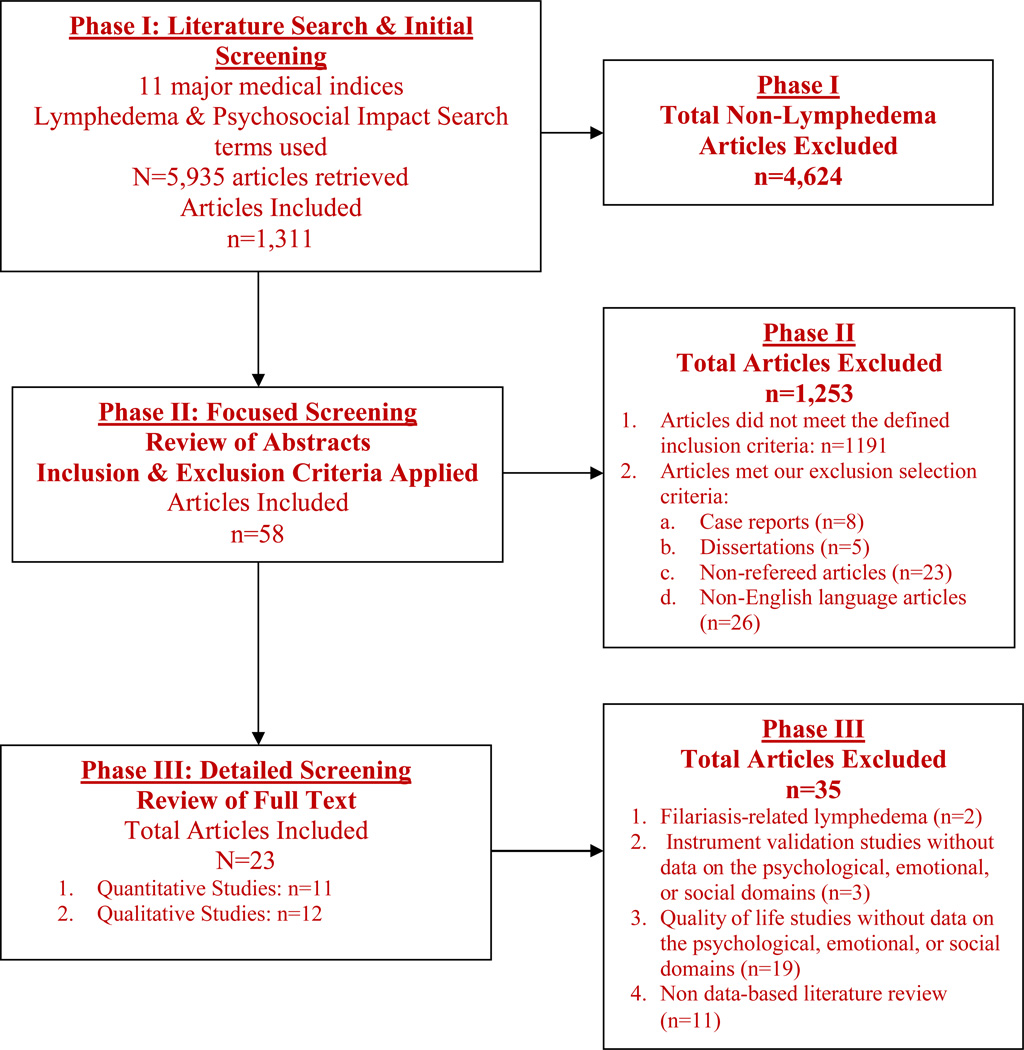
Eleven electronic databases were searched and 1311 articles retrieved; 23 met inclusion criteria. Twelve articles utilized qualitative methodology and 11 used quantitative methodology. An established quality assessment tool was used to assess the quality of the included studies.
The overall quality of the 23 included studies was adequate. A critical limitation of current literature is the lack of conceptual or operational definitions for the concept of psychosocial impact. Quantitative studies showed statistically significant poorer social well-being in persons with lymphedema, including perceptions related to body image, appearance, sexuality, and social barriers. No statistically significant differences were found between persons with and without lymphedema in the domains of emotional well-being (happy or sad) and psychological distress (depression and anxiety). All 12 of the qualitative studies consistently described negative psychological impact (negative self-identity, emotional disturbance, and psychological distress) and negative social impact (marginalization, financial burden, perceived diminished sexuality, social isolation, perceived social abandonment, public insensitivity, and non-supportive work environment). Factors associated with psychosocial impact were also identified.
Lymphedema has a negative psychosocial impact on affected individuals. The current review sheds light on the conceptualization and operationalization of the definitions of psychosocial impact with respect to lymphedema. Development of a lymphedema-specific instrument is needed to better characterize the impact of lymphedema and to examine the factors contributing to these outcomes in cancer and non-cancer-related populations.
本系统评价旨在评估 2004 年至 2011 年期间发表的关于淋巴水肿心理社会影响的当代同行评议文献的证据水平。
检索了 11 个电子数据库,共检索到 1311 篇文章,符合纳入标准的有 23 篇。12 篇文章采用定性方法,11 篇文章采用定量方法。使用既定的质量评估工具评估纳入研究的质量。
23 项纳入研究的总体质量尚可。当前文献的一个关键局限性是缺乏对心理社会影响概念的概念或操作定义。定量研究表明,患有淋巴水肿的人在社会幸福感方面存在统计学上显著较差的情况,包括与身体形象、外貌、性和社会障碍相关的认知。在情感幸福感(快乐或悲伤)和心理困扰(抑郁和焦虑)方面,患有和不患有淋巴水肿的人之间没有发现统计学上的显著差异。12 项定性研究均一致描述了负面的心理影响(消极的自我认同、情绪困扰和心理困扰)和负面的社会影响(边缘化、经济负担、感知到的性能力下降、社会孤立、感知到的社会抛弃、公众的不敏感和非支持性的工作环境)。还确定了与心理社会影响相关的因素。
淋巴水肿对受影响的个体有负面影响。本综述阐明了淋巴水肿心理社会影响的概念化和操作化定义。需要开发一种专门针对淋巴水肿的工具,以更好地描述淋巴水肿的影响,并研究癌症和非癌症相关人群中导致这些结果的因素。