Department of Surgery, Washington University School of Medicine, St. Louis, MO, USA.
Nucleus. 2012 Nov-Dec;3(6):508-15. doi: 10.4161/nucl.22427. Epub 2012 Oct 9.
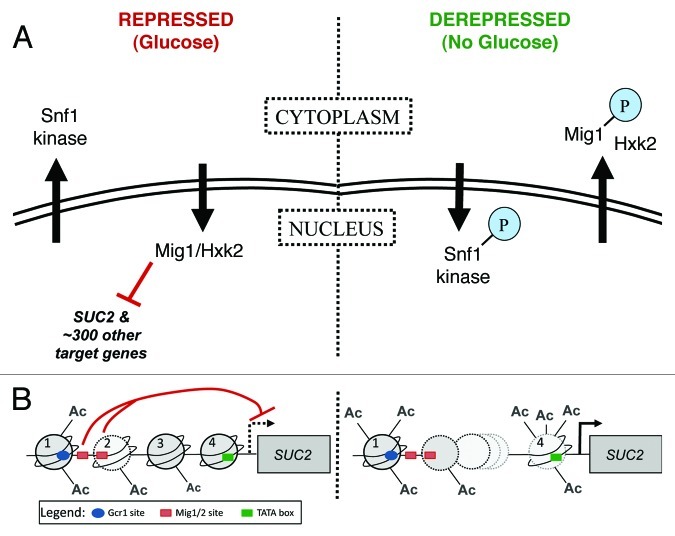
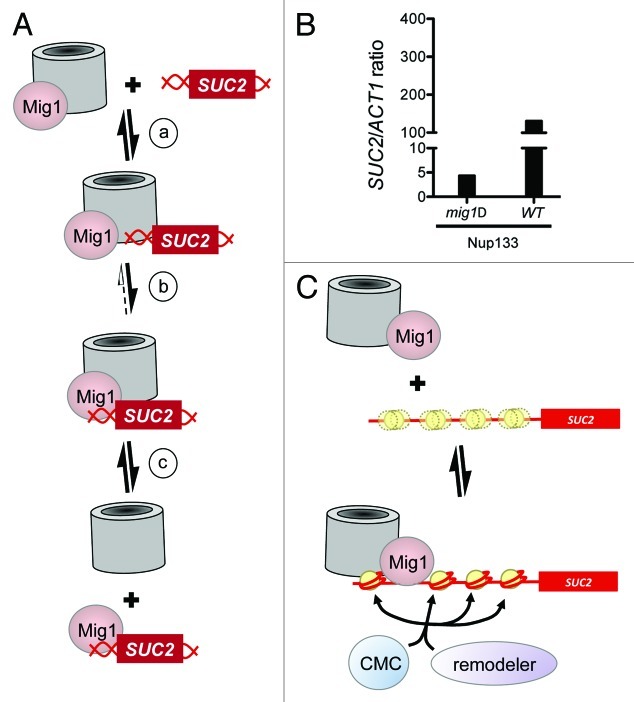
Transcriptional regulation is a complex process that requires the integrated action of many multi-protein complexes. The way in which a living cell coordinates the action of these complexes in time and space is still poorly understood. Recent work has shown that nuclear pores, well known for their role in 3' processing and export of transcripts, also participate in the control of transcriptional initiation. We have recently begun to explore how nuclear pores interface with the well-described machinery that regulates initiation. This work led to the discovery that specific nucleoporins are required for binding of the repressor protein Mig1 to its site in target promoters. Nuclear pores are therefore involved in repressing, as well as activating, transcription. Here we discuss in detail the main models explaining our result and consider what each implies about the roles that nuclear pores play in the regulation of gene expression.
转录调控是一个复杂的过程,需要许多多蛋白复合物的综合作用。目前人们对活细胞如何在时间和空间上协调这些复合物的作用仍知之甚少。最近的研究表明,核孔在 3' 加工和转录本输出方面的作用众所周知,它们也参与转录起始的控制。我们最近开始探索核孔如何与调控起始的已有描述机制相互作用。这项工作导致发现了特定的核孔蛋白对于阻遏蛋白 Mig1 与其靶启动子上的结合位点的结合是必需的。因此,核孔参与抑制和激活转录。在这里,我们详细讨论了解释我们的结果的主要模型,并考虑了每个模型对核孔在基因表达调控中的作用的含义。