Aging Research Center, Karolinska Institute and Stockholm University Stockholm, Sweden.
Front Integr Neurosci. 2012 Sep 19;6:74. doi: 10.3389/fnint.2012.00074. eCollection 2012.
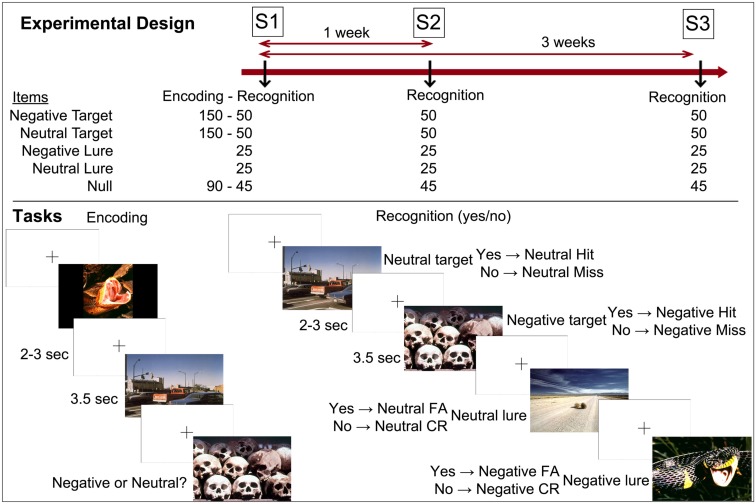
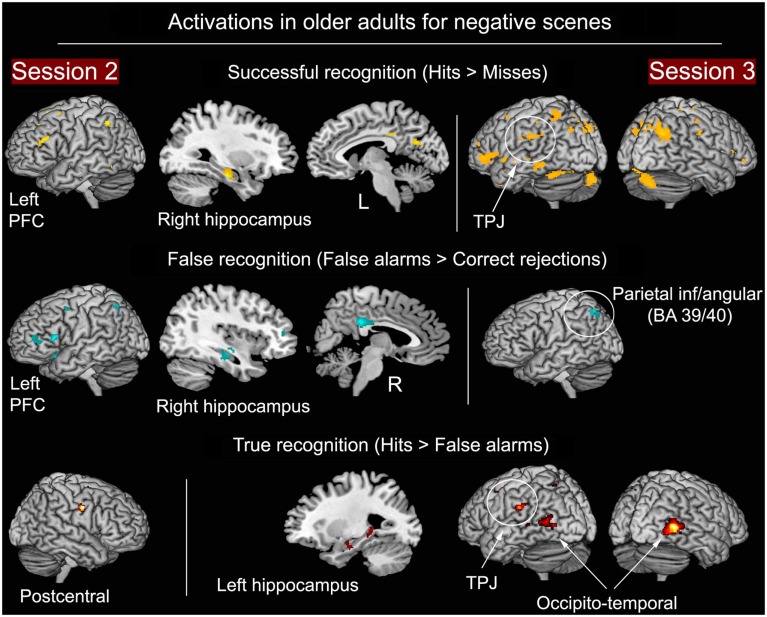
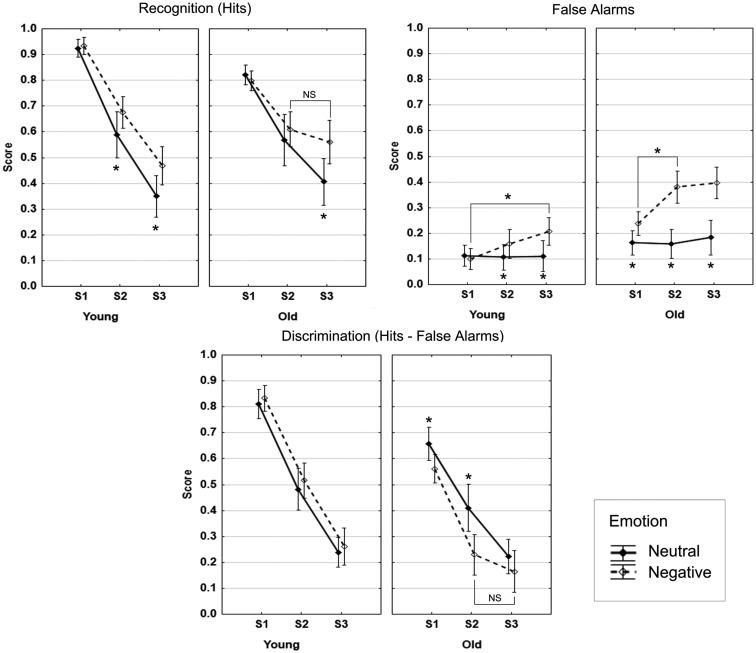
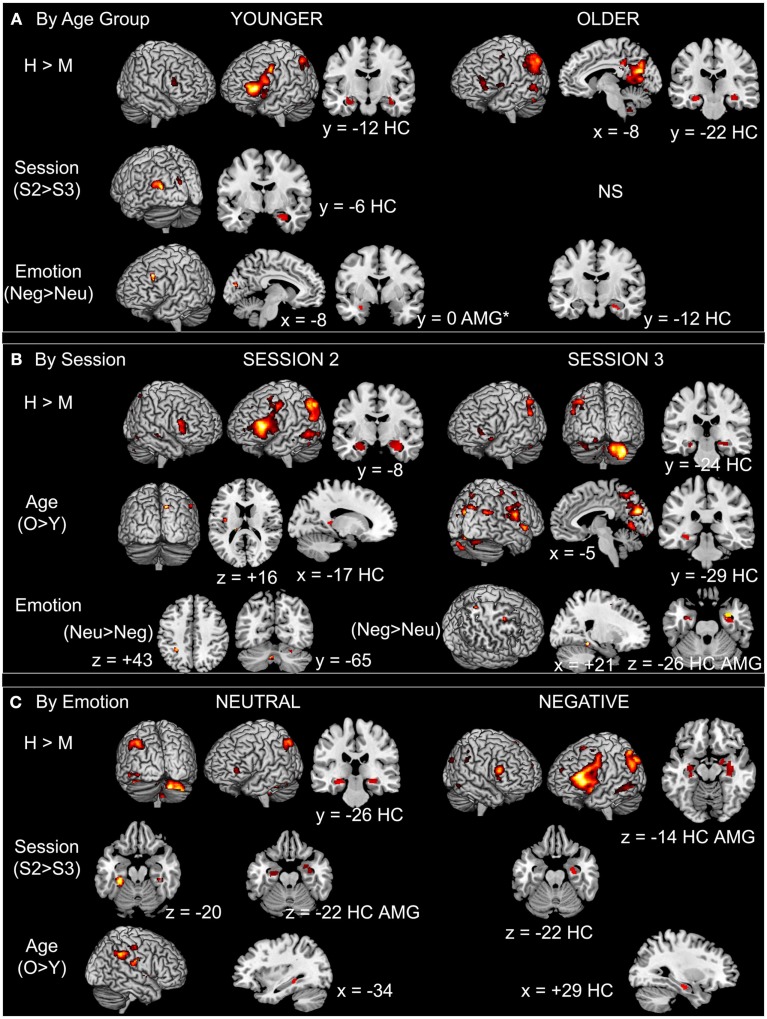
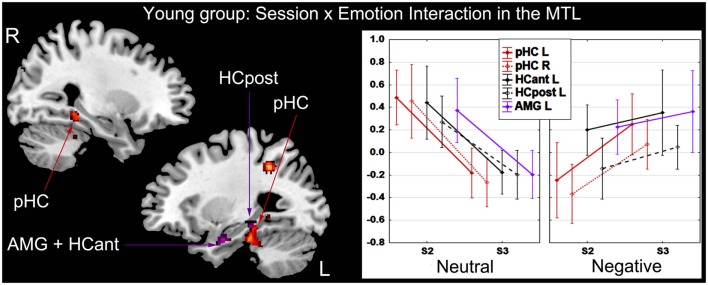
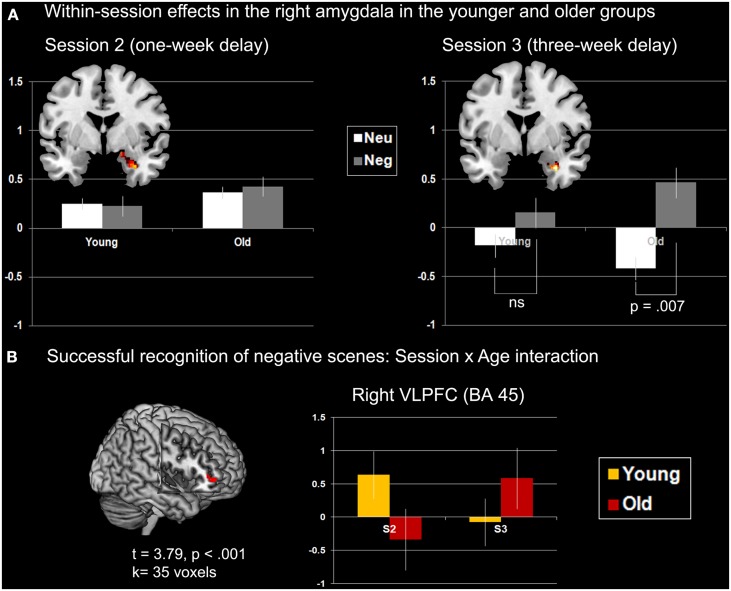
Some studies have suggested that the memory advantage for negative emotional information over neutral information ("negativity effect") is reduced in aging. Besides the fact that most findings are based on immediate retrieval, the neural underpinnings of long-term emotional memory in aging have so far not been investigated. To address these issues, we assessed recognition of neutral and negative scenes after 1- and 3-week retention intervals in younger and older adults using functional magnetic resonance imaging. We further used an event-related design in order to disentangle successful, false, and true recognition. This study revealed four key findings: (1) increased retention interval induced an increased rate of false recognitions for negative scenes, canceling out the negativity effect (present for hit rates only) on discrimination in both younger and older adults; (2) in younger, but not older, adults, reduced activity of the medial temporal lobe was observed over time for neutral scenes, but not for negative scenes, where stable or increased activity was seen; (3) engagement of amygdala (AMG) was observed in older adults after a 3-week delay during successful recognition of negative scenes (hits vs. misses) in comparison with neutral scenes, which may indicate engagement of automatic processes, but engagement of ventrolateral prefrontal cortex was unrelated to AMG activity and performance; and (4) after 3 weeks, but not after 1 week, true recognition of negative scenes was characterized by more activity in left hippocampus and lateral occipito-temporal regions (hits vs. false alarms). As these regions are known to be related to consolidation mechanisms, the observed pattern may indicate the presence of delayed consolidation of true memories. Nonetheless, older adults' low performance in discrimination of negative scenes could reflect the fact that overall, after long delays of retention, they rely more on general information rather than on perceptual detail in making recognition judgments.
一些研究表明,与中性信息相比,老年人对负性情绪信息的记忆优势(“负性效应”)会降低。除了大多数发现基于即时检索之外,衰老过程中长时情绪记忆的神经基础迄今尚未被研究。为了解决这些问题,我们使用功能磁共振成像评估了年轻和老年成年人在 1 周和 3 周的记忆保留间隔后对中性和负性场景的识别。我们进一步使用事件相关设计来区分成功、错误和真实识别。这项研究揭示了四个关键发现:(1)随着保留间隔的增加,负性场景的错误识别率也会增加,从而抵消了年轻和老年成年人在辨别率上的负性效应(仅适用于击中率);(2)在年轻成年人中,随着时间的推移,中颞叶的活动减少,但在中性场景中没有,而在负性场景中则保持稳定或增加;(3)在成功识别负性场景(击中与未击中)时,与中性场景相比,老年成年人的杏仁核(AMG)在 3 周的延迟后被激活,这可能表明自动过程的参与,但外侧前额叶皮层的参与与 AMG 活动和表现无关;(4)3 周后,但 1 周后,负性场景的真实识别特征是左海马体和外侧枕颞区域的活动增加(击中与假警报)。由于这些区域与巩固机制有关,因此观察到的模式可能表明真实记忆的延迟巩固。尽管如此,老年成年人对负性场景的辨别能力较低可能反映了这样一个事实,即在长时间的记忆保留后,他们总体上更多地依赖于一般信息,而不是知觉细节来进行识别判断。