Department of Psychology, University of Akron Akron, OH, USA.
Front Integr Neurosci. 2012 Aug 23;6:60. doi: 10.3389/fnint.2012.00060. eCollection 2012.
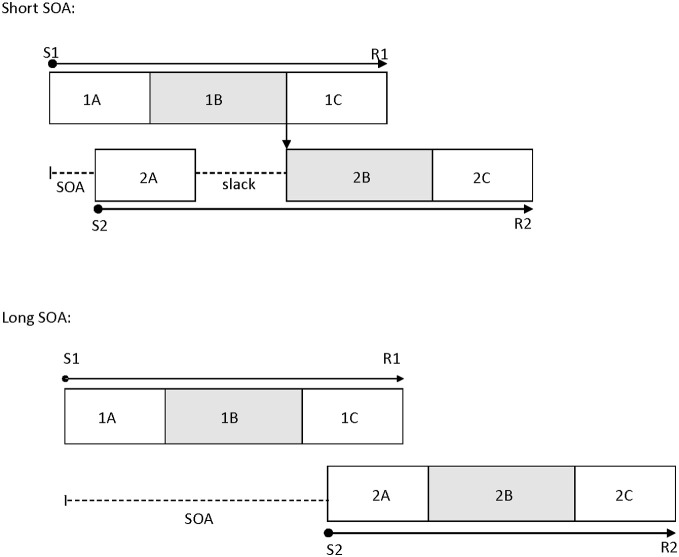
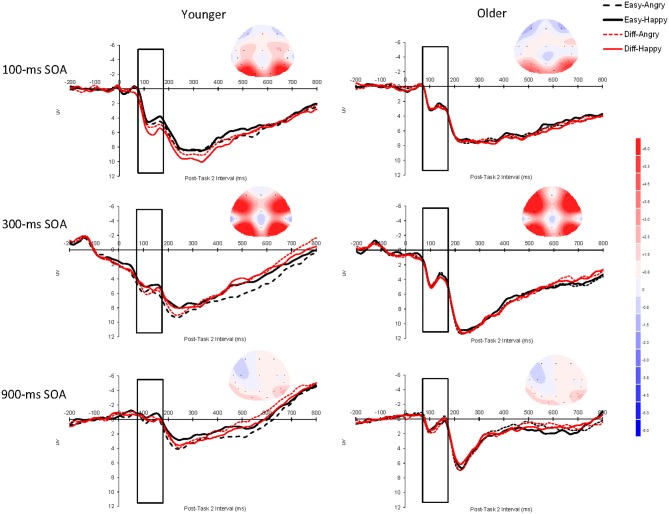
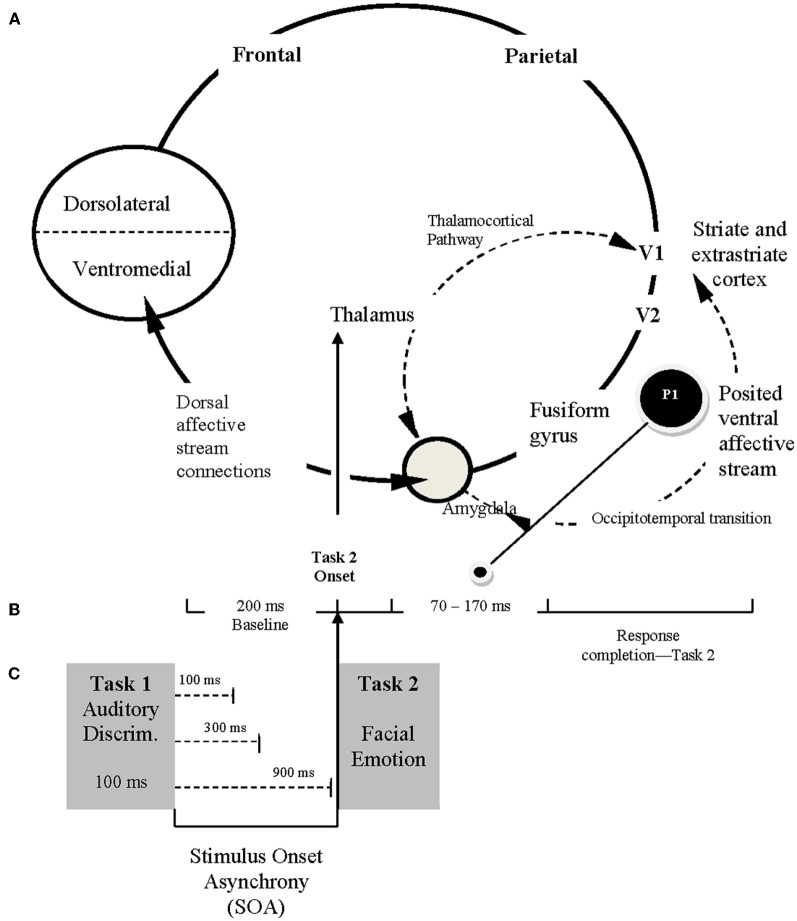
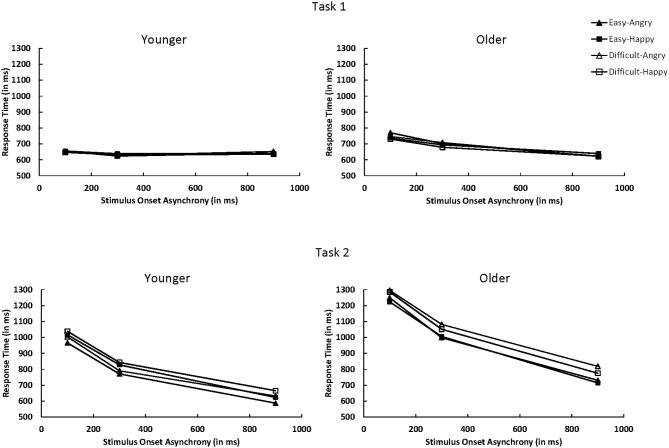
The present study examined adult age differences in processing emotional faces using a psychological refractory period paradigm. We used both behavioral and event-related potential (P1 component) measures. Task 1 was tone discrimination (fuzzy vs. pure tones) and Task 2 was emotional facial discrimination ("happy" vs. "angry" faces). The stimulus onset asynchrony (SOA) between the two tasks was 100, 300, and 900 ms. Earlier research observed larger age deficits in emotional facial discrimination for negative (angry) than for positive (happy) faces (Baena et al., 2010). Thus, we predicted that older adults would show decreased attentional efficiency in carrying out dual-task processing on the P1 (a component linked to amygdalar modulation of visual perception; Rotshtein et al., 2010). Both younger and older groups showed significantly higher P1 amplitudes at 100- and 300-ms SOAs than at the 900-ms SOA, and this suggests that both age groups could process Task 2 faces without central attention. Also, younger adults showed significantly higher P1 activations for angry than for happy faces, but older adults showed no difference. These results are consistent with the idea that younger adults exhibited amygdalar modulation of visual perception, but that older adults did not.
本研究采用心理不应期范式考察了成年人在处理情绪面孔时的年龄差异。我们使用了行为和事件相关电位(P1 成分)测量。任务 1 是音高辨别(模糊音与纯音),任务 2 是情绪面部辨别(“高兴”与“生气”的面孔)。两个任务之间的刺激呈现时间间隔(SOA)分别为 100、300 和 900 毫秒。早期研究观察到,在情绪面部辨别中,与积极(高兴)面孔相比,消极(生气)面孔的年龄差异更大(Baena 等人,2010)。因此,我们预测,老年人在执行 P1 的双重任务处理时(与杏仁核调节视觉感知有关的成分;Rotshtein 等人,2010),注意力效率会降低。年轻组和老年组在 100 和 300ms SOA 时的 P1 振幅明显高于 900ms SOA,这表明两个年龄组都可以不通过中央注意力来处理任务 2 的面孔。此外,年轻成年人对生气面孔的 P1 激活明显高于高兴面孔,但老年人没有差异。这些结果与年轻人表现出杏仁核调节视觉感知的观点一致,但老年人则没有。