Department of Neurology, Goethe-University Frankfurt/Main, Germany ; Neuroscience Laboratory, Department of Neurology, China Medical University Hospital Taichung, Taiwan ; Institute of Medical Science and School of Medicine, China Medical University Taichung, Taiwan.
Front Hum Neurosci. 2012 Sep 19;6:260. doi: 10.3389/fnhum.2012.00260. eCollection 2012.
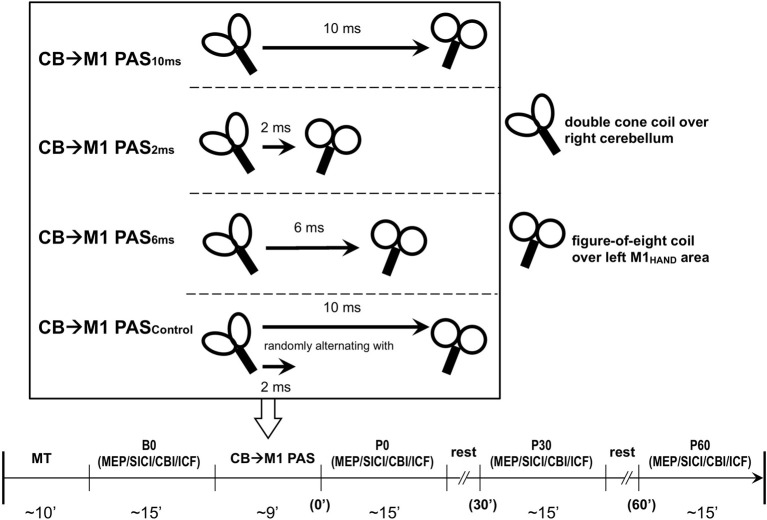
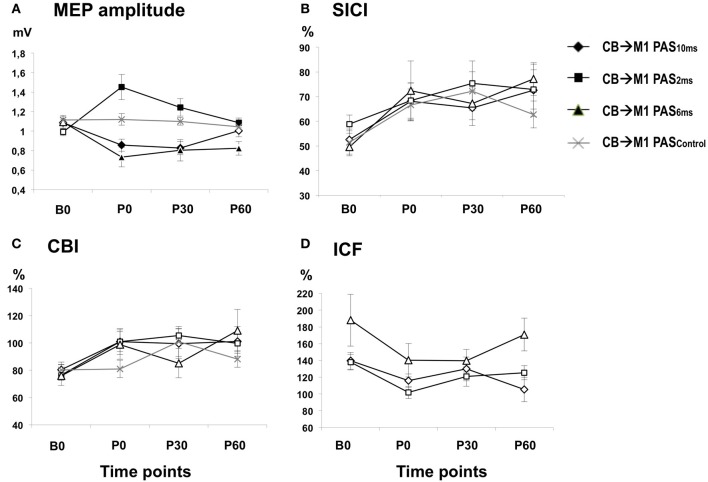
The cerebellum is crucially important for motor control and adaptation. Recent non-invasive brain stimulation studies have indicated the possibility to alter the excitability of the cerebellum and its projections to the contralateral motor cortex, with behavioral consequences on motor control and adaptation. Here we sought to induce bidirectional spike-timing dependent plasticity (STDP)-like modifications of motor cortex (M1) excitability by application of paired associative stimulation (PAS) in healthy subjects. Conditioning stimulation over the right lateral cerebellum (CB) preceded focal transcranial magnetic stimulation (TMS) of the left M1 hand area at an interstimulus interval of 2 ms (CB→M1 PAS(2 ms)), 6 ms (CB→M1 PAS(6 ms)) or 10 ms (CB→M1 PAS(10 ms)) or randomly alternating intervals of 2 and 10 ms (CB→M1 PAS(Control)). Effects of PAS on M1 excitability were assessed by the motor-evoked potential (MEP) amplitude, short-interval intracortical inhibition (SICI), intracortical facilitation (ICF) and cerebellar-motor cortex inhibition (CBI) in the first dorsal interosseous muscle of the right hand. CB→M1 PAS(2 ms) resulted in MEP potentiation, CB→M1 PAS(6 ms) and CB→M1 PAS(10 ms) in MEP depression, and CB→M1 PAS(Control) in no change. The MEP changes lasted for 30-60 min after PAS. SICI and CBI decreased non-specifically after all PAS protocols, while ICF remained unaltered. The physiological mechanisms underlying these MEP changes are carefully discussed. Findings support the notion of bidirectional STDP-like plasticity in M1 mediated by associative stimulation of the cerebello-dentato-thalamo-cortical pathway and M1. Future studies may investigate the behavioral significance of this plasticity.
小脑对于运动控制和适应至关重要。最近的非侵入性脑刺激研究表明,有可能改变小脑及其对对侧运动皮层的投射的兴奋性,从而对运动控制和适应产生行为后果。在这里,我们试图通过在健康受试者中应用成对关联刺激(PAS)来诱导运动皮层(M1)兴奋性的双向尖峰时间依赖性可塑性(STDP)样修饰。在刺激间隔为 2 毫秒(CB→M1 PAS(2 ms))、6 毫秒(CB→M1 PAS(6 ms))或 10 毫秒(CB→M1 PAS(10 ms))时,右侧外侧小脑(CB)的条件刺激先于左 M1 手部区域的焦点经颅磁刺激(TMS),或者随机交替间隔为 2 和 10 毫秒(CB→M1 PAS(Control))。通过右手第一背间骨肌的运动诱发电位(MEP)幅度、短间隔内皮质内抑制(SICI)、皮质内易化(ICF)和小脑-运动皮层抑制(CBI)评估 PAS 对 M1 兴奋性的影响。CB→M1 PAS(2 ms)导致 MEP 增强,CB→M1 PAS(6 ms)和 CB→M1 PAS(10 ms)导致 MEP 抑制,而 CB→M1 PAS(Control)则没有变化。MEP 变化在 PAS 后持续 30-60 分钟。所有 PAS 方案后 SICI 和 CBI 非特异性降低,而 ICF 保持不变。仔细讨论了这些 MEP 变化的生理机制。研究结果支持通过小脑齿状核丘脑皮质通路和 M1 的关联刺激介导的 M1 中双向类似 STDP 的可塑性的概念。未来的研究可能会研究这种可塑性的行为意义。