Department of Biomedical Engineering and Computational Science, School of Science, Aalto University Espoo, Finland.
Front Physiol. 2012 Sep 26;3:384. doi: 10.3389/fphys.2012.00384. eCollection 2012.
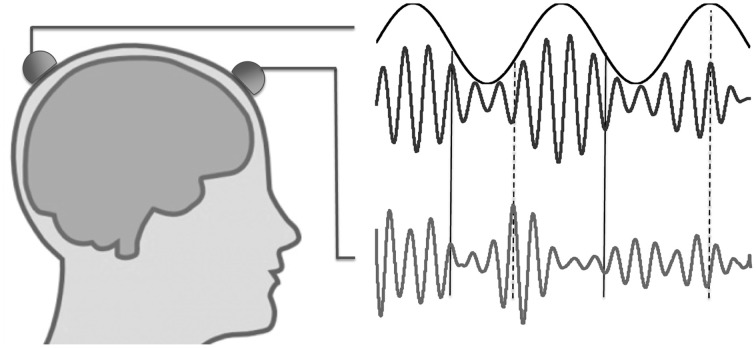
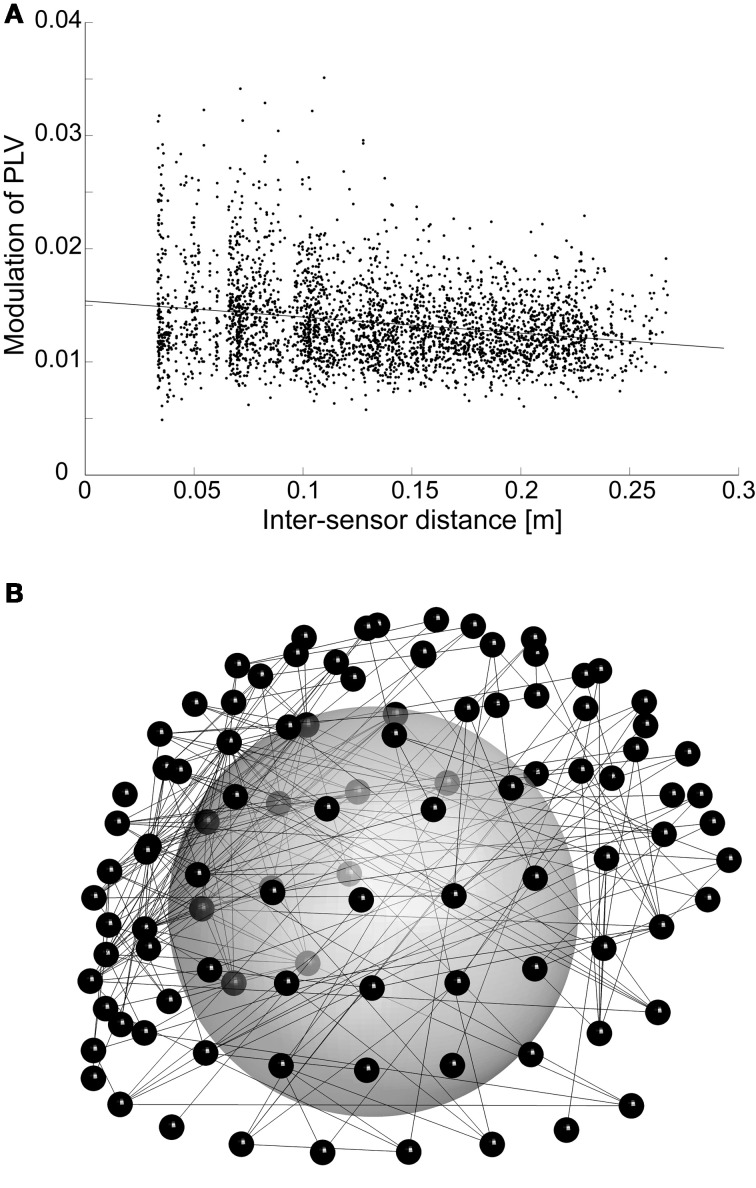
Neuronal interactions form the basis for our brain function, and oscillations and synchrony are the principal candidates for mediating them in the cortical networks. Phase synchrony, where oscillatory neuronal ensembles directly synchronize their phases, enables precise integration between separated brain regions. However, it is unclear how neuronal interactions are dynamically coordinated in space and over time. Cross-scale effects have been proposed to be responsible for linking levels of processing hierarchy and to regulate neuronal dynamics. Most notably, nested oscillations, where the phase of a neuronal oscillation modulates the amplitude of a faster one, may locally integrate neuronal activities in distinct frequency bands. Yet, hierarchical control of inter-areal synchrony could provide a more comprehensive view to the dynamical structure of oscillatory interdependencies in the human brain. In this study, the notion of nested oscillations is extended to a cross-frequency and inter-areal model of oscillatory interactions. In this model, the phase of a slower oscillation modulates inter-areal synchrony in a higher frequency band. This would allow cross-scale integration of global interactions and, thus, offers a mechanism for binding distributed neuronal activities. We show that inter-areal phase synchrony can be modulated by the phase of a slower neuronal oscillation using magnetoencephalography (MEG). This effect is the most pronounced at frequencies below 35 Hz. Importantly, changes in oscillation amplitudes did not explain the findings. We expect that the novel cross-frequency interaction could offer new ways to understand the flexible but accurate dynamic organization of ongoing neuronal oscillations and synchrony.
神经元相互作用构成了我们大脑功能的基础,而振荡和同步是皮质网络中介它们的主要候选者。相位同步是指振荡神经元集合直接同步它们的相位,使分离的脑区之间能够进行精确的整合。然而,神经元相互作用如何在空间和时间上动态协调还不清楚。跨尺度效应被认为是连接处理层次结构水平和调节神经元动力学的原因。最值得注意的是,嵌套振荡,其中神经元振荡的相位调制更快的振荡的幅度,可能在不同的频率带本地整合神经元活动。然而,区域间同步的分层控制可以为人类大脑中振荡相互依赖的动态结构提供更全面的观点。在这项研究中,嵌套振荡的概念被扩展到一个跨频和区域间的振荡相互作用模型。在这个模型中,较慢的振荡的相位调制在较高的频率带中的区域间同步。这将允许全局相互作用的跨尺度整合,从而提供一种绑定分布式神经元活动的机制。我们使用脑磁图(MEG)显示,较慢的神经元振荡的相位可以调制区域间的相位同步。这种效应在低于 35 Hz 的频率下最为明显。重要的是,振荡幅度的变化并不能解释这些发现。我们预计新的跨频相互作用可以提供新的方法来理解正在进行的神经元振荡和同步的灵活但准确的动态组织。