Doesburg Sam M, Vinette Sarah A, Cheung Michael J, Pang Elizabeth W
Department of Diagnostic Imaging, Hospital for Sick Children Toronto, ON, Canada.
Front Psychol. 2012 Jun 13;3:195. doi: 10.3389/fpsyg.2012.00195. eCollection 2012.
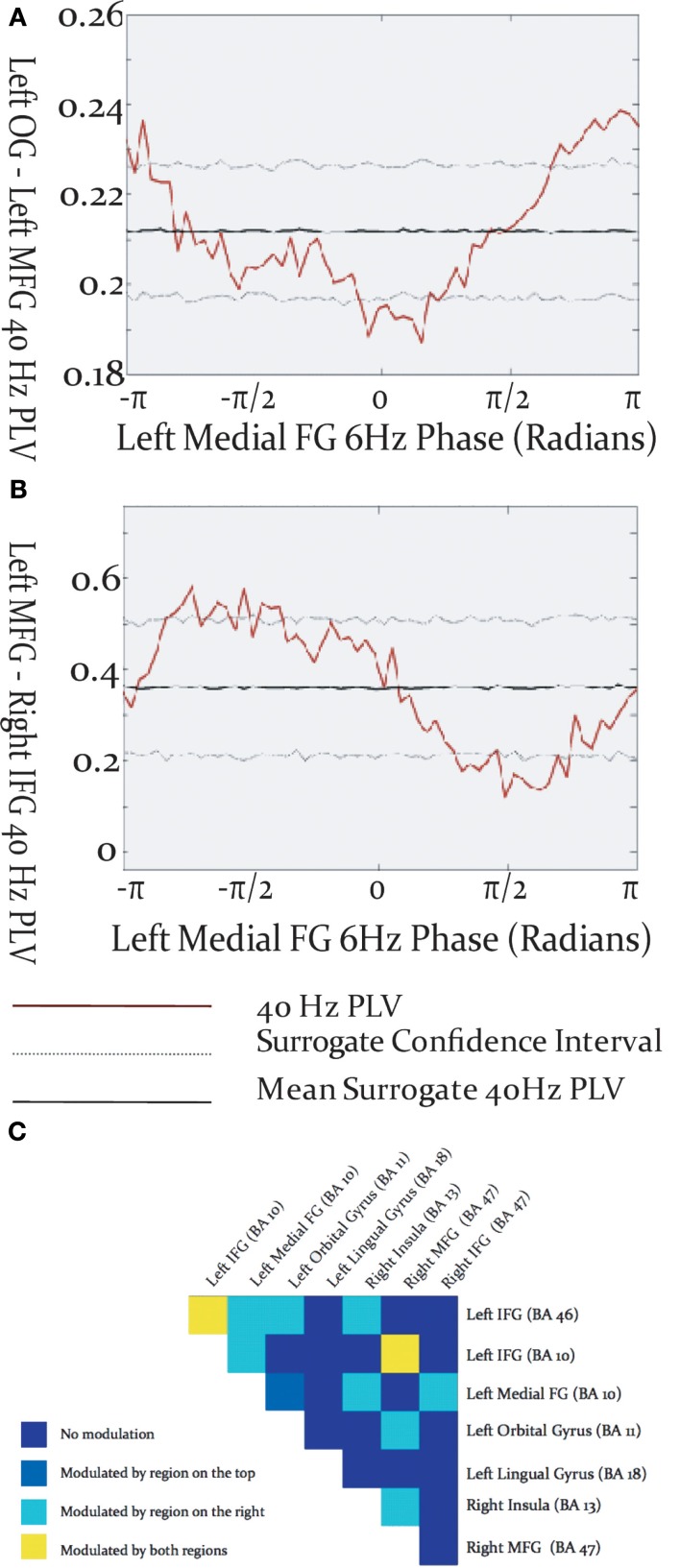
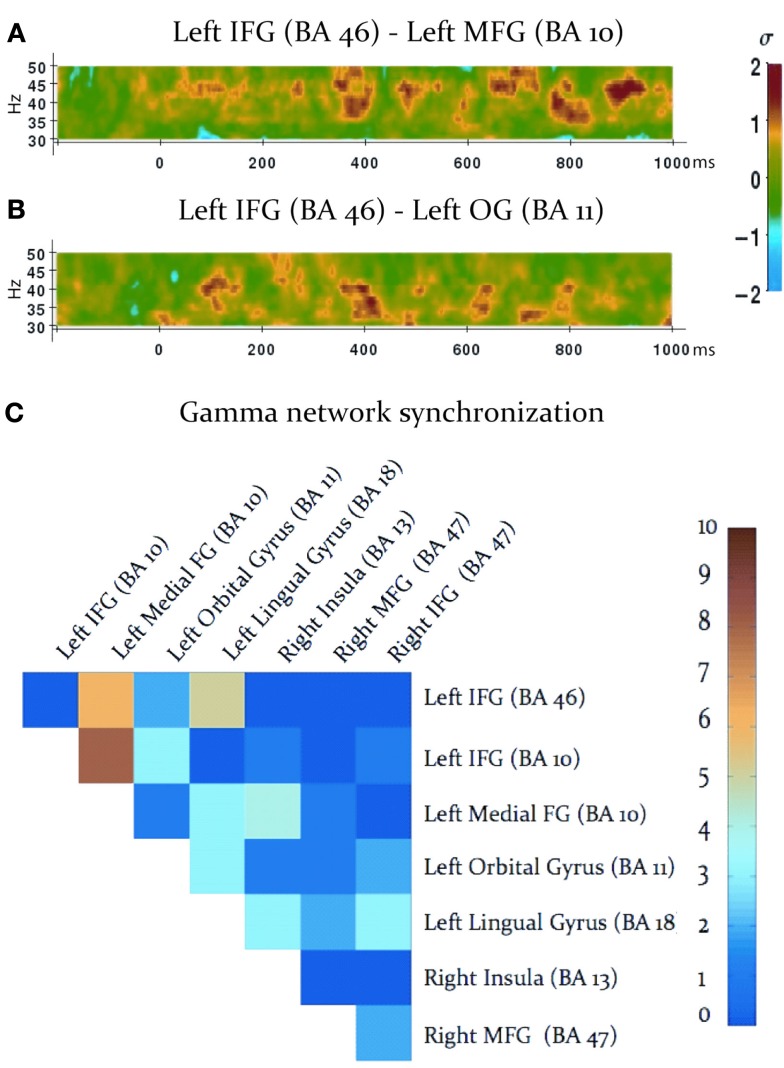
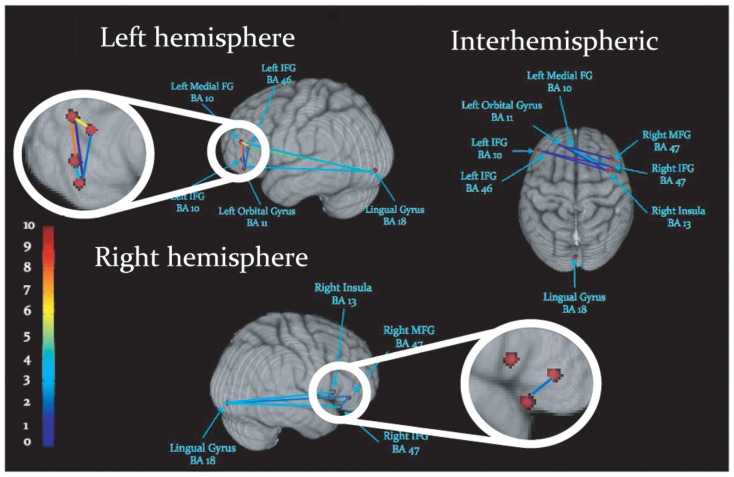
Expressive language is complex and involves processing within a distributed network of cortical regions. Functional MRI and magnetoencephalography (MEG) have identified brain areas critical for expressive language, but how these regions communicate across the network remains poorly understood. It is thought that synchronization of oscillations between neural populations, particularly at a gamma rate (>30 Hz), underlies functional integration within cortical networks. Modulation of gamma rhythms by theta-band oscillations (4-8 Hz) has been proposed as a mechanism for the integration of local cell coalitions into large-scale networks underlying cognition and perception. The present study tested the hypothesis that these oscillatory mechanisms of functional integration were present within the expressive language network. We recorded MEG while subjects performed a covert verb generation task. We localized activated cortical regions using beamformer analysis, calculated inter-regional phase locking between activated areas, and measured modulation of inter-regional gamma synchronization by theta phase. The results show task-dependent gamma-band synchronization among regions activated during the performance of the verb generation task, and we provide evidence that these transient and periodic instances of high-frequency connectivity were modulated by the phase of cortical theta oscillations. These findings suggest that oscillatory synchronization and cross-frequency interactions are mechanisms for functional integration among distributed brain areas supporting expressive language processing.
表达性语言很复杂,涉及在一个分布式皮质区域网络内进行处理。功能磁共振成像(fMRI)和脑磁图(MEG)已确定了对表达性语言至关重要的脑区,但这些区域如何在网络中进行通信仍知之甚少。人们认为,神经群体之间振荡的同步,特别是在伽马频率(>30 Hz)下,是皮质网络内功能整合的基础。有人提出,theta波段振荡(4-8 Hz)对伽马节律的调制是将局部细胞联合整合到认知和感知基础的大规模网络中的一种机制。本研究检验了这样一种假设,即这些功能整合的振荡机制存在于表达性语言网络中。我们在受试者执行一项隐蔽的动词生成任务时记录了脑磁图。我们使用波束形成器分析定位激活的皮质区域,计算激活区域之间的区域间相位锁定,并测量theta相位对区域间伽马同步的调制。结果显示,在动词生成任务执行过程中激活的区域之间存在任务依赖的伽马波段同步,并且我们提供了证据表明,这些高频连接的瞬态和周期性实例受到皮质theta振荡相位的调制。这些发现表明,振荡同步和跨频率相互作用是支持表达性语言处理的分布式脑区之间功能整合的机制。