Institute of Immunology, Zhejiang University School of Medicine, Hangzhou, China.
Eur J Immunol. 2013 Jan;43(1):258-69. doi: 10.1002/eji.201242697. Epub 2012 Nov 27.
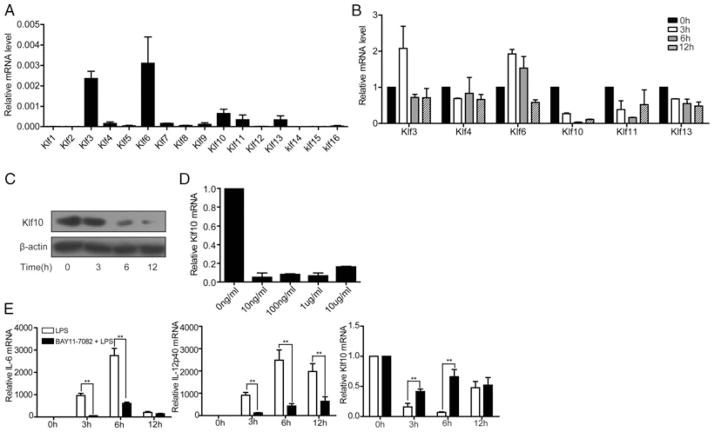
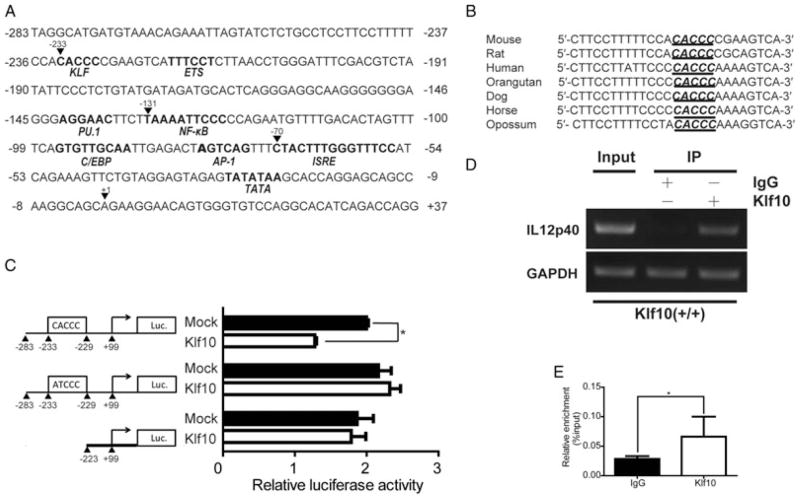
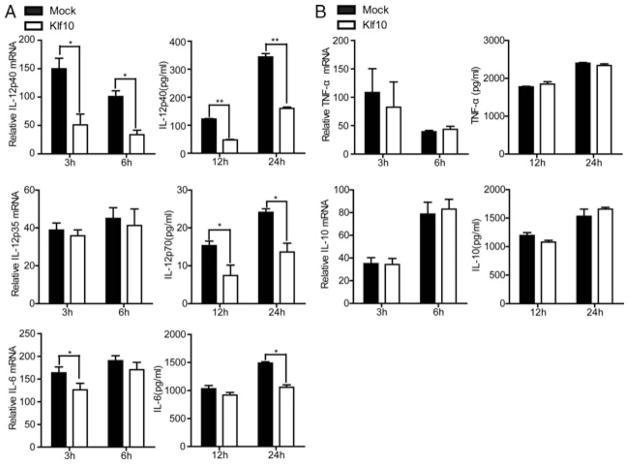
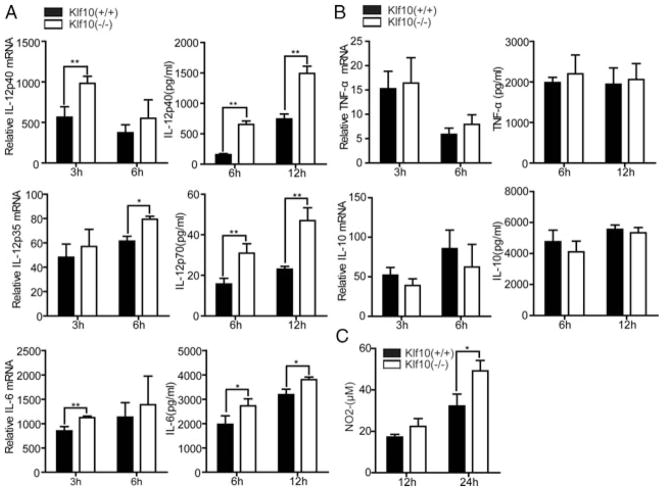
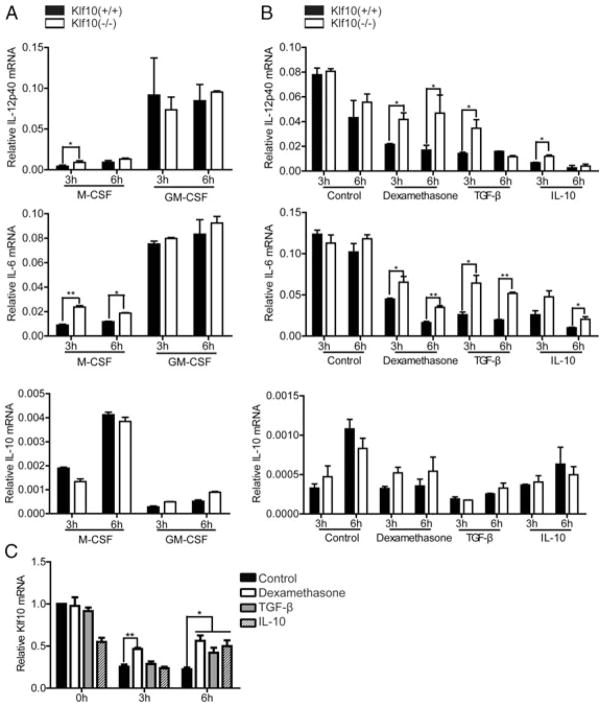
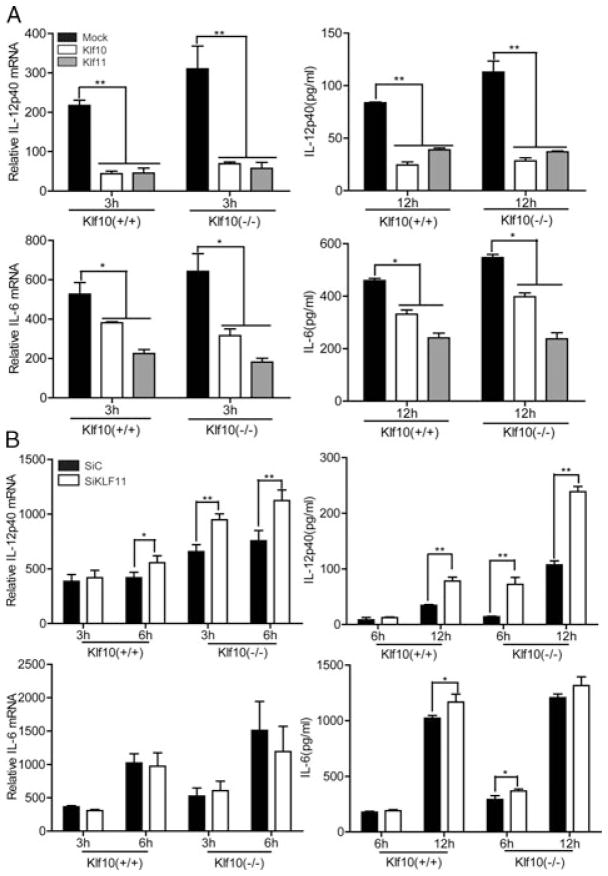
Bone marrow-derived macrophages (BMMs) treated with granulocyte-macrophage colony-stimulating factor (GM-CSF) or macrophage colony-stimulating factor (M-CSF), differentiate into GM-CSF-induced mouse bone marrow-derived macrophages (GM-BMMs) or M-CSF-induced mouse bone marrow-derived macrophages (M-BMMs), which have an M1 or M2 profile, respectively. GM-BMMs produce large amounts of proinflammatory cytokines and mediate resistance to pathogens, whereas M-BMMs produce antiinflammatory cytokines that contribute to tissue repair and remodeling. M-BMMs stimulated with lipopolysaccharide (LPS) are in an antiinflammatory state, with an IL-12(low) IL-10(high) phenotype. However, the regulation of this process remains unclear. Klf10 belongs to the family of Krüppel-like transcription factors and was initially described as a TGF-β inducible early gene 1. IL-12p40 is upregulated in LPS-stimulated M-BMMs from Klf10-deficient mice, but downregulated during Klf10 overexpression. Klf11, another member of the Krüppel-like factor family, can also repress the production of IL-12p40. Furthermore, Klf10 binds to the CACCC element of the IL-12p40 promoter and inhibits its transcription. We have therefore identified Klf10 as a transcription factor that regulates the expression of IL-12p40 in M-BMMs.
骨髓来源的巨噬细胞(BMMs)经粒细胞-巨噬细胞集落刺激因子(GM-CSF)或巨噬细胞集落刺激因子(M-CSF)处理后,分化为 GM-CSF 诱导的小鼠骨髓来源巨噬细胞(GM-BMMs)或 M-CSF 诱导的小鼠骨髓来源巨噬细胞(M-BMMs),分别具有 M1 或 M2 表型。GM-BMMs 产生大量促炎细胞因子并介导对病原体的抗性,而 M-BMMs 产生抗炎细胞因子,有助于组织修复和重塑。用脂多糖(LPS)刺激的 M-BMMs 处于抗炎状态,具有 IL-12(low)IL-10(high)表型。然而,这一过程的调节机制尚不清楚。Klf10 属于 Krüppel 样转录因子家族,最初被描述为 TGF-β诱导的早期基因 1。LPS 刺激的 M-BMMs 中 Klf10 缺失小鼠的 IL-12p40 上调,但在 Klf10 过表达时下调。Klf11 是 Krüppel 样因子家族的另一个成员,也可以抑制 IL-12p40 的产生。此外,Klf10 结合 IL-12p40 启动子的 CACCC 元件并抑制其转录。因此,我们鉴定出 Klf10 是一种转录因子,可调节 M-BMMs 中 IL-12p40 的表达。