Mahabob M Nazargi, Anbuselvan G J, Kumar B Senthil, Raja S, Kothari Sucitha
Department of Oral Medicine and Radiology, CRI, KSRIDSR, Thiruchengode, India.
J Pharm Bioallied Sci. 2012 Aug;4(Suppl 2):S373-5. doi: 10.4103/0975-7406.100279.
Supernumerary teeth are considered as one of the most significant dental anomalies during the primary and early mixed dentition stage. The main objective of the study was to determine the prevalence rate of supernumerary teeth in the patients who reported to the Department of Oral Medicine and Radiology and to study the associated clinical complications.
A longitudinal observational study was conducted of 2216 patients for a period of 4 months with the documentation of demographic data, the presence of supernumerary teeth, their location, and associated complications such as mechanical trauma, dental caries, and associated pathology.
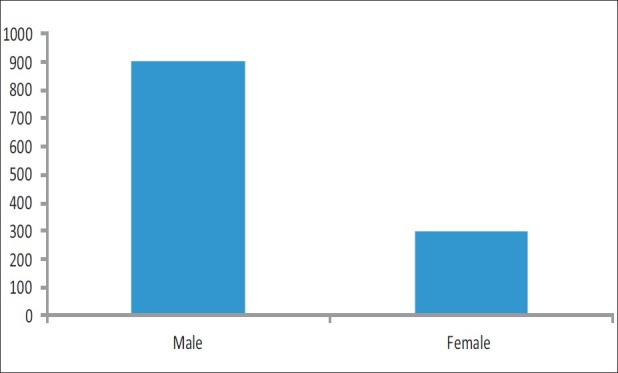
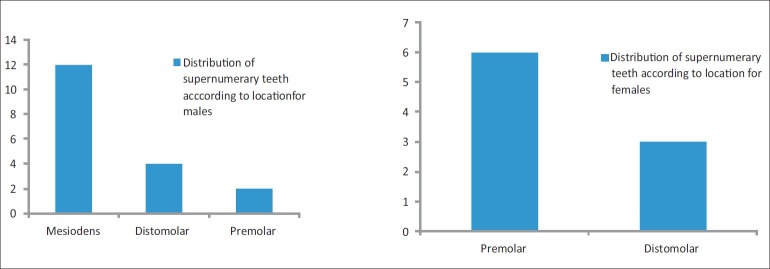
The study recorded 27 supernumerary teeth from the examined 2216 patients. This yields a prevalence of 1.2%, with greater frequency in males which was 1.49% and in females the frequency was 0.85%. The greatest proportion of supernumerary teeth was found in the maxillary anterior region (77.8%). Out of this, 85.7% were classified as mesiodens based on their location. The displacement of adjacent teeth was the most common finding, followed by dental caries.
The prevalence of supernumerary teeth in this study was 1.2% which is in agreement with that reported in similar studies and the maxillary mesiodens was the most common location. Displacement of adjacent teeth was the most common finding.
多生牙被认为是乳牙期和早混合牙列期最重要的牙齿异常之一。本研究的主要目的是确定到口腔医学与放射科就诊患者的多生牙患病率,并研究相关的临床并发症。
对2216例患者进行了为期4个月的纵向观察研究,记录人口统计学数据、多生牙的存在情况、其位置以及相关并发症,如机械性创伤、龋齿和相关病理情况。
该研究在检查的2216例患者中记录到27颗多生牙。患病率为1.2%,男性患病率更高,为1.49%,女性患病率为0.85%。多生牙最常见于上颌前部区域(77.8%)。其中,85.7%根据其位置被分类为正中多生牙。相邻牙齿移位是最常见的表现,其次是龋齿。
本研究中多生牙的患病率为1.2%,与类似研究报道一致,上颌正中多生牙是最常见的位置。相邻牙齿移位是最常见的表现。