Terrier Benjamin, Derian Nicolas, Schoindre Yoland, Chaara Wahiba, Geri Guillaume, Zahr Noël, Mariampillai Kubéraka, Rosenzwajg Michelle, Carpentier Wassila, Musset Lucile, Piette Jean-Charles, Six Adrien, Klatzmann David, Saadoun David, Patrice Cacoub, Costedoat-Chalumeau Nathalie
Arthritis Res Ther. 2012 Oct 17;14(5):R221. doi: 10.1186/ar4060.
Systemic lupus erythematosus (SLE) is a T and B cell-dependent autoimmune disease characterized by the appearance of autoantibodies, a global regulatory T cells (Tregs) depletion and an increase in Th17 cells. Recent studies have shown the multifaceted immunomodulatory effects of vitamin D, notably the expansion of Tregs and the decrease of Th1 and Th17 cells. A significant correlation between higher disease activity and lower serum 25-hydroxyvitamin D levels [25(OH)D] was also shown.
In this prospective study, we evaluated the safety and the immunological effects of vitamin D supplementation (100,000 IU of cholecalciferol per week for 4 weeks, followed by 100,000 IU of cholecalciferol per month for 6 months.) in 20 SLE patients with hypovitaminosis D.
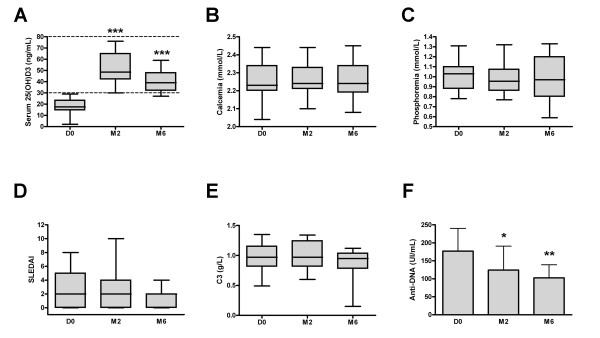
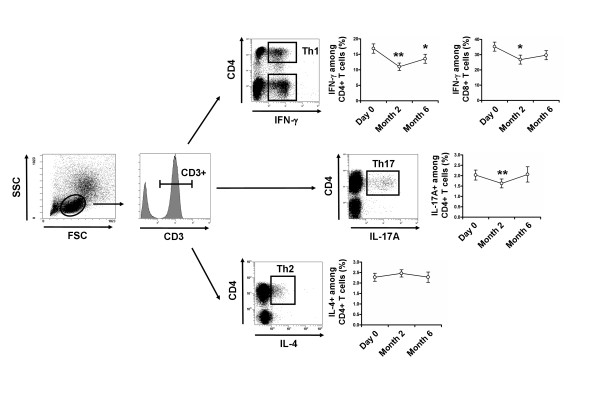
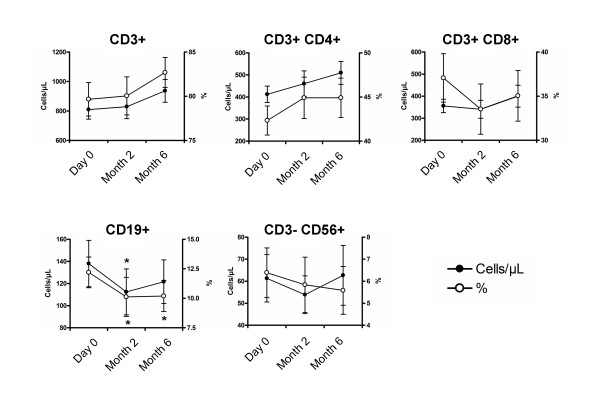
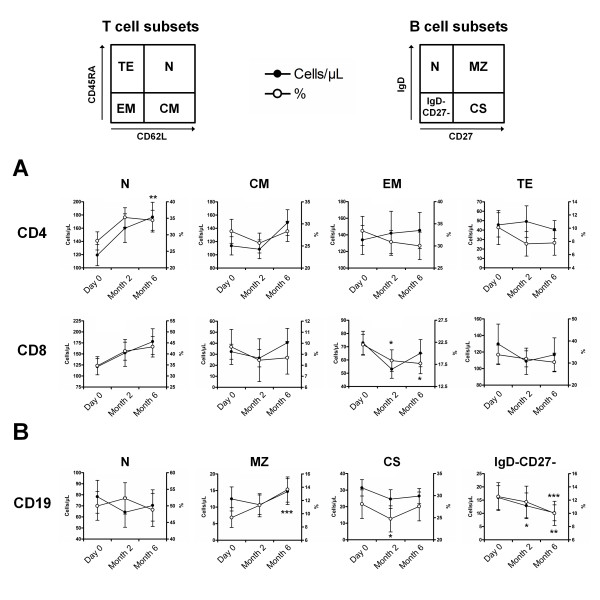
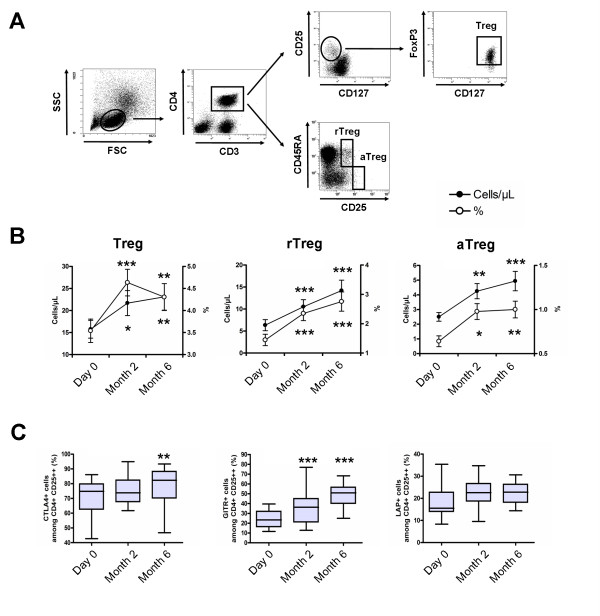
Serum 25(OH)D levels dramatically increased under vitamin D supplementation from 18.7±6.7 at day 0 to 51.4±14.1 (p<0.001) at 2 months and 41.5±10.1 ng/mL (p<0.001) at 6 months. Vitamin D was well tolerated and induced a preferential increase of naïve CD4+ T cells, an increase of regulatory T cells and a decrease of effector Th1 and Th17 cells. Vitamin D also induced a decrease of memory B cells and anti-DNA antibodies. No modification of the prednisone dosage or initiation of new immunosuppressant agents was needed in all patients. We did not observe SLE flare during the 6 months follow-up period.
This preliminary study suggests the beneficial role of vitamin D in SLE patients and needs to be confirmed in randomized controlled trials.
系统性红斑狼疮(SLE)是一种依赖T细胞和B细胞的自身免疫性疾病,其特征为自身抗体出现、整体调节性T细胞(Tregs)耗竭以及Th17细胞增加。最近的研究显示了维生素D具有多方面的免疫调节作用,尤其是Tregs的扩增以及Th1和Th17细胞的减少。还显示疾病活动度较高与血清25-羟基维生素D水平[25(OH)D]较低之间存在显著相关性。
在这项前瞻性研究中,我们评估了维生素D补充剂(每周100,000国际单位胆钙化醇,共4周,随后每月100,000国际单位胆钙化醇,共6个月)对20名维生素D缺乏的SLE患者的安全性和免疫效果。
在补充维生素D的情况下,血清25(OH)D水平显著升高,从第0天的18.7±6.7急剧升至2个月时的51.4±14.1(p<0.001)以及6个月时的41.5±10.1 ng/mL(p<0.001)。维生素D耐受性良好,可诱导初始CD4+ T细胞优先增加、调节性T细胞增加以及效应性Th1和Th17细胞减少。维生素D还可诱导记忆B细胞和抗DNA抗体减少。所有患者均无需调整泼尼松剂量或开始使用新的免疫抑制剂。在6个月的随访期内,我们未观察到SLE病情复发。
这项初步研究表明维生素D对SLE患者具有有益作用,需要在随机对照试验中加以证实。