Dias Eros da Mota, Giollo Luiz Tadeu, Martinelli Débora Dada, Mazeti Camila, Júnior Heitor Moreno, Vilela-Martin José Fernando, Yugar-Toledo Juan Carlos
Hypertension Clinic, Department of Internal Medicine, State Medical School of São José do Rio Preto, Brazil.
Cardiovasc Ultrasound. 2012 Oct 18;10:41. doi: 10.1186/1476-7120-10-41.
The role of hypertension in the loss of cognitive function is controversial. Relationships between hypertension and increases in cerebral vascular resistance, diffused lesions and multiple lacunar infarcts of the white matter are well known. Thus, the objectives of this study were: to evaluate the relationship between hypertension and cognitive dysfunction (CD), identify risk factors and determine the association between early markers of vascular disease and CD in hypertensive individuals.
Two hundred individuals aged between 40 and 80 years old were evaluated in this cross-sectional prospective study. Fifty participants were controls (CT). The remaining 150 hypertensive patients were subdivided into two groups, those with CD (HCD) and those without CD (HNCD). All participants underwent clinical evaluations and biochemical blood tests were performed. CD was investigated using the Mini Mental State Examination (MMSE) following the guidelines for its use in Brazil. The impact of hypertension on the arterial bed was assessed by identifying and measuring changes in the intima-media thickness (IMT) by vascular ultrasonography of the carotid arteries and analyses of the central blood pressure and Augmentation Index by applanation tonometry of the radial artery.
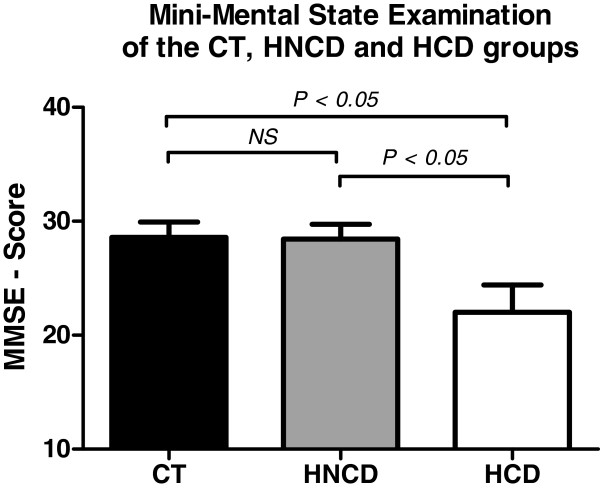
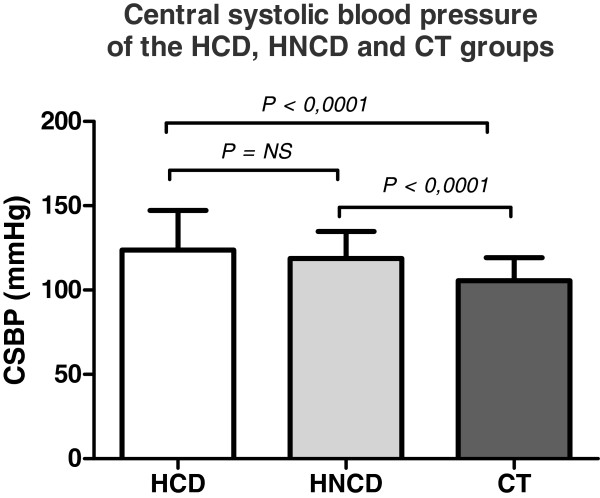
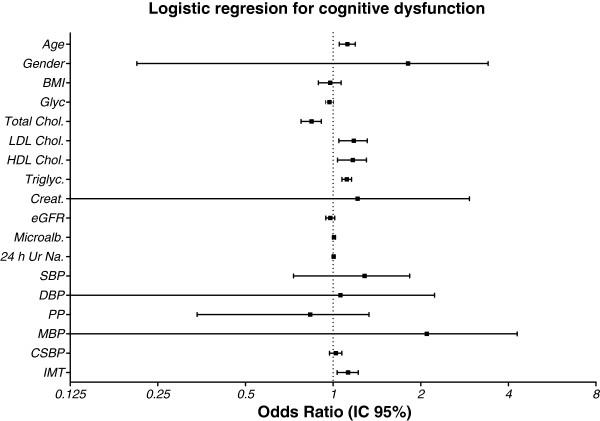
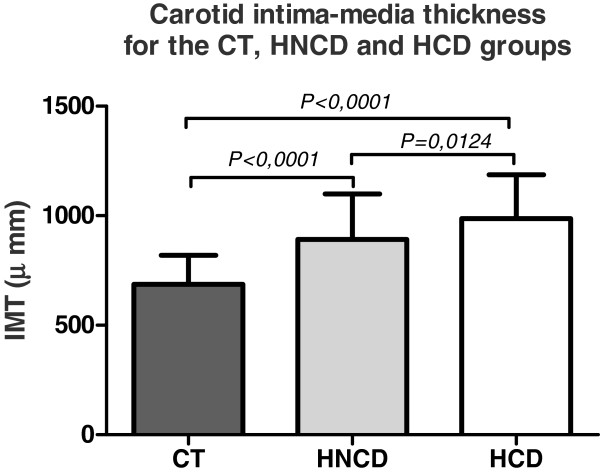
There were no significant differences in the total cholesterol, high-density lipoprotein cholesterol and triglycerides plasma concentrations between the three groups. The serum creatinine and estimated glomerular filtration rate were within normal ranges for all three groups. A significantly lower MMSE score was recorded for the HCD Group compared to the HNCD and CT Groups (p-value < 0.05).The IMT was significantly different between the HNCD and HCD Groups (p-value = 0.0124). A significant difference in the IMT was also observed between hypertensive patients and the CT Group (p-value < 0.0001). Age, low-density cholesterol, high-density cholesterol, triglycerides and IMT increased the Odds Ratio for cognitive dysfunction.The central systolic pressure was significantly higher in the HCD and HNCD Groups compared to CT Group (p-value < 0.0001).
Hypertensive patients with CD have changes in the vascular morphology characterized by an increased carotid IMT, enhanced atherosclerotic lipid profile and impaired hemodynamic functional manifested by elevated central systolic blood pressure.
高血压在认知功能丧失中的作用存在争议。高血压与脑血管阻力增加、弥漫性病变和白质多发性腔隙性梗死之间的关系已为人所知。因此,本研究的目的是:评估高血压与认知功能障碍(CD)之间的关系,确定危险因素,并确定高血压个体中血管疾病早期标志物与CD之间的关联。
在这项横断面前瞻性研究中,对200名年龄在40至80岁之间的个体进行了评估。50名参与者为对照组(CT)。其余150名高血压患者被分为两组,即患有CD的患者(HCD)和未患有CD的患者(HNCD)。所有参与者均接受了临床评估并进行了血液生化检测。按照巴西使用指南,采用简易精神状态检查表(MMSE)对CD进行调查。通过颈动脉血管超声识别和测量内膜中层厚度(IMT)的变化,以及通过桡动脉压平式眼压测量法分析中心血压和增强指数,评估高血压对动脉床的影响。
三组之间的总胆固醇、高密度脂蛋白胆固醇和甘油三酯血浆浓度无显著差异。三组的血清肌酐和估计肾小球滤过率均在正常范围内。与HNCD组和CT组相比,HCD组的MMSE评分显著更低(p值<0.05)。HNCD组和HCD组之间的IMT存在显著差异(p值=0.0124)。高血压患者与CT组之间的IMT也存在显著差异(p值<0.0001)。年龄、低密度胆固醇、高密度胆固醇、甘油三酯和IMT增加了认知功能障碍的比值比。与CT组相比,HCD组和HNCD组的中心收缩压显著更高(p值<0.0001)。
患有CD的高血压患者存在血管形态变化,其特征为颈动脉IMT增加、动脉粥样硬化脂质谱增强以及中心收缩压升高所表现出的血流动力学功能受损。