Department of Biochemistry and Molecular Biology, University of Athens, Panepistimiopolis, Athens 15701, Greece.
BMC Cancer. 2012 Oct 20;12:484. doi: 10.1186/1471-2407-12-484.
Head and neck squamous cell carcinoma (HNSCC) represents one of the most commonly diagnosed malignancies worldwide. The DDC gene encodes L-DOPA decarboxylase, an enzyme catalyzing the decarboxylation of L-DOPA to dopamine. We have recently shown that DDC mRNA is a significant predictor of patients' prognosis in colorectal adenocarcinoma and prostate cancer. The aim of the current study was to analyze the DDC mRNA expression in HNSCC patients.
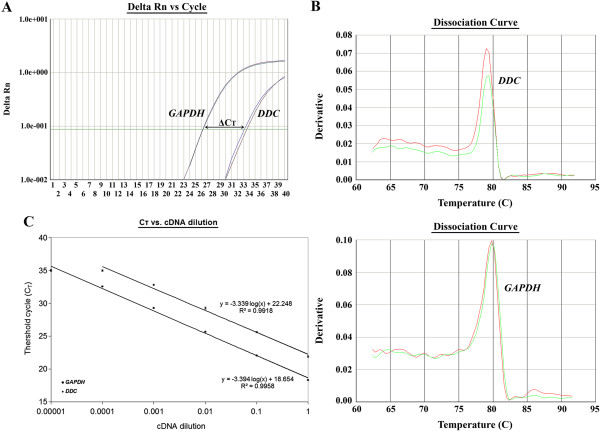
53 malignant tumors were resected from the larynx, pharynx, tongue, buccal mucosa, parotid glands, and nasal cavity, as well as from 34 adjacent non-cancerous tissues of HNSCC patients, and were homogenized. Total RNA was isolated and converted into first-strand cDNA. An ultrasensitive real-time PCR method based on the SYBR Green chemistry was used for DDC mRNA quantification in head and neck tissue specimens. Relative quantification was performed using the comparative Ct (2-ddCt) method.
DDC mRNA levels were lower in squamous cell carcinomas (SCCs) of the larynx and tongue than in adjacent non-cancerous tissue specimens. Furthermore, low DDC mRNA expression was noticed in laryngeal and tongue tumors of advanced TNM stage or bigger size, compared to early-stage or smaller tumors, respectively. No statistically significant differences were observed between SCCs resected from pharynx, buccal mucosa, or nasal cavity, and their normal counterparts.
This is the first study examining the DDC mRNA expression in HNSCC. According to our results, DDC mRNA expression may constitute a potential prognostic biomarker in tongue and/or larynx SCCs, which principally represent the overwhelming majority of HNSCC cases.
头颈部鳞状细胞癌(HNSCC)是全球最常见的恶性肿瘤之一。DDC 基因编码 L-多巴脱羧酶,该酶催化 L-多巴脱羧生成多巴胺。我们最近表明,DDC mRNA 是结直肠癌和前列腺癌患者预后的重要预测因子。本研究旨在分析 HNSCC 患者的 DDC mRNA 表达。
从喉、咽、舌、颊黏膜、腮腺和鼻腔的恶性肿瘤以及 34 例 HNSCC 患者的相邻非癌组织中切除了 53 个恶性肿瘤,并进行匀浆。分离总 RNA 并转化为第一链 cDNA。使用基于 SYBR Green 化学的超灵敏实时 PCR 方法对头颈部组织标本中的 DDC mRNA 进行定量。使用比较 Ct(2-ddCt)法进行相对定量。
喉和舌的鳞状细胞癌(SCC)中的 DDC mRNA 水平低于相邻的非癌组织标本。此外,与早期或较小的肿瘤相比,晚期或较大的喉和舌肿瘤中的 DDC mRNA 表达水平较低。在咽、颊黏膜或鼻腔切除的 SCC 与相应的正常组织之间未观察到统计学上的显著差异。
这是首次研究 HNSCC 中 DDC mRNA 的表达。根据我们的结果,DDC mRNA 表达可能是舌和/或喉 SCC 的潜在预后生物标志物,而舌和/或喉 SCC 主要代表绝大多数 HNSCC 病例。