Department of Pediatrics, University at Buffalo, School of Medicine and Biomedical Sciences, Farber Hall, Room G56, 3435 Main Street, Building #26, Buffalo, NY 14214-3000, United States.
Department of Pediatrics, University at Buffalo, School of Medicine and Biomedical Sciences, Farber Hall, Room G56, 3435 Main Street, Building #26, Buffalo, NY 14214-3000, United States.
Appetite. 2013 Jan;60(1):40-50. doi: 10.1016/j.appet.2012.08.030. Epub 2012 Oct 22.
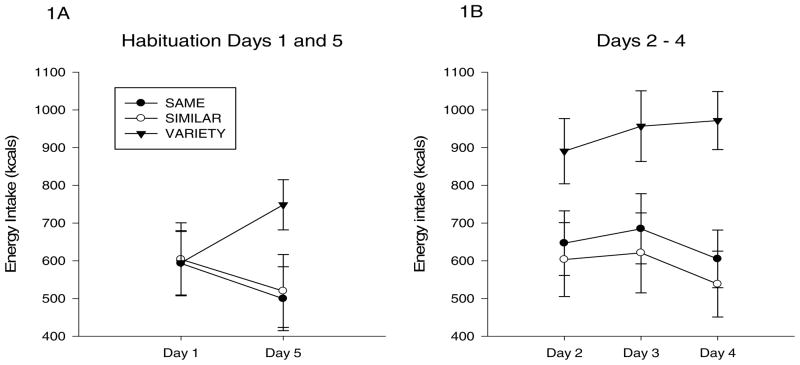
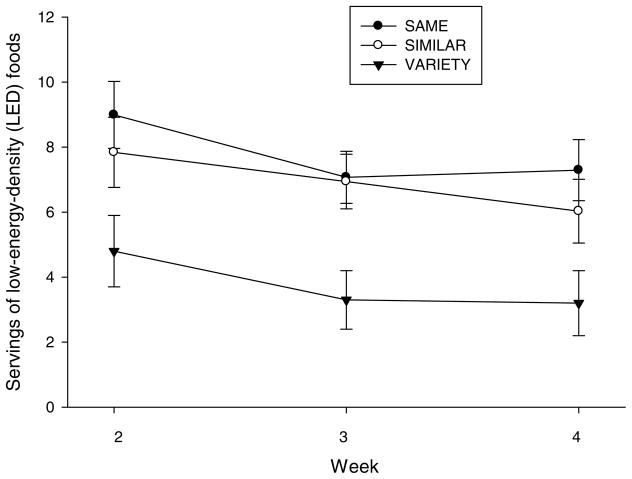
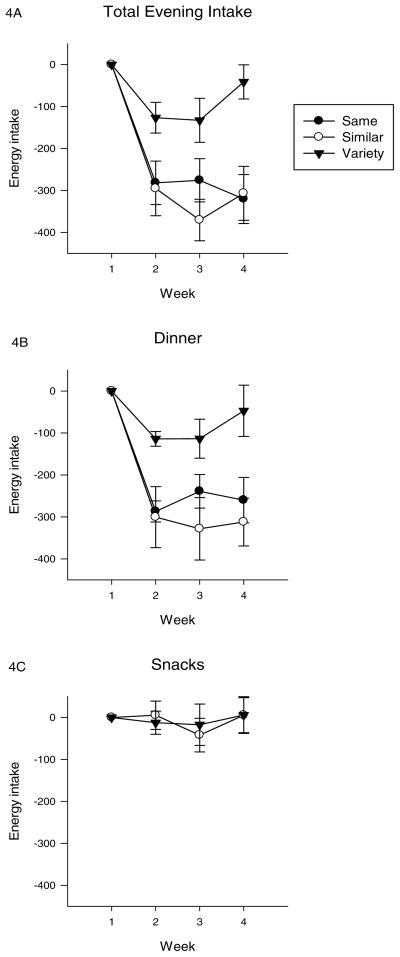
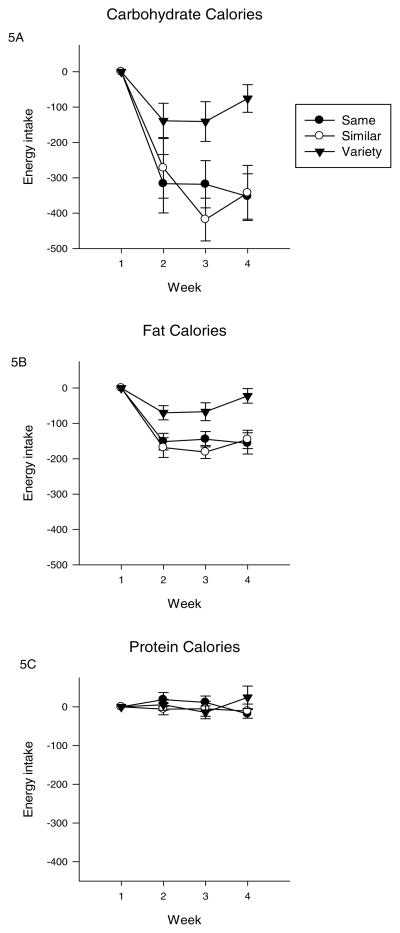
Greater food variety is related to increased energy intake, and one approach to reduce food intake is to reduce food variety. The effects of varying the variety of foods at the dinner meal to reduce energy intake was assessed in laboratory and field experiments. Experiment 1 randomly assigned 31 overweight children to one of three conditions that provided one laboratory meal per day over a week. Conditions were the SAME macaroni and cheese, SIMILAR types of macaroni and cheese, or a VARIETY of high-energy-dense foods. On days 1 and 5 all children consumed the same macaroni and cheese meal. Results showed significant differences in energy consumed between SAME and SIMILAR versus VARIETY from day 1 to 5, with SAME and SIMILAR decreasing and VARIETY increasing energy intake. Trials to habituation, a potential mechanism for the variety effect, showed the same pattern of between group differences as energy intake. Experiment 2 randomly assigned 30 overweight children to conditions that provided the SAME, SIMILAR or VARIETY of high-energy-dense entrees along with a variety of low-energy-dense dinner entrees to eat in their homes for 4 weeks. Results showed significant between group differences in energy intake across weeks, with significant decreases over weeks for the SAME and SIMILAR versus VARIETY groups. The pattern of results across the experiments shows the same pattern of reduction in energy intake if children eat the same or similar characteristics of foods (types of macaroni and cheese), which may provide ideas about how to develop dietary variety prescriptions that can reduce intake and be tested in clinical trials.
食物种类的增加与能量摄入的增加有关,而减少食物摄入的一种方法是减少食物种类。本研究在实验室和现场实验中评估了在晚餐中改变食物种类以减少能量摄入的效果。实验 1 将 31 名超重儿童随机分配到三种条件之一,这些条件在一周内每天提供一份实验室餐。条件为:相同的通心粉和奶酪、相似类型的通心粉和奶酪或多种高能量密度食物。在第 1 天和第 5 天,所有儿童均食用相同的通心粉和奶酪餐。结果显示,从第 1 天到第 5 天,相同和相似条件下消耗的能量与多种条件下消耗的能量存在显著差异,相同和相似条件下消耗的能量减少,而多种条件下消耗的能量增加。适应试验(一种可能的多样性效应机制)显示了与能量摄入相同的组间差异模式。实验 2 将 30 名超重儿童随机分配到相同、相似或多种高能量密度主菜条件下,并在家中提供各种低能量密度的晚餐主菜供其食用 4 周。结果显示,在 4 周的时间里,各组之间的能量摄入存在显著差异,与相同和相似组相比,多种组的能量摄入显著减少。两项实验的结果模式表明,如果儿童食用相同或相似特征的食物(通心粉和奶酪的类型),能量摄入会减少,这可能为如何制定可以减少摄入量并在临床试验中进行测试的饮食多样性处方提供思路。