AIDS Research Center, National Institute of Infectious Diseases Tokyo, Japan.
Front Microbiol. 2012 Oct 17;3:369. doi: 10.3389/fmicb.2012.00369. eCollection 2012.
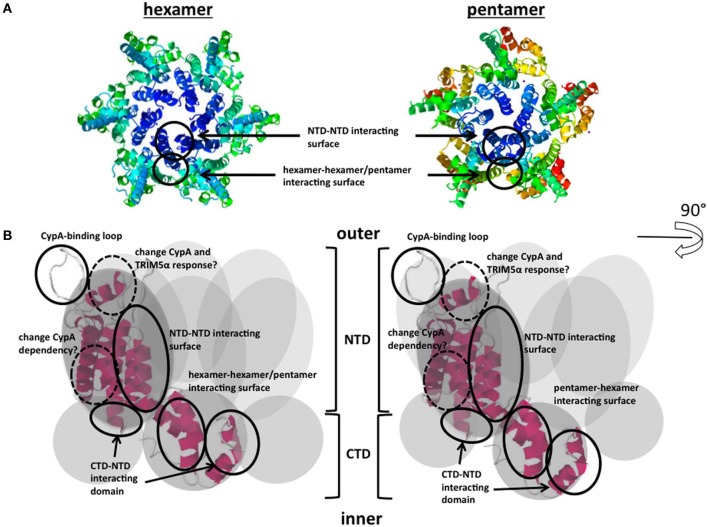
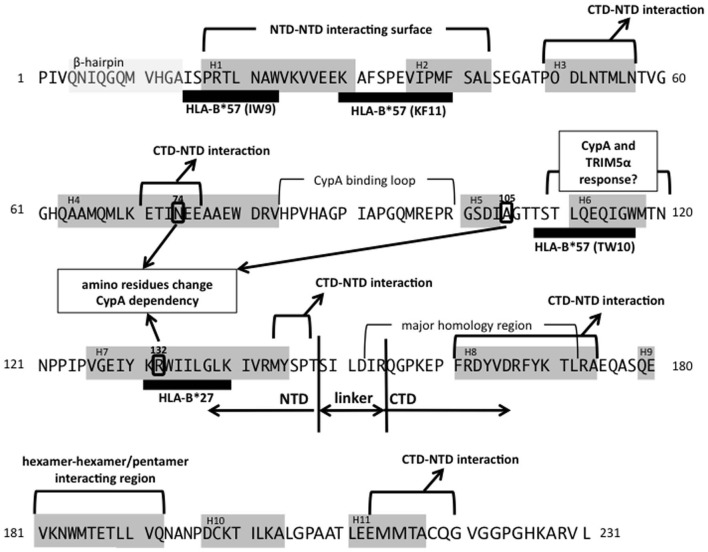
In mature HIV-1 particles, viral capsid (CA) proteins form the conical core structure that encapsidates two copies of the viral RNA genome. After fusion of the viral envelope and cellular membranes, the CA core enters into the cytoplasm of the target cells. CA proteins then interact with a variety of viral other protein as well as host factors, which may either support or inhibit replication of the virus. Recent studies have revealed that CA proteins are important not only for the uncoating step but also for the later nuclear import step. Identification of proteins that interact with CA to fulfill these functions is, therefore, important for understanding the unknown HIV-1 replication machinery. CA proteins can also be targets of the host immune response. Notably, some HLA-restricted cytotoxic T-lymphocyte (CTL) responses that recognize CA functional regions can greatly contribute to delay in AIDS progression. The multi-functionality of the CA protein may limit the flexible virus evolution and reduce the possibility of an escape mutant arising. The presence of many functional regions in CA protein may make it a potential target for effective therapies.
在成熟的 HIV-1 颗粒中,病毒衣壳(CA)蛋白形成锥形核心结构,将两个病毒 RNA 基因组包裹起来。在病毒包膜与细胞膜融合后,CA 核心进入靶细胞的细胞质。然后,CA 蛋白与各种病毒其他蛋白以及宿主因子相互作用,这些蛋白可能支持或抑制病毒的复制。最近的研究表明,CA 蛋白不仅对脱壳步骤很重要,而且对后续的核输入步骤也很重要。因此,鉴定与 CA 相互作用以完成这些功能的蛋白质对于了解未知的 HIV-1 复制机制非常重要。CA 蛋白也可以成为宿主免疫反应的靶标。值得注意的是,一些识别 CA 功能区域的 HLA 限制性细胞毒性 T 淋巴细胞(CTL)反应可以极大地延缓 AIDS 的进展。CA 蛋白的多功能性可能限制了病毒的灵活进化,并降低了产生逃逸突变体的可能性。CA 蛋白中存在许多功能区域,这使其成为有效治疗的潜在靶标。