Semiarid Prairie Agricultural Research Centre, Agriculture and Agri-Food Canada, Swift Current, Saskatchewan, Canada.
PLoS One. 2012;7(10):e45153. doi: 10.1371/journal.pone.0045153. Epub 2012 Oct 10.
Shorter growing season and water stress near wheat maturity are the main factors that presumably limit the yield potential of spring wheat due to late seeding in Saskatchewan, Canada. Advancing seeding dates can be a strategy to help producers mitigate the impact of climate change on spring wheat. It is unknown, however, how early farmers can seed while minimizing the risk of spring frost damage and the soil and machinery constraints.
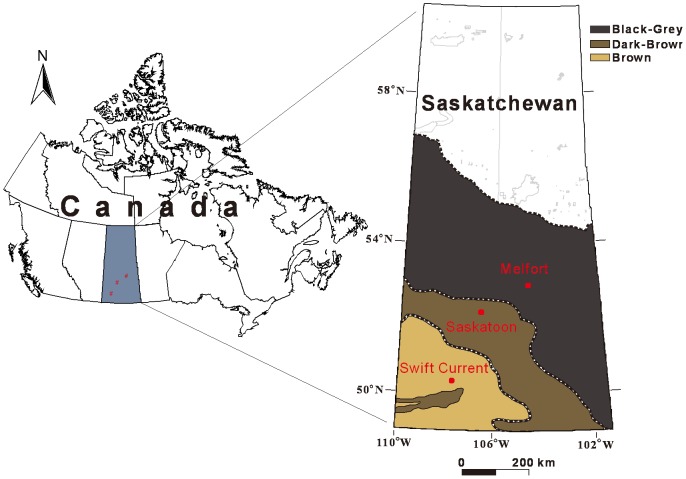
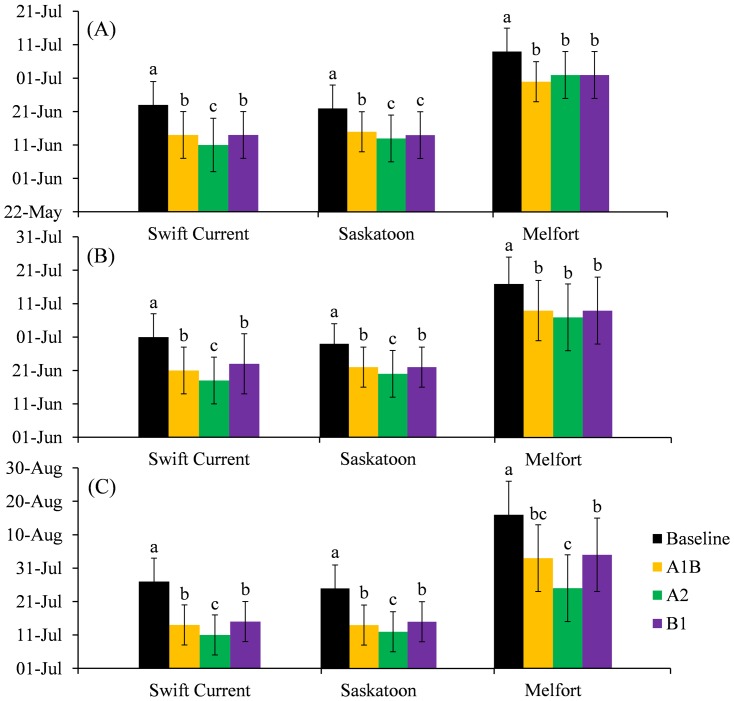
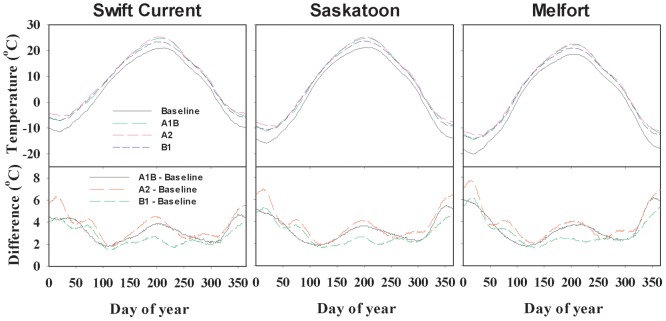
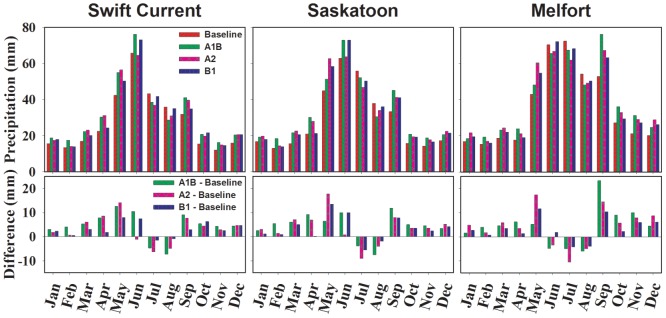
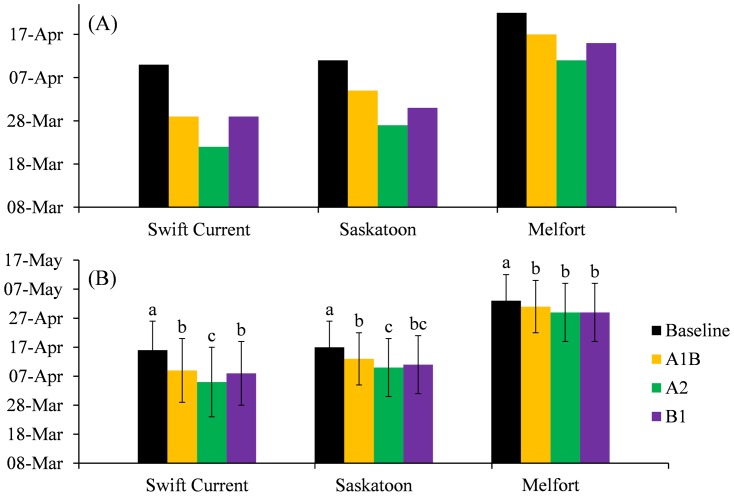
METHODOLOGY/PRINCIPAL FINDINGS: This paper explores early seeding dates of spring wheat on the Canadian Prairies under current and projected future climate. To achieve this, (i) weather records from 1961 to 1990 were gathered at three sites with different soil and climate conditions in Saskatchewan, Canada; (ii) four climate databases that included a baseline (treated as historic weather climate during the period of 1961-1990) and three climate change scenarios (2040-2069) developed by the Canadian global climate model (GCM) with the forcing of three greenhouse gas (GHG) emission scenarios (A2, A1B and B1); (iii) seeding dates of spring wheat (Triticum aestivum L.) under baseline and projected future climate were predicted. Compared with the historical record of seeding dates, the predicted seeding dates were advanced under baseline climate for all sites using our seeding date model. Driven by the predicted temperature increase of the scenarios compared with baseline climate, all climate change scenarios projected significantly earlier seeding dates than those currently used. Compared to the baseline conditions, there is no reduction in grain yield because precipitation increases during sensitive growth stages of wheat, suggesting that there is potential to shift seeding to an earlier date. The average advancement of seeding dates varied among sites and chosen scenarios. The Swift Current (south-west) site has the highest potential for earlier seeding (7 to 11 days) whereas such advancement was small in the Melfort (north-east, 2 to 4 days) region.
CONCLUSIONS/SIGNIFICANCE: The extent of projected climate change in Saskatchewan indicates that growers in this region have the potential of earlier seeding. The results obtained in this study may be used for adaptation assessments of seeding dates under possible climate change to mitigate the impact of potential warming.
在加拿大萨斯喀彻温省,由于春季播种较晚,较短的生长季节和接近小麦成熟时的水分胁迫,据推测这是限制春小麦产量潜力的主要因素。提前播种日期可以帮助生产者缓解气候变化对春小麦的影响。然而,目前还不清楚农民可以多早播种,同时最大限度地降低春季霜害风险以及土壤和机械限制的风险。
方法/主要发现:本文探讨了在当前和未来预计的气候条件下,萨斯喀彻温省草原上春小麦的早期播种日期。为此,(i)在加拿大萨斯喀彻温省三个具有不同土壤和气候条件的地点收集了 1961 年至 1990 年的天气记录;(ii)使用加拿大全球气候模式(GCM)生成的四个气候数据库,包括一个基线(在 1961-1990 年期间被视为历史天气气候)和三个气候变化情景(2040-2069 年),其中温室气体(GHG)排放情景(A2、A1B 和 B1)对其进行了强制;(iii)预测了在基线和预计未来气候条件下春小麦(Triticum aestivum L.)的播种日期。与所有地点的历史播种日期记录相比,使用我们的播种日期模型,在基线气候下,预测的播种日期提前了。由于与基线气候相比,情景预测的温度升高,所有气候变化情景都预测出比目前使用的播种日期更早的日期。与基线条件相比,由于小麦敏感生长阶段的降水增加,谷物产量没有减少,这表明有可能将播种日期提前。播种日期的提前程度因地点和所选情景而异。斯威夫特卡伦特(西南)地点的播种日期提前潜力最大(7 至 11 天),而梅尔福特(东北,2 至 4 天)地区的这种提前程度较小。
结论/意义:萨斯喀彻温省预计的气候变化程度表明,该地区的种植者有可能提前播种。本研究获得的结果可用于适应可能的气候变化下播种日期的评估,以缓解潜在变暖的影响。