Physiology Unit, Football Performance and Science Department, ASPIRE Academy for Sports Excellence Doha, Qatar.
Front Physiol. 2012 Oct 22;3:406. doi: 10.3389/fphys.2012.00406. eCollection 2012.
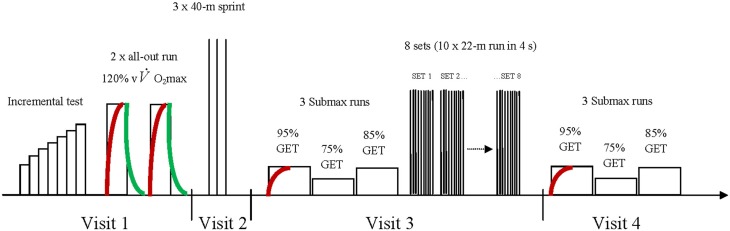
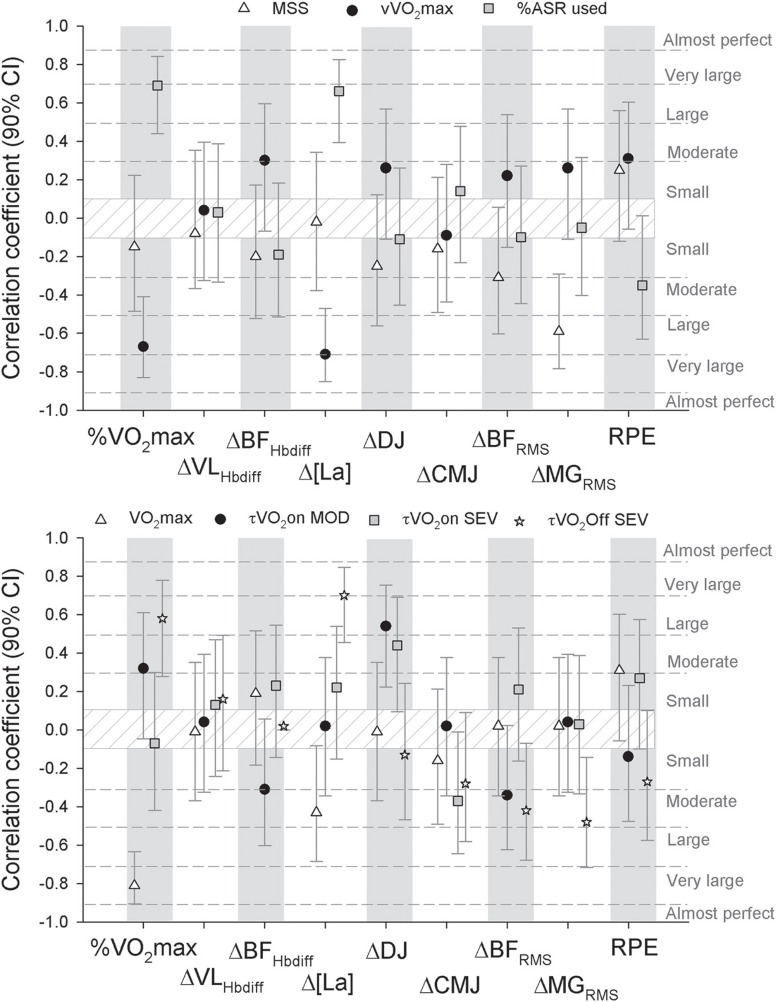
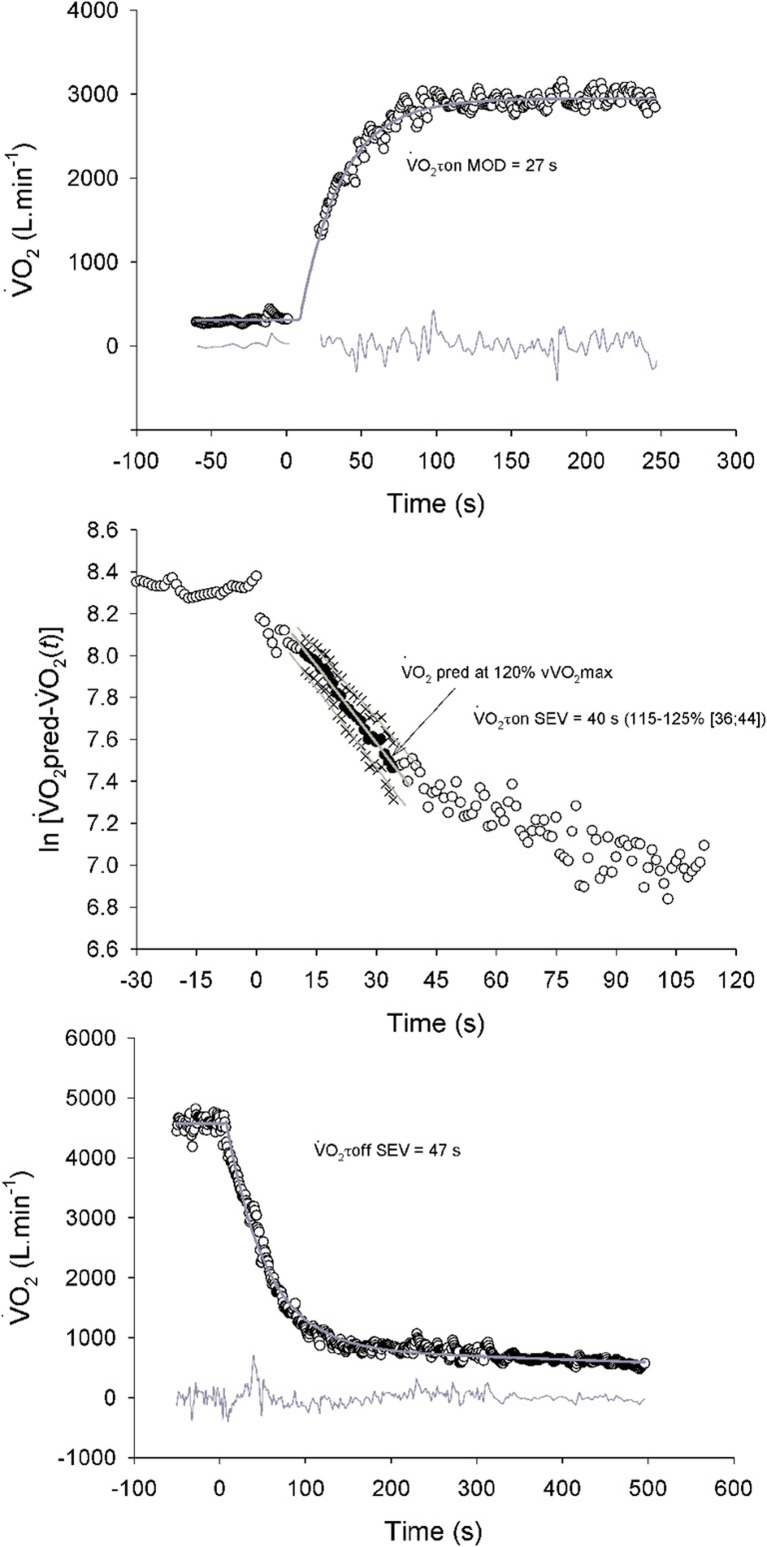
We examined the respective associations between aerobic fitness ([Formula: see text]max), metabolic control ([Formula: see text] kinetics) and locomotor function, and various physiological responses to high-intensity intermittent (HIT) running exercise in team sport players. Eleven players (30.5 ± 3.6 year) performed a series of tests to determine their [Formula: see text]max and the associated velocity (v[Formula: see text]max), maximal sprinting speed (MSS) and [Formula: see text] kinetics at exercise onset in the moderate and severe intensity domains, and during recovery ([Formula: see text] SEV). Cardiorespiratory variables, oxygenation and electromyography of lower limbs muscles and blood lactate ([La]) concentration were collected during a standardized HIT protocol consisting in 8 sets of 10, 4-s runs. During HIT, four players could not complete more than two sets; the others finished at least five sets. Metabolic responses to the two first sets of HIT were negatively correlated with [Formula: see text]max, v[Formula: see text]max, and [Formula: see text] SEV (r = -0.6 to -0.8), while there was no clear relationship with the other variables. [Formula: see text], oxygenation and [La] responses to the first two sets of HIT were the only variables that differed between the players which could complete at least five sets or those who could not complete more than two sets. Players that managed to run at least five sets presented, in comparison with the others, greater v[Formula: see text]max [ES = +1.5(0.4; 2.7), MSS(ES = +1.0(0.1; 1.9)] and training load [ES = +3.8 (2.8; 4.9)]. There was no clear between-group difference in any of the [Formula: see text] kinetics measures [e.g., ES = -0.1(-1.4; 1.2) for [Formula: see text] SEV]. While [Formula: see text]max and v[Formula: see text]max are likely determinant for HIT tolerance, the importance of [Formula: see text] kinetics as assessed in this study appears limited in the present population. Knowing the main factors influencing tolerance to HIT running exercise may assist practitioners in personalizing training interventions.
我们研究了有氧适能 ([Formula: see text]max)、代谢控制 ([Formula: see text] 动力学) 和运动功能与团队运动运动员高强度间歇 (HIT) 跑步运动各种生理反应之间的关系。11 名运动员(30.5 ± 3.6 岁)进行了一系列测试,以确定他们的 [Formula: see text]max 及其相关速度 (v[Formula: see text]max)、最大冲刺速度 (MSS) 和中度和重度强度域运动起始时的 [Formula: see text] 动力学,以及恢复期间 ([Formula: see text] SEV)。在一项标准化 HIT 方案中,运动员进行了 8 组 10 次、4 秒跑,在此过程中收集了心肺变量、下肢肌肉的氧合和肌电图以及血液乳酸 ([La]) 浓度。在 HIT 期间,有四名运动员无法完成超过两组;其余人至少完成了五组。HIT 的前两组的代谢反应与 [Formula: see text]max、v[Formula: see text]max 和 [Formula: see text] SEV 呈负相关(r = -0.6 至 -0.8),而与其他变量没有明显关系。HIT 的前两组的 [Formula: see text]、氧合和 [La] 反应是能够完成至少五组的运动员与不能完成超过两组的运动员之间唯一的变量差异。与其他运动员相比,能够至少完成五组的运动员具有更大的 v[Formula: see text]max [ES = +1.5(0.4; 2.7),MSS(ES = +1.0(0.1; 1.9)] 和训练负荷 [ES = +3.8 (2.8; 4.9)]。在任何 [Formula: see text] 动力学测量中,两组之间都没有明显的差异[例如,[Formula: see text] SEV 的 ES = -0.1(-1.4; 1.2)]。虽然 [Formula: see text]max 和 v[Formula: see text]max 可能是 HIT 耐受性的决定因素,但在本研究中评估的 [Formula: see text] 动力学的重要性在当前人群中似乎有限。了解影响 HIT 跑步运动耐受性的主要因素可能有助于从业者个性化训练干预措施。