Paquette Myriam, Bieuzen François, Billaut François
Département de kinésiologie, Université Laval, Quebec, QC, Canada.
Institut National du sport du Québec, Montreal, QC, Canada.
Front Sports Act Living. 2019 Jul 31;1:6. doi: 10.3389/fspor.2019.00006. eCollection 2019.
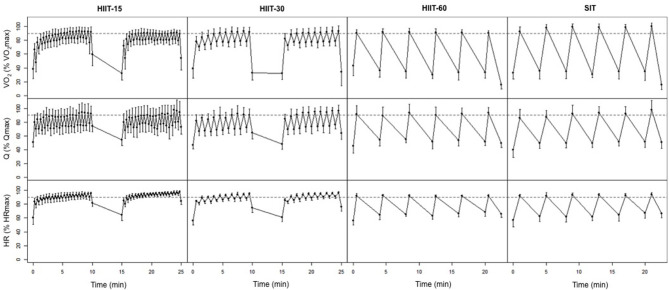
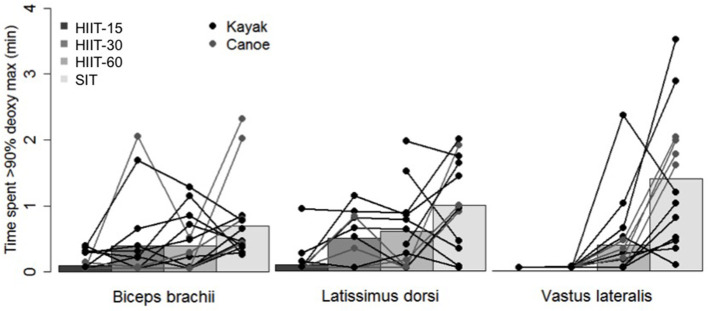
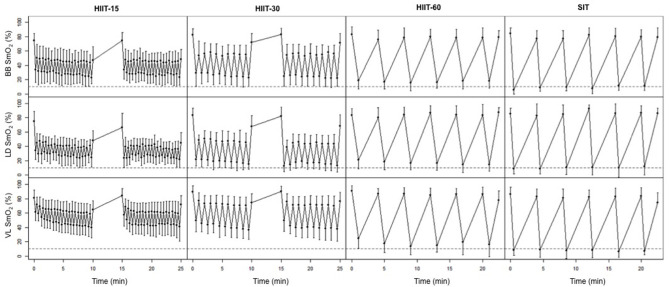
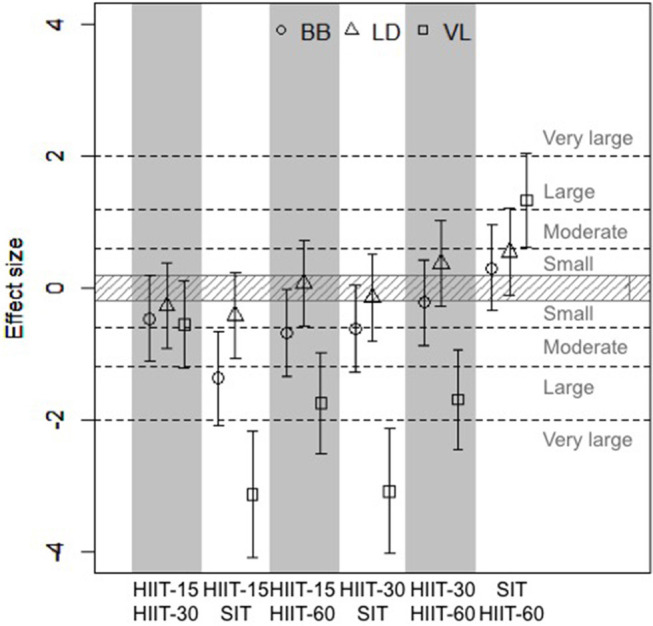
Recent data suggests that peripheral adaptations, i.e., the muscle ability to extract and use oxygen, may be a stronger predictor of canoe-kayak sprint performance compared to VOmax or central adaptations. If maximizing the time near VOmax during high-intensity interval training (HIIT) sessions is believed to optimize central adaptations, maximizing the time near maximal levels of muscle desaturation could represent a critical stimulus to optimize peripheral adaptations. Therefore, the purpose of this study was to assess the VO, muscle oxygenation and cardiac output responses to various HIIT sessions, and to determine which type of HIIT elicits the lowest muscle oxygenation and the longest cumulated time at low muscle O saturation. Thirteen well-trained canoe-kayak athletes performed an incremental test to determine VOmax and peak power output (PPO), and 4 HIIT sessions (HIIT-15: 40x[15 s at 115%PPO, 15 s at 30%PPO]; HIIT-30: 20x[30 s at 115%PPO, 30 s at 30%PPO]; HIIT-60: 6x[1 min at 130%PPO, 3 min rest]; sprint interval training (SIT): 6x[30 s all-out, 3 min 30 rest]) on a canoe or kayak ergometer. Portable near-infrared spectroscopy monitors were placed on the (LD), (BB), and (VL) during every session to assess changes in muscle O saturation (SmO, % of physiological range). HIIT-15 and HIIT-30 elicited a longer time >90%VOmax (HIIT-15: 8.1 ± 6.2 min, HIIT-30: 6.8 ± 4.6 min), compared to SIT (1.7 ± 1.3 min, = 0.006 and = 0.035) but not HIIT-60 (4.1 ± 1.7 min). SIT and HIIT-60 elicited the lowest SmO in the VL (SIT: 0 ± 1%, HIIT-60: 8 ± 9%) compared to HIIT-15 (26 ± 12%, < 0.001 and = 0.007) and HIIT-30 (25 ± 12%, < 0.001 and = 0.030). SIT produced the longest time at >90% of maximal deoxygenation in all 3 muscles, with effect sizes ranging from small to very large. Short HIIT performed on a canoe/kayak ergometer elicits the longest time near VOmax, potentially conducive to VOmax improvements, but SIT is needed in order to maximize muscle deoxygenation during training, which would potentially conduct to greater peripheral adaptations.
近期数据表明,外周适应性,即肌肉摄取和利用氧气的能力,相比于最大摄氧量(VOmax)或中枢适应性,可能是皮划艇短距离冲刺成绩更强有力的预测指标。如果认为在高强度间歇训练(HIIT)期间使接近VOmax的时间最大化可优化中枢适应性,那么使接近肌肉去饱和最大水平的时间最大化可能是优化外周适应性的关键刺激因素。因此,本研究的目的是评估不同HIIT训练对VO、肌肉氧合和心输出量的反应,并确定哪种类型的HIIT能引发最低的肌肉氧合以及在低肌肉氧饱和度下最长的累积时间。13名训练有素的皮划艇运动员进行了递增测试以确定VOmax和峰值功率输出(PPO),并在皮划艇测力计上进行了4次HIIT训练(HIIT - 15:40次[115%PPO下15秒,30%PPO下15秒];HIIT - 30:20次[115%PPO下30秒,30%PPO下30秒];HIIT - 60:6次[130%PPO下1分钟,休息3分钟];冲刺间歇训练(SIT):6次[全力冲刺30秒,休息3分30秒])。每次训练期间,便携式近红外光谱监测仪被放置在(此处原文缺失具体肌肉名称,暂用括号代替)外侧阔肌(LD)、股直肌(BB)和股外侧肌(VL)上,以评估肌肉氧饱和度(SmO,生理范围的百分比)的变化。与SIT(1.7±1.3分钟,P = 0.006和P = 0.035)相比,HIIT - 15和HIIT - 30引发的超过90%VOmax的时间更长(HIIT - 15:8.1±6.2分钟,HIIT - 30:6.8±4.6分钟),但HIIT - 60(4.1±1.7分钟)并非如此。与HIIT - 15(26±12%,P < 0.001和P = 0.007)和HIIT - 30(25±12%,P < 0.001和P = 0.030)相比,SIT和HIIT - 60在股外侧肌中引发的SmO最低(SIT:0±1%,HIIT - 60:8±9%)。SIT在所有3块肌肉中产生的超过最大去氧90%的时间最长,效应大小从小到非常大不等。在皮划艇测力计上进行的短时间HIIT引发接近VOmax的最长时间,可能有助于提高VOmax,但为了在训练期间使肌肉去氧最大化则需要进行SIT,这可能会带来更大的外周适应性。