Lee Myung Chul, Kim Hye Young, Kong Seom Gim, Kim Young Mi, Park Su Eun, Im Young Tak, Park Hee Ju
Department of Pediatrics, Seoul National University College of Medicine, Seoul, Korea.
Tuberc Respir Dis (Seoul). 2012 Jun;72(6):493-500. doi: 10.4046/trd.2012.72.6.493. Epub 2012 Jun 29.
This study investigated the clinical characteristics and risk factors of the severity of pandemic influenza A (H1N1) 2009 infection in pediatric patients in Busan and Gyeongsangnam-do.
Cases of influenza A (H1N1) 2009 in patients under the age of 18 years, confirmed by reverse transcription polymerase chain reaction, at Pusan National University Hospital and Pusan National University Yangsan Hospital from the last week of August 2009 through the last week of February 2010 were retrospectively analyzed.
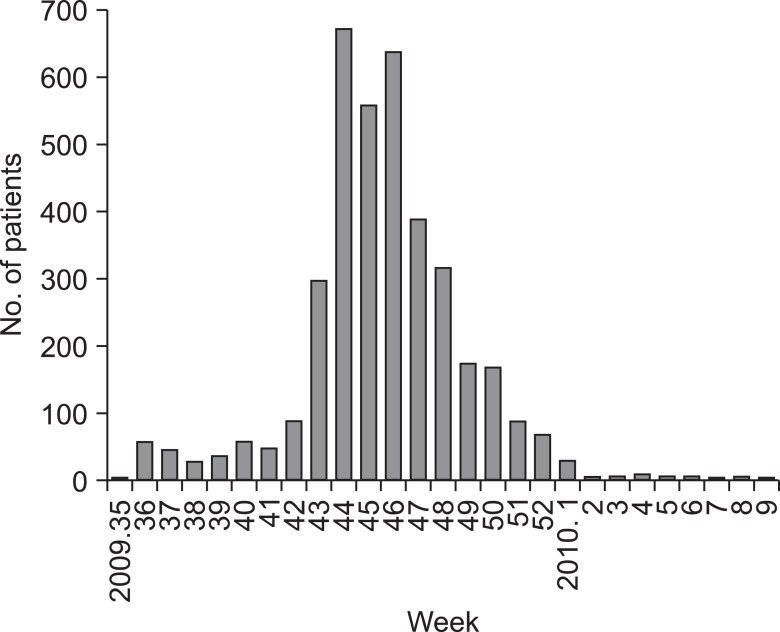
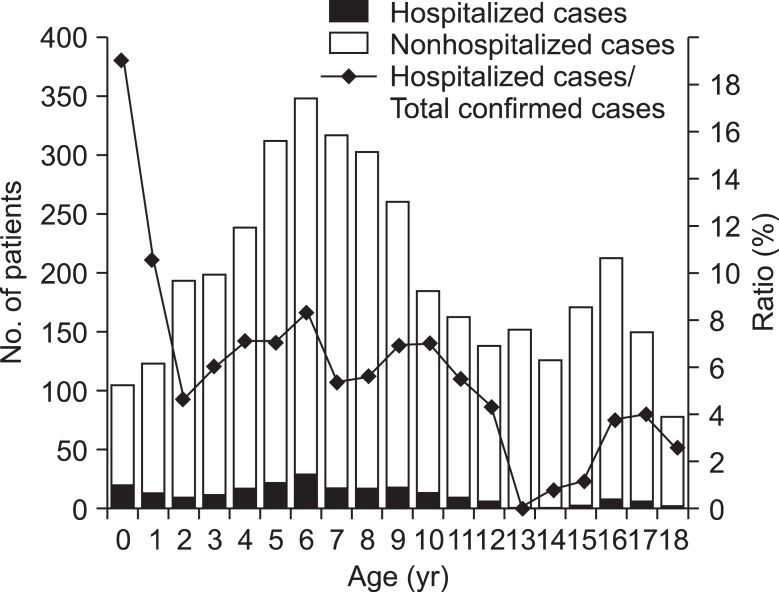
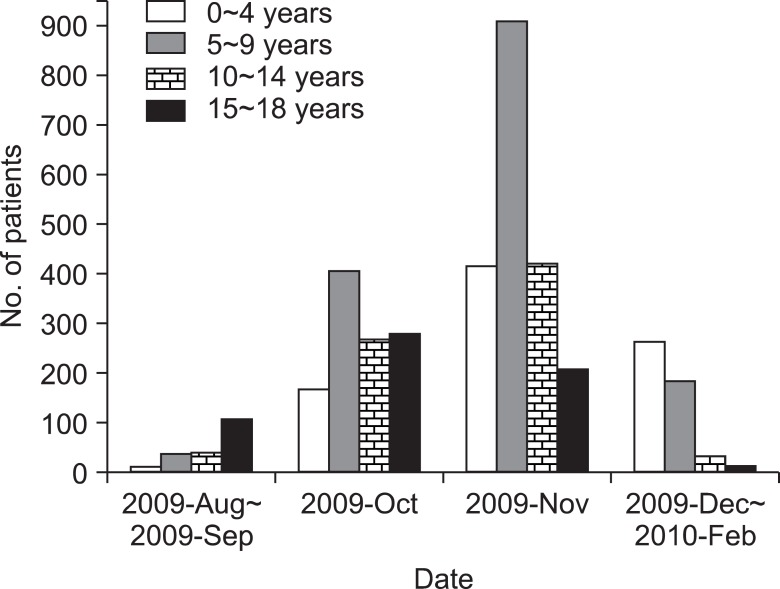
Of the 3,777 confirmed cases of influenza A (H1N1) 2009, 2,200 (58.2%) were male and 1,577 (41.8%) were female. The average age of the patients was 8.4±4.8 years. The total cases peaked during 44th to 46th week. Most of the patients were in the 5- to 9-year-old age group. Oseltamivir was administered to 2,959 (78.3%) of the patients. 221 patients (5.9%) were hospitalized, age an average of 6.7±4.5 years. The average duration of hospitalization was 7.4±5.6 days. One hundred cases (45.2%) had pneumonia. Risk factors for hospitalization included male gender, <2 years of age, and underlying disease. Children with asthma were at very high risk of hospitalization, over 20 times the non-asthmatic children (odds ratio [OR], 21.684; confidence interval [CI], 13.29539.791). Likewise the children with neurologic deficits faced a 16 times higher risk (OR, 15.738; CI, 7.96131.111). Ten of the patients (4.5%) were admitted to the intensive care unit, and eight (3.6%) required mechanical ventilation.
Of the pediatric patients with pandemic influenza A (H1N1) 2009, most of the patients were in the 5- to 9-year-old age group. Risk factors for hospitalization included male gender, <2 years of age, and underlying disease. The most common complication was pneumonia. The very high risk of severe morbidity in children with asthma or neurologic disease shows the critical importance of targeted vaccine coverage, special awareness and swift care by both guardians and primary care providers.
本研究调查了釜山和庆尚南道地区儿童感染2009年甲型H1N1流感大流行的临床特征及病情严重程度的危险因素。
回顾性分析了2009年8月最后一周至2010年2月最后一周在釜山国立大学医院和釜山国立大学梁山医院确诊的18岁以下甲型H1N1流感患者病例,确诊方法为逆转录聚合酶链反应。
在3777例确诊的2009年甲型H1N1流感病例中,男性2200例(58.2%),女性1577例(41.8%)。患者的平均年龄为8.4±4.8岁。病例总数在第44至46周达到峰值。大多数患者年龄在5至9岁之间。2959例(78.3%)患者接受了奥司他韦治疗。221例(5.9%)患者住院,平均年龄为6.7±4.5岁。平均住院时间为7.4±5.6天。100例(45.2%)患有肺炎。住院的危险因素包括男性、2岁以下以及有基础疾病。哮喘患儿住院风险非常高,是非哮喘患儿的20多倍(优势比[OR],21.684;可信区间[CI],13.29539.791)。同样,有神经功能缺陷的儿童面临的风险高16倍(OR,15.738;CI,7.96131.111)。10例患者(4.5%)入住重症监护病房,8例(3.6%)需要机械通气。
在2009年甲型H1N1流感大流行的儿童患者中,大多数患者年龄在5至9岁之间。住院的危险因素包括男性、2岁以下以及有基础疾病。最常见的并发症是肺炎。哮喘或神经疾病患儿发生严重疾病的风险非常高,这表明针对性疫苗接种、监护人及初级保健提供者的特别关注和迅速护理至关重要。