Institute for Public Health, UMIT, The Health and Life Sciences University Hall, Tyrol, Austria.
BMC Public Health. 2012 Oct 26;12:909. doi: 10.1186/1471-2458-12-909.
Using a data set of works councils of trade union IG Metal, this paper investigates psychosocial stress and strain on this specific group in comparison to employees working in administration in general (leadership and non-leadership-role) and a national reference value.
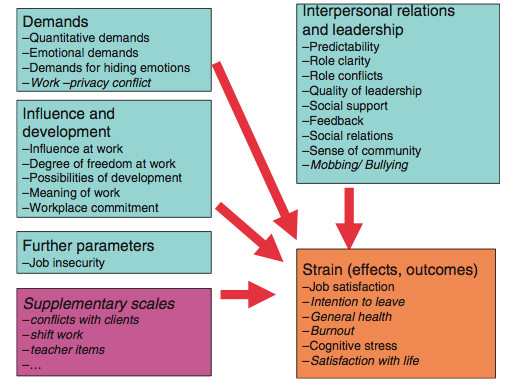
For assessing psychosocial work factors on works councils within the sector represented by the trade union IG Metal in Germany, a research by using the German standard version of COPSOQ (Copenhagen Psychosocial Questionnaire) was performed. The instrument includes 87 single items forming 25 aspects of strain and stress. Results from the study group of works councils were compared to those from employees working in administration and to the general population mean (COPSOQ database). Statistical analysis included t-tests, analysis of variance and multiple comparisons of means. To be significant in terms of statistics, p<0.05 (two-tailed) and a minimum deviation of 5 or more points between groups' mean values identify the relevant values.
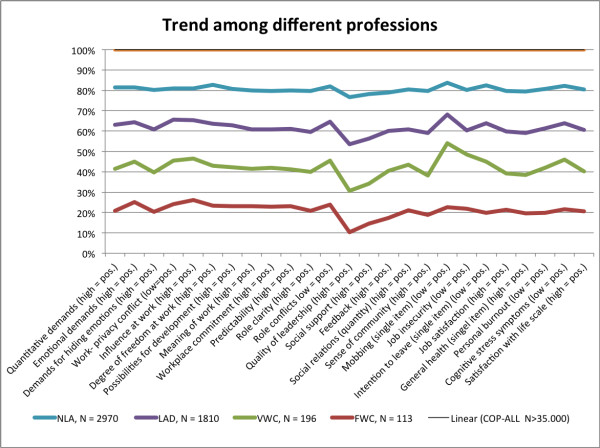
All in all, 309 works councils from a national survey of the German chemical and metalworking industries took part in the study. 113 were full-time works council members (exempted from the duty to perform their regular work), 196 were voluntary members (acting as employee representatives on an honorary basis alongside their normal duties). Comparison between works councils and employees working in administration (leadership roles (N=1810) and non-leadership roles (N=2970)) and for employees in general (N=35.000) showed unfavourable values for works councils for most scales. Significantly higher values indicating higher strain and stress were found for the scales: emotional demands, work-privacy conflict, role conflicts, mobbing, cognitive stress symptoms and burnout. Unfavourable results were obtained for the aspects: quality of leadership, social support, sense of community and general health. Favourable findings were found on the scales: influence at work, quantity of social relations and the partly positive values for quantitative demands and commitment to the workplace.
Compared to the reference groups, works council members perceive the psychosocial demands of working life as more exhausting for the majority of aspects. This allows several conclusions. One reason may be the extended tasks employee representatives face, an other may be that the education of most works council members does not seem appropriate to the high demands of their managerial and executive tasks.
本文使用德国金属行业工会 IG Metall 的职工会理事会的数据,研究了与一般行政管理人员(领导和非领导角色)以及全国参考值相比,这一特定群体的心理社会压力和紧张程度。
为了评估德国金属行业工会代表部门内职工会理事会的心理社会工作因素,采用了德国版 COPSOQ(哥本哈根心理社会问卷)进行研究。该工具包括 87 个单项,形成了 25 个压力和紧张方面。将职工会理事会的研究组结果与行政管理人员和一般人群平均值(COPSOQ 数据库)进行比较。统计分析包括 t 检验、方差分析和均值多重比较。统计学上有意义的结果是 p<0.05(双侧)和组间均值差值至少为 5 或更多,以确定相关值。
共有来自德国化工和金属行业全国调查的 309 名职工会理事会成员参加了研究。其中 113 名为全职职工会理事(免除履行其正常工作的义务),196 名为志愿理事(在履行正常职责的同时,以荣誉身份担任员工代表)。与行政管理人员(领导角色(N=1810)和非领导角色(N=2970))和一般员工(N=35000)相比,职工会理事会的大多数指标值都不利。在情绪需求、工作隐私冲突、角色冲突、骚扰、认知压力症状和倦怠等方面,职工会理事会的得分明显更高,表明压力和紧张程度更高。在领导质量、社会支持、社区意识和一般健康方面的结果不理想。在工作影响力、社会关系数量以及对定量要求和对工作场所的承诺的部分积极价值方面,发现了有利的结果。
与参考组相比,职工会理事普遍认为工作生活的心理社会需求更具挑战性。这可以得出几个结论。一个原因可能是员工代表面临的扩展任务,另一个原因可能是大多数职工会理事的教育似乎不符合他们管理和执行任务的高要求。