Fuss Isabelle, Nübling Matthias, Hasselhorn Hans-Martin, Schwappach David, Rieger Monika A
Department of Occupational and Environmental Medicine, Institute of General Practice and Family Medicine, Faculty of Medicine, University Witten/Herdecke, Alfred-Herrhausen-Str. 50, 58448 Witten, Germany.
BMC Public Health. 2008 Oct 7;8:353. doi: 10.1186/1471-2458-8-353.
Germany currently experiences a situation of major physician attrition. The incompatibility between work and family has been discussed as one of the major reasons for the increasing departure of German physicians for non-clinical occupations or abroad. This study investigates predictors for one particular direction of Work-Family Conflict--namely work interfering with family conflict (WIF)--which are located within the psychosocial work environment or work organisation of hospital physicians. Furthermore, effects of WIF on the individual physicians' physical and mental health were examined. Analyses were performed with an emphasis on gender differences. Comparisons with the general German population were made.
Data were collected by questionnaires as part of a study on Psychosocial work hazards and strains of German hospital physicians during April-July 2005. Two hundred and ninety-six hospital physicians (response rate 38.9%) participated in the survey. The Copenhagen Psychosocial Questionnaire (COPSOQ), work interfering with family conflict scale (WIF), and hospital-specific single items on work organisation were used to assess WIF, its predictors, and consequences.
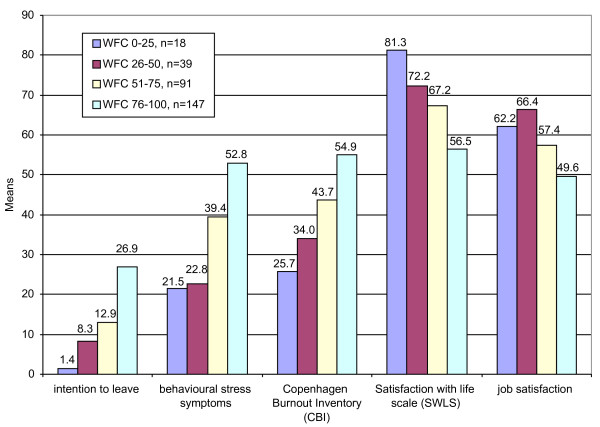
German hospital physicians reported elevated levels of WIF (mean = 74) compared to the general German population (mean = 45, p < .01). No significant gender difference was found. Predictors for the WIF were lower age, high quantitative demands at work, elevated number of days at work despite own illness, and consequences of short-notice changes in the duty roster. Good sense of community at work was a protective factor. Compared to the general German population, we observed a significant higher level of quantitative work demands among hospital physicians (mean = 73 vs. mean = 57, p < .01). High values of WIF were significantly correlated to higher rates of personal burnout, behavioural and cognitive stress symptoms, and the intention to leave the job. In contrast, low levels of WIF predicted higher job satisfaction, better self-judged general health status, better work ability, and higher satisfaction with life in general. Compared to the German general population, physicians showed significantly higher levels of individual stress and quality of life as well as lower levels for well-being. This has to be judged as an alerting finding regarding the state of physicians' health.
In our study, work interfering with family conflict (WIF) as part of Work-Family Conflict (WFC) was highly prevalent among German hospital physicians. Factors of work organisation as well as factors of interpersonal relations at work were identified as significant predictors for WIF. Some of these predictors are accessible to alteration by improving work organisation in hospitals.
德国目前正面临着严重的医生流失问题。工作与家庭的不相容被认为是德国医生越来越多地转向非临床职业或出国工作的主要原因之一。本研究调查了医院医生心理社会工作环境或工作组织中特定方向的工作-家庭冲突——即工作干扰家庭冲突(WIF)的预测因素。此外,还研究了WIF对个体医生身心健康的影响。分析重点关注性别差异,并与德国普通人群进行了比较。
作为2005年4月至7月德国医院医生心理社会工作危害与压力研究的一部分,通过问卷调查收集数据。296名医院医生(回复率38.9%)参与了调查。使用哥本哈根心理社会问卷(COPSOQ)、工作干扰家庭冲突量表(WIF)以及医院特定的工作组织单项指标来评估WIF、其预测因素和后果。
与德国普通人群(均值=45,p<.01)相比,德国医院医生报告的WIF水平较高(均值=74)。未发现显著的性别差异。WIF的预测因素包括年龄较小、工作中的高工作量要求、即使生病仍工作的天数增加以及值班表临时变更的后果。工作中的良好社区感是一个保护因素。与德国普通人群相比,我们观察到医院医生的工作量要求显著更高(均值=73对均值=57,p<.01)。WIF的高值与个人倦怠、行为和认知压力症状的较高发生率以及离职意愿显著相关。相比之下,低水平的WIF预示着更高的工作满意度、更好的自我判断总体健康状况、更好的工作能力以及更高总体生活满意度。与德国普通人群相比,医生表现出显著更高的个人压力和生活质量水平以及更低的幸福感水平。这一发现对于医生的健康状况而言必须被视为一个警示信号。
在我们的研究中,作为工作-家庭冲突(WFC)一部分的工作干扰家庭冲突(WIF)在德国医院医生中非常普遍。工作组织因素以及工作中的人际关系因素被确定为WIF的重要预测因素。通过改善医院的工作组织,其中一些预测因素是可以改变的。
