Ulhassan Waqar, von Thiele Schwarz Ulrica, Thor Johan, Westerlund Hugo
Department of Learning, Informatics, Management and Ethics, Medical Management Centre, Karolinska Institutet, Plan 5, Tomtebodavägen 18A, SE-17165 Stockholm, Sweden.
BMC Health Serv Res. 2014 Oct 22;14:480. doi: 10.1186/1472-6963-14-480.
As health care struggles to meet increasing demands with limited resources, Lean has become a popular management approach. It has mainly been studied in relation to health care performance. The empirical evidence as to how Lean affects the psychosocial work environment has been contradictory. This study aims to study the interaction between Lean and the psychosocial work environment using a comprehensive model that takes Lean implementation information, as well as Lean theory and the particular context into consideration.
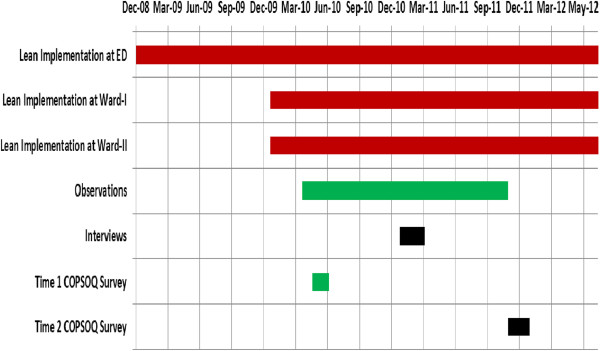
The psychosocial work environment was measured twice with the Copenhagen Psychosocial Questionnaire (COPSOQ) employee survey during Lean implementations on May-June 2010 (T1) (n = 129) and November-December 2011 (T2) (n = 131) at three units (an Emergency Department (ED), Ward-I and Ward-II). Information based on qualitative data analysis of the Lean implementations and context from a previous paper was used to predict expected change patterns in the psychosocial work environment from T1 to T2 and subsequently compared with COPSOQ-data through linear regression analysis.
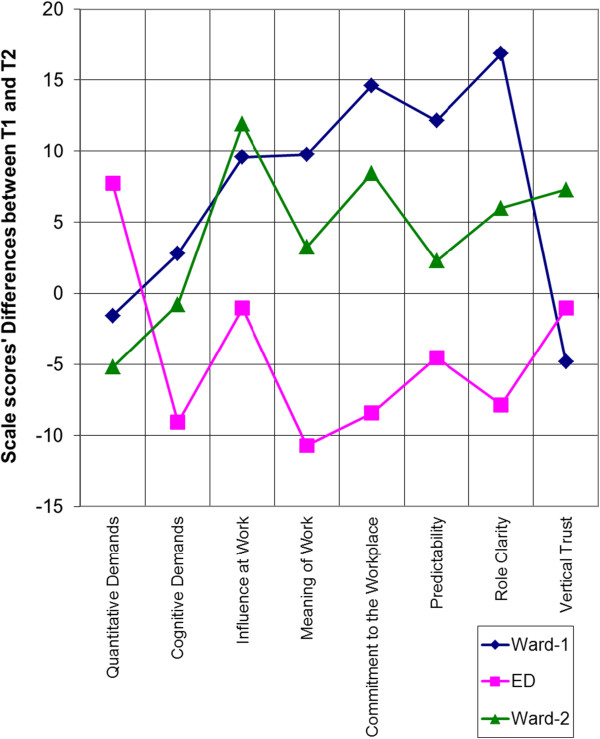
Between T1 and T2, qualitative information showed a well-organized and steady Lean implementation on Ward-I with active employee participation, a partial Lean implementation on Ward-II with employees not seeing a clear need for such an intervention, and deterioration in already implemented Lean activities at ED, due to the declining interest of top management. Quantitative data analysis showed a significant relation between the expected and actual results regarding changes in the psychosocial work environment. Ward-I showed major improvements especially related to job control and social support, ED showed a major decline with some exceptions while Ward-II also showed improvements similar to Ward-I.
The results suggest that Lean may have a positive impact on the psychosocial work environment given that it is properly implemented. Also, the psychosocial work environment may even deteriorate if Lean work deteriorates after implementation. Employee managers and researchers should note the importance of employee involvement in the change process. Employee involvement may minimize the intervention's harmful effects on psychosocial work factors. We also found that a multi-method may be suitable for investigating relations between Lean and the psychosocial work environment.
在医疗保健领域努力以有限资源满足不断增长的需求之际,精益管理已成为一种流行的管理方法。此前主要围绕其对医疗保健绩效的影响展开研究。关于精益管理如何影响心理社会工作环境的实证证据存在矛盾之处。本研究旨在运用一个综合模型来探究精益管理与心理社会工作环境之间的相互作用,该模型兼顾了精益管理实施信息、精益理论以及特定背景。
在2010年5月至6月(T1)(n = 129)以及2011年11月至12月(T2)(n = 131)对三个科室(一个急诊科(ED)、一号病房和二号病房)实施精益管理期间,使用哥本哈根心理社会问卷(COPSOQ)员工调查对心理社会工作环境进行了两次测量。基于对精益管理实施情况的定性数据分析以及先前一篇论文中的背景信息,来预测从T1到T2心理社会工作环境的预期变化模式,随后通过线性回归分析将其与COPSOQ数据进行比较。
在T1和T2之间,定性信息显示一号病房精益管理实施有序且稳定,员工积极参与;二号病房部分实施了精益管理,但员工认为没有明显必要进行此类干预;急诊科由于高层管理人员兴趣下降,已实施的精益活动出现恶化。定量数据分析表明,心理社会工作环境变化的预期结果与实际结果之间存在显著关联。一号病房有显著改善,尤其在工作控制和社会支持方面;急诊科总体大幅下降,但有一些例外情况;二号病房也呈现出与一号病房类似的改善。
结果表明,如果精益管理得到妥善实施,可能会对心理社会工作环境产生积极影响。此外,如果实施后精益工作出现恶化,心理社会工作环境甚至可能恶化。员工管理者和研究人员应注意员工参与变革过程的重要性。员工参与可能会将干预对心理社会工作因素的有害影响降至最低。我们还发现,多方法可能适用于研究精益管理与心理社会工作环境之间的关系。