Department of Nutrition, Carolina Population Center, University of North Carolina, Chapel Hill, NC 27516, USA.
J Acad Nutr Diet. 2012 Nov;112(11):1828-34.e1-6. doi: 10.1016/j.jand.2012.07.009.
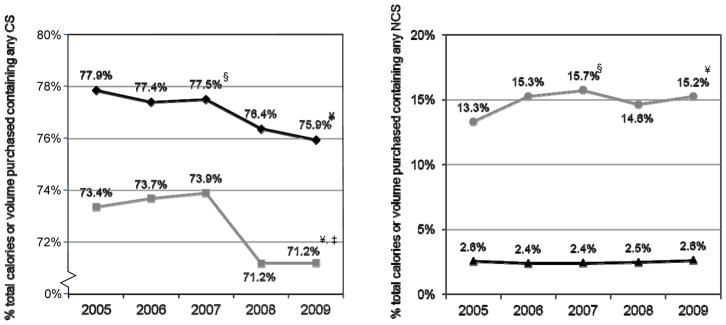
Our understanding of the use of caloric and noncaloric sweeteners in the US food supply is limited. This study uses full ingredient list and Nutrition Facts label data from Gladson Nutrition Database and nationally representative purchases of consumer packaged foods from Nielsen Homescan in 2005 through 2009 to understand the use of caloric sweeteners (including fruit juice concentrate) and noncaloric sweeteners in consumer packaged foods. Of the 85,451 uniquely formulated foods purchased during 2005 through 2009, 75% contain sweeteners (68% with caloric sweetener only, 1% with noncaloric sweetener only, 6% with both caloric and noncaloric sweeteners). Caloric sweetener are in >95% of cakes/cookies/pies, granola/protein/energy bars, ready-to-eat cereals, sweet snacks, and sugar-sweetened beverages. Noncaloric sweetener are in >33% of yogurts and sport/energy drinks, 42% of waters (plain or flavored), and most dietetic sweetened beverages. Across unique products, corn syrup is the most commonly listed sweetener, followed by sorghum, cane sugar, high-fructose corn syrup, and fruit juice concentrate. Also, 77% of all calories purchased in the United States in 2005-2009 contained caloric sweeteners and 3% contained noncaloric sweeteners, and 73% of the volume of foods purchased contained caloric sweetener and 15% contained noncaloric sweetener. Trends during this period suggest a shift toward the purchase of noncaloric sweetener-containing products. Our study poses a challenge toward monitoring sweetener consumption in the United States by discussing the need and options available to improve measures of caloric sweetener and noncaloric sweetener and additional requirements on Nutrition Facts labels on consumer packaged foods.
我们对美国食品供应中使用热量和无热量甜味剂的了解有限。本研究使用了 Gladson 营养数据库中的完整成分列表和营养事实标签数据,以及 2005 年至 2009 年全国代表性的消费者包装食品购买数据来自尼尔森家庭扫描,以了解消费者包装食品中使用的热量甜味剂(包括果汁浓缩物)和无热量甜味剂。在 2005 年至 2009 年期间购买的 85451 种独特配方食品中,75%含有甜味剂(68%仅含热量甜味剂,1%仅含无热量甜味剂,6%同时含热量和无热量甜味剂)。热量甜味剂存在于 >95%的蛋糕/饼干/馅饼、格兰诺拉麦片/蛋白质/能量棒、即食麦片、甜零食和加糖饮料中。无热量甜味剂存在于 >33%的酸奶和运动/能量饮料、42%的水(普通或调味)以及大多数营养甜味饮料中。在独特的产品中,玉米糖浆是最常见的甜味剂,其次是高粱、蔗糖、高果糖玉米糖浆和果汁浓缩物。此外,2005-2009 年在美国购买的所有卡路里中,77%含有热量甜味剂,3%含有无热量甜味剂,购买的食物量中 73%含有热量甜味剂,15%含有无热量甜味剂。在此期间的趋势表明,人们开始转向购买含有无热量甜味剂的产品。我们的研究通过讨论改进热量甜味剂和无热量甜味剂测量方法以及消费者包装食品营养事实标签上的其他要求的必要性和选择,对监测美国甜味剂消费提出了挑战。