Institute of Nanoengineering and Microsystems, National Tsing Hua University, Hsinchu, 300, Taiwan, ROC.
Biosens Bioelectron. 2013 Mar 15;41:717-22. doi: 10.1016/j.bios.2012.09.066. Epub 2012 Oct 8.
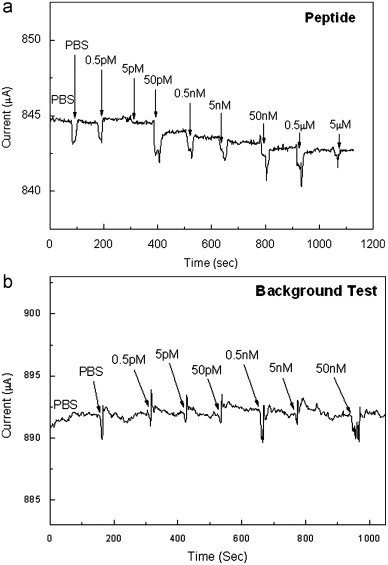
Antibody-immobilized AlGaN/GaN high electron mobility transistors (HEMTs) were used to detect a short peptide consisting of 20 amino acids. One-binding-site model and two-binding-site model were used for the analysis of the electrical signals, revealing the number of binding sites on an antibody and the dissociation constants between the antibody and the short peptide. In the binding-site models, the surface coverage ratio of the short peptide on the sensor surface is relevant to the electrical signals resulted from the peptide-antibody binding on the HEMTs. Two binding sites on an antibody were observed and two dissociation constants, 4.404×10(-11) M and 1.596×10(-9) M, were extracted from the binding-site model through the analysis of the surface coverage ratio of the short peptide on the sensor surface. We have also shown that the conventional method to extract the dissociation constant from the linear regression of curve-fitting with Langmuir isotherm equation may lead to an incorrect information if the receptor has more than one binding site for the ligand. The limit of detection (LOD) of the sensor observed in the experimental result (~10 pM of the short peptide) is very close to the LOD (around 2.7-3.4 pM) predicted from the value of the smallest dissociation constants. The sensitivity of the sensor is not only dependent on the transistors, but also highly relies on the affinity of the ligand-receptor pair. The results demonstrate that the AlGaN/GaN HEMTs cannot only be used for biosensors, but also for the biological affinity study.
抗体固定化的 AlGaN/GaN 高电子迁移率晶体管 (HEMTs) 被用于检测由 20 个氨基酸组成的短肽。采用单结合位模型和双结合位模型对电信号进行分析,揭示了抗体上的结合位数量和抗体与短肽之间的离解常数。在结合位模型中,传感器表面上短肽的表面覆盖率与 HEMTs 上肽-抗体结合产生的电信号有关。观察到抗体上有两个结合位,并通过分析传感器表面上短肽的表面覆盖率,从结合位模型中提取出两个离解常数,分别为 4.404×10(-11) M 和 1.596×10(-9) M。我们还表明,如果受体对配体有多个结合位,从曲线拟合的 Langmuir 等温线方程的线性回归中提取离解常数的传统方法可能会导致错误的信息。实验结果观察到的传感器的检测限 (LOD) (~10 pM 的短肽) 非常接近从小的离解常数预测的 LOD(约 2.7-3.4 pM)。传感器的灵敏度不仅取决于晶体管,还高度依赖于配体-受体对的亲和力。结果表明,AlGaN/GaN HEMTs 不仅可用于生物传感器,还可用于生物亲和力研究。