Monakhova Yulia B, Lachenmeier Dirk W
Department of Chemistry, Saratov State University, Saratov, Russia. ; Chemisches und Veterinäruntersuchungsamt (CVUA) Karlsruhe, Karlsruhe, Germany.
Environ Health Toxicol. 2012;27:e2012016. doi: 10.5620/eht.2012.27.e2012016. Epub 2012 Sep 30.
5-Hydroxymethylfurfural (HMF) regularly occurs in foods and in alcoholic beverages. However, the risk of HMF associated with alcohol consumption has not been systematically studied, so that this study will provide the first quantitative risk assessment of HMF for consumers of alcoholic beverages.
Human dietary intake of HMF via alcoholic beverages in the European Union was estimated based on WHO alcohol consumption data combined with our own survey data (n=944) and literature data (n=147) about the HMF contents of different beverage groups (beer, wine, spirits and unrecorded alcohol). The risk assessment was conducted using the margin of exposure (MOE) approach.
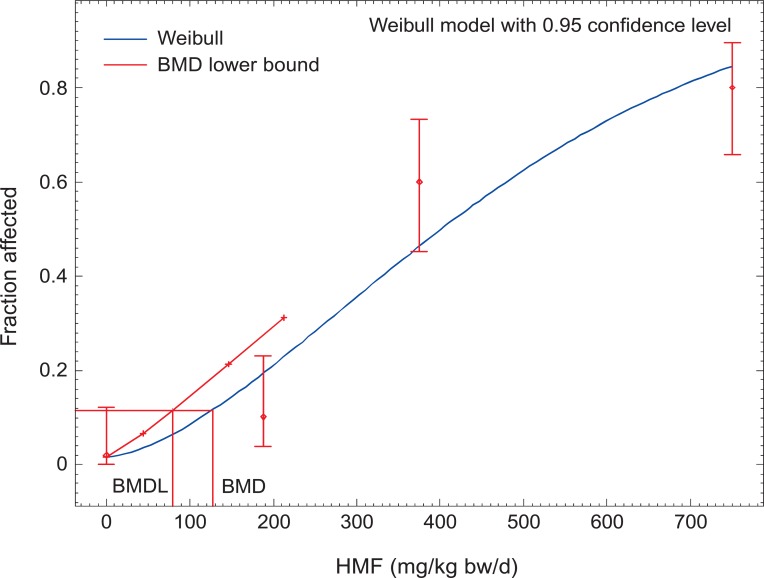
For olfactory epithelium metaplasia in female mice, a benchmark dose (BMD) of 127 mg/kg bodyweight (bw)/d and a BMD lower confidence limit (BMDL) of 79 mg/kg bw/d were calculated from National Toxicology Program oral long-term animal experiments. The average human exposure to HMF from alcoholic beverages was estimated at 6.0E-3 mg/kg bw/d, which is approximately 8.5% of the total dietary exposure. In comparison of the human exposure with BMDL, the MOE was 13,167 for average alcohol consumption scenarios, which is a value that would be generally assumed as safe for threshold based compounds.
The results show that the risk from HMF to the alcohol-consuming population is rather low and the priority for risk management (e.g. to reduce the contamination) is also low. Further toxicological research about HMF is required to further elucidate its mechanism.
5-羟甲基糠醛(HMF)经常出现在食品和酒精饮料中。然而,与酒精消费相关的HMF风险尚未得到系统研究,因此本研究将首次对酒精饮料消费者进行HMF的定量风险评估。
根据世界卫生组织的酒精消费数据,结合我们自己的调查数据(n = 944)和关于不同饮料组(啤酒、葡萄酒、烈酒和未记录酒精饮料)中HMF含量的文献数据(n = 147),估算欧盟地区人类通过酒精饮料摄入HMF的情况。使用暴露边际(MOE)方法进行风险评估。
根据美国国家毒理学计划的长期口服动物实验,对于雌性小鼠的嗅上皮化生,计算出的基准剂量(BMD)为127毫克/千克体重(bw)/天,基准剂量下限(BMDL)为79毫克/千克bw/天。估计人类通过酒精饮料摄入HMF的平均量为6.0E-3毫克/千克bw/天,约占总膳食暴露量的8.5%。将人类暴露量与BMDL进行比较,在平均酒精消费情况下,MOE为13,167,对于基于阈值的化合物,这个值通常被认为是安全的。
结果表明,HMF对饮酒人群的风险相当低,风险管理的优先级(如减少污染)也较低。需要对HMF进行进一步的毒理学研究,以进一步阐明其作用机制。